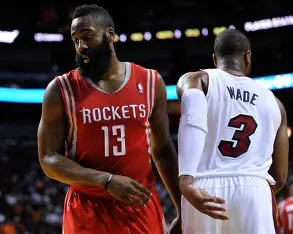
Dwyane Wade vs. James Harden: Why D-Wade Will Always Be Better
Dwyane Wade vs. James Harden: Why D-Wade Will Always Be Better
By age 35, both Dwyane Wade and James Harden had carved out Hall of Fame careers. Wade, revered for his midrange mastery, slashing brilliance, and defensive grit, and Harden, a statistical marvel who redefined offensive efficiency with step-backs and free throws. But when the lights shine brightest—when reputations are forged in fire and banners are raised—Wade simply stands taller. This isn’t a spreadsheet debate. It’s about legacy. It’s about moments. It’s about what truly lasts.
Accolades by 35: Rings Matter More Than MVP Votes
Let’s start with the scoreboard that matters most: championships.
Dwyane Wade by 35:
- 3× NBA Champion (2006, 2012, 2013)
- 1× Finals MVP (2006)
- 12× All-Star
- 8× All-NBA (2 First Team, 3 Second, 3 Third)
- 3× All-Defensive Team
James Harden by 35:
- 0× NBA Champion
- 0× Finals MVP
- 1× MVP (2018)
- 11× All-Star
- 7× All-NBA (6 First Team)
Harden’s accolades reflect individual brilliance, but Wade’s tell a broader story—team greatness, postseason impact, and sustained excellence on both ends. He was the undisputed alpha of a title team in 2006, the steady veteran in 2012–13, and the bridge between eras in Miami. Harden, despite multiple super teams and MVP-caliber teammates, never returned to the Finals after losing to Wade and the Heat in 2012—and that’s not a coincidence, it’s a pattern.
Wade wasn’t just a scorer—he was a relentless defender. He led all guards in blocks multiple seasons, routinely guarding the opposing team’s best perimeter threat. Harden, meanwhile, became notorious for defensive lowlights and lapses in effort. One played both ends with pride. The other often coasted on one side of the floor.
Statistical Showdown: Harden’s Volume vs. Wade’s Two-Way Value
Compare their production by age 35:
Wade (2003–2017):
- Regular Season: 22.7 PPG, 4.7 RPG, 5.6 APG, 48.4% FG, 1.6 SPG, 0.9 BPG
- Playoffs: 22.3 PPG, 48.0% FG in 171 games
- Advanced: 23.7 PER, +5.0 BPM
-
Regular Season: 24.1 PPG, 5.6 RPG, 7.2 APG, 43.9% FG, 1.5 SPG, 0.5 BPG
-
Playoffs: 22.4 PPG, 42.2% FG in 165 games
-
Advanced: 23.7 PER, +5.9 BPM
Harden’s edge in volume and passing is clear. But Wade was more efficient, more versatile, and far more balanced. His field goal percentage was significantly higher despite a tougher shot diet and fewer gimmicks (no foul-hunting theatrics here). And while Harden’s playoff numbers fall off, Wade’s stayed consistent—even elevated—against the league’s best defenses. Stat sheets are useful, but context matters.
Harden’s reliance on drawing fouls, isolation dribbles, and high-usage systems helped inflate his stats—but also made his game harder to replicate under playoff intensity. Wade’s style, built on athleticism, footwork, and feel, translated under any system, in any era.
Game 7 Ghost: Harden’s Glaring Weakness
Playoff performance separates the good from the great—and this is where Harden’s legacy takes a hit. He’s 3–4 in Game 7s, and his numbers in those games are troubling:
Game 7 Averages: 19.3 PPG, 7.9 APG, sub-40% FG
- 2018 vs. Warriors: 2-of-13 from 3 in a 27-straight-miss debacle
- 2023 vs. Celtics: 9 points, 5 turnovers in a critical loss
- 2025 vs. Nuggets: -29 plus-minus in a home elimination game
From Brooklyn to Philly to L.A., Harden has often shrunk in the biggest moments. He’s had more than enough talent around him—Chris Paul, Kevin Durant, Joel Embiid, Kawhi Leonard—and still, no return to the Finals. The common thread? James Harden.
Harden scored 10 points with 6 turnovers in a closeout game at home. Wade dropped 43 in a must-win Finals game on the road. That’s the difference.
Wade: A Proven Closer and Championship Pillar
Now flip the lens.
In 2006, Wade averaged 34.7 PPG in the Finals, singlehandedly toppling the Mavericks in one of the greatest postseason performances ever. His Game 3 heroics sparked a 4-0 run to clinch Miami’s first title. At 24, he was already a closer. In 2012 and 2013, he adapted his game next to LeBron James and still played a critical role in back-to-back titles, never demanding the spotlight—just delivering in it.
He never avoided the big moment. He owned it.
- 3–2 career record in the Finals
- No flameouts, no quit narratives
- Played hurt, sacrificed ego, and still produced
Wade was a competitor first, star second. He took charges, chased blocks, and never let legacy moments slip through his fingers. That’s what separates champions from stat kings.
Legacy Check: What Defines Greatness?
Harden will retire as a Hall of Famer—his offensive resume is too good not to. But the story will always include caveats: no rings, postseason letdowns, and exits that felt more like escapes. Even in his MVP season, the conversation was about how far Houston could go in spite of his playoff history.
Wade? He’s enshrined in both Springfield and NBA lore. A cultural icon in Miami. A Finals MVP. A clutch legend. A two-way dynamo.
So let’s call it what it is:
If you want numbers, Harden wins some arguments.
If you want winners, leaders, and clutch greatness—Wade never loses them.
Until Harden rewrites his postseason script—and that window is closing fast—D-Wade will always be better.
When the careers are over and the banners hang, one name echoes in championship lore. The other echoes in “what ifs.”
Wade didn’t just play in the big moments—he defined them. That’s why he’ll always be better.



Leave a Reply
Want to join the discussion?Feel free to contribute!