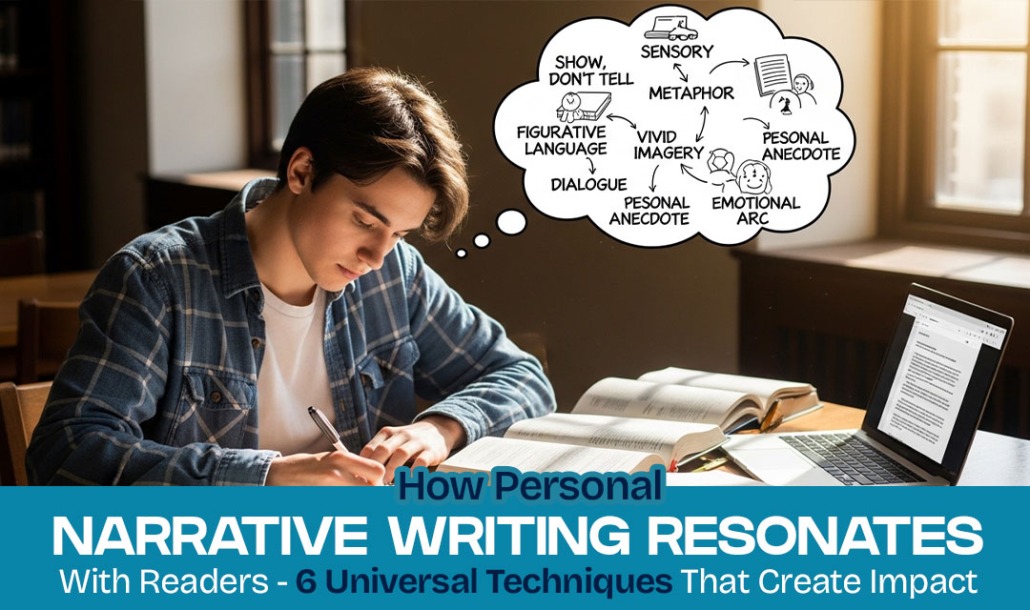
How Personal Narrative Writing Resonates With Readers – 6 Universal Techniques That Create Impact
Personal narrative writing remains a cornerstone of creative expression and academic success. This guide explores six essential techniques including vivid setting establishment, foreshadowing, epiphany moments, backstory integration, sensory details, and dialogue blending. These methods help students craft compelling first-person narrative stories that resonate with readers while meeting academic standards.
A personal narrative is essentially a first-person story based on a real-life experience. It focuses on a specific, transformative moment rather than your entire life history. In fact, it is a powerful tool for writers to convey personal growth, deep emotions, and unique insights.
The relevance of this skill has never been higher for students, especially as university admissions and personal branding become increasingly focused. In a world of online communication, your ability to tell a structured and engaging story will help you stand out in college applications and professional networking.
This article will provide you with a mentoring perspective on “what they don’t tell you” about professional-grade storytelling for the modern age. Our guide is based on an extensive analysis of top UK educational resources. By following this outline, you will learn how to write a complex narrative.
Key Points for a Quick Look
- Personal narrative writing is the art of sharing your words with readers through various techniques of storytelling.
- These techniques include vivid settings, foreshadowing, epiphany, backstory, sensory details, and dialogue.
- Use these techniques as per the requirements of your draft or you can even blend them. For example, start with vivid settings and proceed to backstory or sensory details along the story.
- The 3 angles of storytelling include first, second and third person narratives. Each one serves a unique purpose for the readers.
- A good personal narrative depends on your story. Make a draft and then build a strong structure, leading to competition of the story.
What Is a Personal Narrative and its Types?
A personal narrative is a story of a life experience that you are talking about. It dwells on a particular experience. In fact, it adopts a first-person perspective to disclose personal experiences and feelings to the reader.
There are 3 powerful intimate angles of personal narrative writing here:
- The first person is ideal for deep emotional connection and personal narratives. In other words, when you write a personal narrative, you are the narrator of your own story.
- Narrative writing can take other forms, too. In the second-person narrative, the story uses “you,” placing the reader in the action (“You step into the room and…”). This is less common in everyday storytelling but can feel immersive.
- Third person uses “he,” “she,” “they.” A third-person omniscient narrator knows all characters’ thoughts, while a third-person limited narrator follows only one character’s perspective.
Types of Personal Narrative Writing
The most common types are memoir, autobiography, literary narrative, and anecdote. These types show the range of personal narrative writing, from expansive life stories to quick, meaningful moments. In most academic or college application settings, shorter forms like anecdotes or focused literary narratives are preferred for their clarity and emotional impact. Many students ask for essay help from top companies like The Academic Papers UK to structure their ideas and convey their stories effectively.
Here is a quick overview of these narrative types:
Memoir
A more complex or extended personal narrative writing that tends to concentrate on a specific time frame or a common theme used in the life of the author. E.g.: a childhood memoir, an immigration tale or a career story. It can be more literary and more thematic than an essay.
Autobiography
The story of a person, in full length, and spanning a large portion or the entire life of the person, told by the writer. This is a type of personal narrative writing that is one of the largest. An autobiography may be chronological and comprehensive as well as personal and reflective.
Literary Narrative
It is a particular form of autobiography that gives attention to experience with language, reading, or writing. For example, learning to read, finding a favourite book or conquering writing difficulties. This type of personal narrative writing is widely applied in writing pedagogy to examine identity as a language user.
Anecdote
A very brief personal narrative or tale of one event. Although short, anecdotes have a lesson for the readers and are frequently employed in bigger works (such as essays or speeches).
6 Personal Narrative Writing Techniques for Students
It is more than just telling a story. In the UK, 72% of the KS2 pupils (age 11) met the expected standard in writing in the 2024/25 academic year. Learning about personal narrative writing helps students to enhance their learning skills. In fact, these techniques shape your personal experience into something meaningful for the reader. Below are 6 practical techniques every student should master in 2026:
Technique 1: Establish a Vivid Setting
A vivid setting grounds your story. It is the background that gives the mood, setting and even reflects the inner emotions. Consider the setting as not only what you are creating, but also the atmosphere of your story. For example, a stormy sky can be an indication of trouble or a cuddly cottage may be an indication of safety. When you can depict the environment at the beginning of the story, it allows the readers to visualise and experience the world that you are in.
Implementation Tips for a Good Vivid Settings
Setting and atmosphere are explicitly taught across many well-known organisations. For example, BBC Bitesize and Teachit.co.uk teach vivid settings using extracts from du Maurier’s Rebecca and Conrad’s Heart of Darkness. Therefore, it is really important to learn these settings. Here is how you can implement good vivid settings in your story:
- Include specific details about place, time, weather, and surroundings. Show concrete objects and colours (e.g. cracked pavement) to make the scene real.
- Use the setting to reflect emotion. For example, describe a cold, grey morning when the narrator feels hopeless, or a golden sunrise when hope emerges. This mirroring subtly deepens the mood.
- Keep descriptions concise but evocative. Avoid long info-dumps. Instead, choose a few striking details that stick in the reader’s mind.
Such personal narrative examples include: “The narrow, rain-slicked lanes of the old town pressed in around me, the chill seeping through my coat as doubt settled deeper in my chest.” This sentence uses setting (rain-slicked lanes, chill) to convey atmosphere and the narrator’s mood.
Technique 2: Employ Foreshadowing
Foreshadowing means planting subtle hints about what will happen later. It builds anticipation and tension, which keeps readers engaged. In a personal narrative, you can foreshadow an event or revelation, so the story feels cohesive. For instance, mentioning something mysterious early or introducing a symbolic object can pay off later. The key is to make hints feel natural, not like obvious spoilers.
Practical Foreshadowing Methods
One common mistake in personal narratives is being too direct with future events. You may allude to things symbolically, like a wilting flower on a windowsill, to an internal thought to be discussed later. Moreover, a throwaway line or a side note can also be used as a breadcrumb that will guide the reader to the climax of your personalised narrative. The following are some of the common foreshadowing techniques:
| Foreshadowing Method | Example in Personal Narrative | Purpose for the Reader |
| Symbolic Object | A wilting flower on the windowsill | Hints at fading hope or personal loss |
| Ominous Detail | A distant rumble of thunder | Suggests an approaching conflict or change |
| Casual Remark | “I never imagined it would end like this” | Builds subtle foreboding and curiosity |
Technique 3: Craft an Epiphany or Moment of Realisation
A personal narrative often hinges on one big insight or change and that’s called an epiphany. This is when the narrator realises something important about themselves or their situation. It gives the story emotional power and closure.
Without this turning point, a narrative can feel flat. But students don’t only struggle with epiphany, but also struggle to write an impactful reflective essay. Below are some strategies for epiphany:
- Build gradually: Show the problem or conflict growing (frustration, confusion, fear). Let the character notice small clues and questions.
- Show, don’t tell: Instead of stating “I realised forgiveness is strength,” show that moment unfolding through action or a sudden thought.
- Make it earned: The insight should feel like a natural result of what’s happened. Don’t pull it out of nowhere.
Example
As the door closed behind her, the silence finally allowed the truth to surface: forgiveness wasn’t weakness, but the only way forward.” In this example, the quiet moment after a dramatic event leads to an internal truth (forgiveness is strength), highlighting a change in mindset.
Technique 4: Integrate Backstory Seamlessly
Backstory adds context without disrupting the flow. In a personal narrative, you usually focus on the present event, but a bit of the past can enrich the story. Backstory shows why characters behave as they do or why a place matters. The trick is to weave it in naturally so readers aren’t yanked out of the moment.
Strategies to Balance Backstory with Current Storytelling
Backstory provides a personal story with the necessary backdrop and richness. However, it must never get the current action off the road or engulf the reader. When you can do it properly, one look back in the past reinforces the emotional appeal. The following are suggestions to balance backstory and storytelling.
- Trigger backstory with something in the scene. For example, catching a whiff of apple pie might bring a memory of Grandma’s kitchen.
- Keep flashbacks short and relevant. Only include past details that directly explain a motivation or emotion.
- Use it to highlight growth. For instance, remembering a childhood fear can make the narrator’s current courage more meaningful.
Example
Perhaps the narrator hears a familiar lullaby and briefly recalls peaceful childhood nights. For this, you might write, “The scent of pine trees was so familiar that it pulled me back to summer evenings by the lake, when even the darkness felt like home.” This gives a glimpse of past comfort to explain the fear now.
Technique 5: Use Sensory Details
Showing rather than telling means painting a picture with your words. Visualisation is a great way to be memorable for your writer. Instead of saying “I was nervous,” show it: describe a racing heart, sweaty palms or a trembling voice. Allow the reader to experience what you are going through by using the five senses (sight, sound, smell, taste, touch). Sensual details bring scenes to life and emotions strike more. The following table illustrates to the readers some tips on how to involve the visualisation of the sensory storytelling:
| Sensory Element | Technique Tip | Benefit in Personal Narrative |
| Sight | Vivid colours and contrasts | Creates visual immediacy |
| Sound | Specific noises or silence | Heightens tension or emotion |
| Touch/Smell/Taste | Textures or scents linked to memory | Deepens emotional resonance |
Technique 6: Blend Dialogue and Inner Voice
Combining dialogue (what characters say) with the narrator’s inner thoughts makes your story dynamic and authentic. Dialogue shows interactions and moves the plot forward, while the inner voice (monologue) reveals hidden feelings and reactions. Using both lets readers “hear” conversations and know what’s unsaid.
Guidance on How to Blend Dialogues
A combination of verbal and nonverbal wisdom is required for personal internal dialogue. It demonstrates what is going on and what is experienced at the same time. But in case you lack the necessary skills to present your personal narrative storytelling, your readers will become bored. Here are some tips for you:
- Use dialogue for key moments or turning points. Keep it natural and concise, like real people often speak in short bursts.
- Follow or intersperse dialogue with a reaction or thought. For example: “It’s not your fault,” she said softly. *Inside, I felt the words twist on my tongue: It is my fault, and I can’t undo it.
- Maintain a consistent voice. Since personal narratives are usually first-person, the inner voice should match that character’s style and knowledge.
How to Write a Perfect Personal Narrative?
Strong writing makes an ordinary moment into a compelling reflective story. Whereas only 26.6% of students enjoy writing, this percentage can be increased by teaching them how to write a perfect narrative.
A quick hack is to focus on a single event rather than your entire life. Then, bring the literary techniques that connect with you, like vivid setting, foreshadowing, sensory details and a genuine epiphany. Here is a complete step-by-step guide for you to create a good personal narrative:
- Choose your story: Pick a specific personal experience or memory that taught you something or left a strong impression. The more vivid or significant, the better.
- Plan the structure: Outline your narrative’s arc. These include introduction, rising action, climax and a brief resolution. Decide where each technique can fit.
- Draft with techniques: Start writing your first draft. Use the technique that sits perfectly with your story. You can even go with multiple stories as per your needs. For example, use a vivid setting to open the scene. Drop in any foreshadowing clues as early hints. Finally, include dialogue for real conversations.
- Revise and edit: After your draft, read it over and check each technique. Have you set a clear scene? Are hints resolved later? Does the epiphany feel natural? Add or trim details as needed. Use tools (spell-checkers, grammar apps, or an AI assistant) to spot typos or suggest clarity, but ensure the final voice is yours. Reading aloud can also help you catch awkward phrasing or slow parts.
- Practice and feedback: Finally, try writing brief narratives using one technique at a time. For instance, retell an event focusing only on sensory details. Or write a short scene using only dialogue and inner thoughts.
How Professionals Enhance Personal Narrative Writing
Personal narratives are most effective when your story is clear and engaging. Professionals from essay writing services UK can guide you in shaping your ideas, strengthening your story’s flow, and using techniques like dialogue, sensory details, and epiphanies effectively. They also help you:
- Select the most meaningful experiences to include
- Organise events for clarity and impact
- Suggest ways to enrich narrative techniques
- Review and refine language while keeping your voice
Conclusion
Personal narrative writing isn’t just about recording facts. Actually, it is about expressing your personal experience in a manner that others can experience. These 6 techniques will help turn your ordinary memories into interesting tales. Besides, they assist you in reaching readers, introspection, and locating your own voice.
Storytelling is important in the contemporary world. Practising personal narrative builds strong writing skills and confidence. You might even find that writing about your experiences can improve your well-being.
Therefore, find a time in your life and put these tips to the test. Describe the picture, place a piece of evidence, and make the narrative develop. Your personal story can be a real star with the proper treatment. To keep in mind: your story is important, it can inspire others, so practice to hone your skills to bring the best out of you.
Frequently Asked Questions about Personal Narrative Writing Techniques
1. How many hours should I spend on a personal narrative?
Students should spend four to eight hours over several sessions, allowing for a strong draft and thorough revision. For a college-level narrative, you need to spend four to six hours. Include 1 hour for brainstorming. Do factor in 30 minutes for revising. This gives you time to reflect on your epiphany and refine your sensory details.
2. What are the best topics for a personal narrative?
The best topics are often “small moments” that carry significant emotional weight. These include a difficult decision, a surprising realisation or a moment of overcoming a fear. Apart from these, you can choose topics that present facts with meaningful relationships to offer your arguments strongly. Nevertheless, you should go with a topic that feels personally relevant and allows you to show genuine growth.
3. How do I choose a topic for a personal narrative?
You can start by listing moments where you felt a strong emotion or where your perspective on a situation changed significantly. From that list, select the one that has the most vivid sensory details and a clear turning point or epiphany. You must be passionate about the topic that you have selected. You can also choose a personal topic to share your experience for a comprehensive learning of the readers.



Leave a Reply
Want to join the discussion?Feel free to contribute!