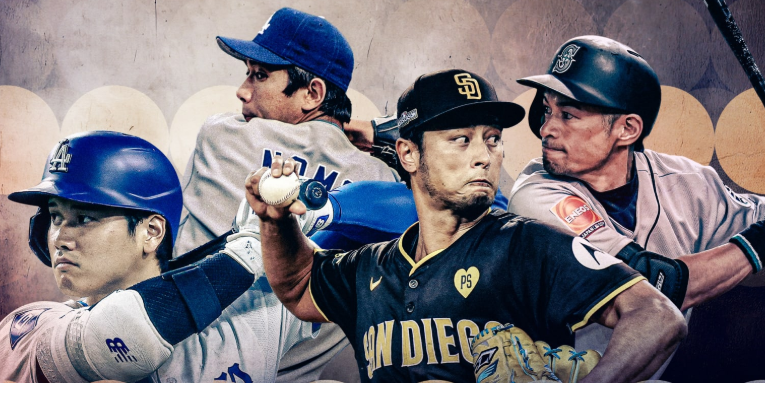
From Ichiro to Ohtani: RotoWire’s Look at the Japanese-Born Stars Who Shaped MLB
Japanese-born players have left a lasting mark on Major League Baseball through elite skill, consistency, and adaptability. From pioneering pitchers who changed how MLB organizations viewed international scouting to modern superstars driving both on-field results and fantasy baseball interest, players from Japan have helped redefine baseball excellence across multiple eras.
For RotoWire readers, that legacy is especially compelling because it bridges historical greatness with modern player evaluation. The same qualities that made Japanese-born stars so impactful in real baseball — command, versatility, efficiency, discipline, and high-end production — also continue to shape the way analysts, fantasy managers, and fans assess player value today.
From Ichiro Suzuki’s precision and consistency to Shohei Ohtani’s unmatched two-way dominance, the Japanese influence on MLB has extended far beyond novelty or international reach. It has become part of the sport’s competitive and analytical foundation.
Ichiro Suzuki
Ichiro Suzuki remains the gold standard among Japanese-born position players in MLB history. When he arrived with the Seattle Mariners in 2001, he immediately proved that elite bat control, speed, and defense could translate at the highest level. His game was built on precision rather than raw power, but the results were extraordinary.
Across 19 MLB seasons with the Mariners, Yankees, and Marlins, Ichiro compiled a .311 batting average, 3,089 hits, 117 home runs, 780 RBIs, 1,420 runs scored, and 509 stolen bases. He also earned 10 Gold Gloves and three Silver Slugger awards. In 2001, he became one of the rare players to win both American League Rookie of the Year and AL MVP in the same season.
His 262-hit campaign in 2004 still stands as the MLB single-season record, and his combination of consistency, durability, and defensive value made him one of the most unique players of his era. Even in today’s more power-focused environment, Ichiro’s profile remains a reminder that elite run creation can come in more than one form.
Shohei Ohtani
Shohei Ohtani represents the most extraordinary evolution of Japanese talent in Major League Baseball. As both an elite hitter and frontline pitcher, Ohtani has revived a two-way model that most modern baseball observers considered impossible to sustain. His combination of power, athleticism, and mound dominance has made him one of the most valuable players the sport has ever seen.
According to RotoWire’s player analysis, Ohtani’s value is especially rare because he impacts games in multiple categories at once, giving him a profile that is nearly unmatched in both real-life roster construction and fantasy baseball formats. Because he offers elite production both at the plate and on the mound, he remains one of the most heavily discussed players every draft season, particularly in resources like RotoWire’s fantasy baseball mock draft, where two-way value can significantly reshape early-round strategy.
In 2023, Ohtani signed a 10-year, $700 million contract with the Los Angeles Dodgers, the largest contract in professional sports history at the time. Its heavily deferred structure gave the Dodgers payroll flexibility while still securing one of baseball’s most impactful talents.
During the 2025 postseason, Ohtani once again showed why he occupies a category of his own. Across 17 playoff games, he hit .265 with 18 hits, eight home runs, 14 RBIs, and 13 runs scored. His impact extended beyond the batter’s box, as his performances influenced both public expectations and the broader conversation around the Dodgers’ championship ceiling.
He earned National League Championship Series MVP honors after a dominant series performance that included a historic Game 4 in which he hit three home runs while also pitching six innings with 10 strikeouts and two hits allowed. Throughout the postseason, he also logged 20 1/3 innings with 28 strikeouts and a 4.43 ERA, reinforcing the singular two-way value that continues to make him one of baseball’s defining players.
Hideo Nomo
Hideo Nomo was the breakthrough figure who changed the way MLB viewed Japanese pitchers. When he joined the Los Angeles Dodgers in 1995, his tornado-style delivery and swing-and-miss stuff immediately made him one of the sport’s most fascinating arms. More importantly, his success gave MLB teams proof that high-level Japanese pitching could translate.
Nomo won National League Rookie of the Year after recording 236 strikeouts and a 2.54 ERA in 1995. He went on to throw two no-hitters in the majors and finished his MLB career with 123 wins and more than 1,900 strikeouts. His impact reached beyond the numbers: he helped create a scouting and development bridge that changed the sport.
Hideki Matsui
Hideki Matsui brought middle-of-the-order power and big-game poise to the majors. Nicknamed “Godzilla,” Matsui arrived in New York with enormous expectations and delivered as a dependable offensive force for the Yankees.
Across 10 MLB seasons, Matsui hit 175 home runs and drove in 760 runs. His most memorable moment came in the 2009 World Series, when he drove in six runs in Game 6 against the Phillies and earned World Series MVP honors. Matsui’s ability to perform under pressure made him one of the most respected Japanese-born hitters of his era.
Yu Darvish
Yu Darvish developed into one of the most technically advanced pitchers to make the jump from Japan to MLB. His deep repertoire, changing velocities, and command of movement allowed him to succeed against a wide range of hitters and lineups. Few pitchers of his generation have combined pure stuff and sequencing as effectively.
After debuting with the Texas Rangers in 2012 and finishing second in American League Rookie of the Year voting, Darvish established himself as a strikeout force. He recorded multiple 200-strikeout seasons and surpassed 2,000 career strikeouts while pitching for the Rangers, Dodgers, Cubs, and Padres.
Darvish’s profile has also made him a natural focus in analytical and fantasy conversations, where pitch mix, workload, and strikeout upside often drive player value. That combination of real-life and fantasy appeal has made him one of the more consistently discussed imported pitchers of the modern era.
Yoshinobu Yamamoto
Yoshinobu Yamamoto arrived in MLB as one of the most accomplished pitchers ever to come out of Nippon Professional Baseball. His command, efficiency, and ability to suppress contact made him one of the most coveted international free agents in recent memory.
Before joining the Dodgers, Yamamoto posted a 70-29 record with a 1.72 ERA across seven seasons with the Orix Buffaloes. He won three straight Eiji Sawamura Awards from 2021 through 2023 and also earned three Pacific League MVP awards, establishing himself as one of the most dominant pitchers in Japanese professional baseball history.
His 12-year, $325 million deal with Los Angeles, which included a $50 million signing bonus, reflected both his résumé and his projected MLB value. During the 2025 season, he justified the hype by posting a 2.49 ERA across 173 2/3 innings, with 201 strikeouts, a 0.990 WHIP, and a .183 opponent batting average.
His postseason numbers were even more impressive. Yamamoto went 3-0 with a 1.09 ERA and 15 strikeouts across 17 2/3 innings in the World Series against Toronto, earning World Series MVP honors. RotoWire’s broader team analysis has also highlighted how players like Ohtani and Yamamoto continue to strengthen the Dodgers’ championship outlook and extend one of baseball’s most formidable title windows.
Kazuhiro Sasaki
Kazuhiro Sasaki quickly became one of the most effective closers to transition from Japanese baseball to MLB. His split-finger fastball helped him dominate late innings for the Seattle Mariners, and his immediate success in the majors underscored the quality of relief pitching coming from Japan.
Sasaki won American League Rookie of the Year in 2000 after recording 37 saves and a 3.16 ERA. He finished his MLB career with 129 saves and remains one of the most accomplished Japanese-born relievers in league history.
Koji Uehara
Koji Uehara built his MLB success on exceptional command and efficiency. After moving into a relief role, he became one of the most reliable late-inning arms in baseball.
During the Red Sox’s 2013 championship season, Uehara recorded 21 saves and posted a 1.09 ERA. He was nearly untouchable in the postseason, finishing with a 0.59 ERA and earning ALCS MVP honors. His profile showed how dominant precision pitching could still be in the highest-leverage moments.
Masahiro Tanaka
Masahiro Tanaka entered the majors with the expectation of becoming a frontline starter, and he largely delivered on that reputation. After one of the most dominant stretches in Japanese professional baseball, he signed a seven-year, $155 million contract with the Yankees in 2014.
Tanaka’s MLB tenure was defined by composure, command, and postseason reliability. He posted a 2.93 ERA in playoff competition with New York, reinforcing his value as a high-level starter capable of handling pressure on the biggest stage.
The Lasting Impact of Japanese-Born Stars in MLB
Taken together, this group reflects far more than international success stories. These players changed how MLB evaluates talent, how teams invest in global scouting, and how fans and analysts think about production across different roles and eras.
Ichiro redefined what elite contact hitting could look like in the modern game. Nomo opened the door for Japanese pitchers to be taken seriously as frontline talents. Matsui delivered in baseball’s biggest moments. Darvish and Tanaka gave teams durable high-end rotation options. Yamamoto represents the next wave of imported ace-level talent. And Ohtani has pushed the sport into territory few imagined possible.
For a brand like RotoWire, that makes this legacy especially relevant. These are not only historically important players — they are also examples of how baseball value is measured, projected, and discussed in today’s game. Their careers continue to influence analysis across real baseball, fantasy formats, and long-range roster building.



Leave a Reply
Want to join the discussion?Feel free to contribute!