Da 5 Bloods Is The Right Film For Our Times
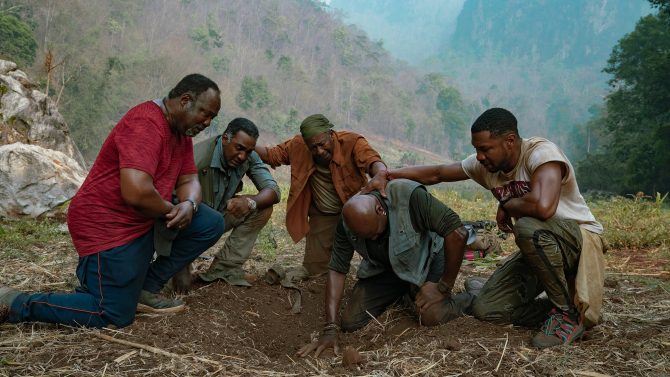
Dropped on Netflix this weekend while Black Lives Matter protests still rage throughout major American cities every day, Spike Lee’s Da 5 Bloods is the right movie for our times. If his previous flick, BlacKkKlansman, was a pin-prick commentary on how American politics has shaped systemic racism in this country, Da 5 Bloods is a sledgehammer to the face. It’s a movie that is all at once a heist film, a war film, a drama about unbreakable bonds, about friendships, about fathers, sons, and daughters, racial strife, a history lesson, and an action flick all rolled into one. It pulls you right into the issue at hand and viciously reminds its viewers that America has always held black lives cheaply.
What Was Good About It?
The good begins and ends with Delroy Lindo, one of American cinema’s most underrated actors of the last thirty years. Lindo, who plays Vietnam vet Paul, is a force of nature in Da 5 Bloods — all rage and melancholy and turmoil bubbling beneath the surface. In the hands of a lesser actor, Paul becomes a cliché lost in a sea of overacting, but Lindo nails the part with just the right touch of sardonic wit and undaunted fury. Paul is the most complex of the four surviving men — he’s a character torn from the pages of William Shakespear’s more abstruse tragedies. Here’s an African American war veteran who got back home from three tours of duty in Vietnam only to deal with the very Americans he fought and bled for spitting at him and calling him a baby killer (among other things). Here’s a warrior that gets so lost in his own unrewarded righteousness, he goes full MAGA in his old age. He hates immigrants and pines for Trump’s border wall, he admits to his shocked buddies that he voted for Trump, and he proudly dons a red Make America Great Again hat. He’s volatile and short-tempered, he struggles to be a good father, he admits to often seeing the ghost of their fallen Blood, Norman (played by Chadwick Boseman in a series of flashbacks). Lindo’s performance of a veteran dealing with the nightmare that is PTSD is the stuff of Academy Awards lore and if he doesn’t win the Oscar for Best Actor, then the Academy can get fucked. Seriously.
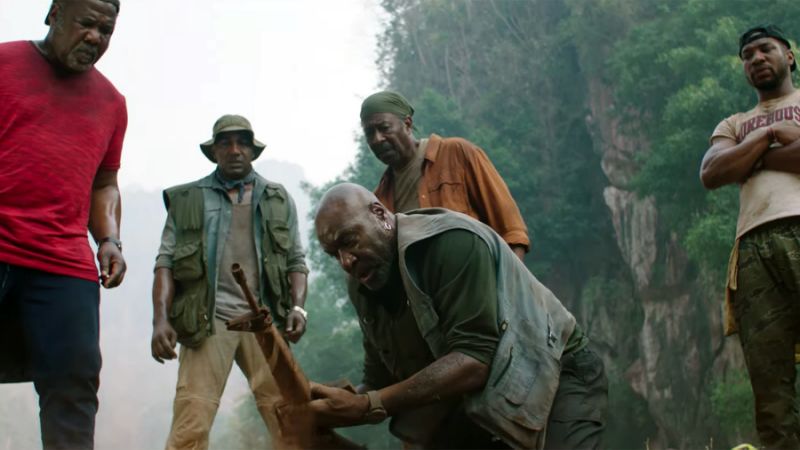
The film’s plot is complex, but it ultimately delivers. Four vets reunite in modern day Vietnam for two reasons: to bring back a case of gold bars they stumbled upon and then buried during the war, and to bring back the remains of their fallen brother — the charismatic leader of their outfit, “Stormin’” Norman. The story then breaks into a series of subplots with the two central characters, Paul (Lindo), and Otis (Clarke Peters). Both men have their own issues and crosses to bear, yet both deal with them in very different ways.
Da Brotherhood. Chemistry is not an issue with the four men. Right away you feel the love they have for each other, even after living lives apart. They bicker like siblings and hold each other up like brothers. It takes great acting to pull off chemistry like this.
Marvin Gaye. If you watch this movie for one reason, it’s to hear Marvin Gaye’s isolated vocals on What’s Going On that plays during the last act of the film.
Spike Lee’s joint. Lee’s fingerprints are all over Da 5 Bloods from the very beginning. His direction, as always, is a mixture of controlled chaos mixed with a great score, and a penchant for throwing in nuggets of the untold versions of white-washed black history. The film opens with footage of Muhammad Ali giving his reasons for why he was a conscientious objector and refused to go fight in Vietnam, making it clear that the Vietnamese people never called him the N-word, or treated him as he’s treated at home in America — and closes with footage of Martin Luther King Jr. giving a speech a year to the day he was assassinated.
The first two minutes of the film is a montage of moments throughout history that echo current events. Yet this film was finished way before the latest protests and unrest spilled into our streets. This isn’t so much Spike Lee being ahead of the times. This is Spike Lee being Spike Lee. Since he hit the scene in 1989, Spike Lee has been shouting through a proverbial bullhorn at moviegoers that black people have been systematically mistreated since the birth of this nation, and it seems that people might finally get it with Da 5 Bloods being released in the midst of ongoing nationwide protests.
The film is peppered with all of Spike Lee’s touches: the overwhelming symphonic soundtrack, the nods to movies that inspired him (in this case, there’s a lot of Apocalypse Now and a little bit of The Wild Bunch, among others), the exaggerated zoom in on faces, the dramatic soliloquies, the historical references, the off-kilter staging of scenes, the Spike Lee Segway (one of his weirdest signature moves, yet one of my favorites).
As it goes with Spike’s movies, Da 5 Bloods’ plot is riddled with questions of morality, mixed with outright criticism of American racism. Here is a group of African American war veterans who found and buried a cache of gold the American government had originally promised to the Vietnam people as payment for their suffering. Yet both African Americans soldiers and South Vietnamese were mistreated by white American soldiers during the war. As Paul reminds the men, they were called the N-word, while the South Vietnamese were called Yellow N-Words by American GIs. Both are in the same racist stew, both deserve reparations. What to do?
What Was Not So Good About It?
Da 5 Bloods is probably a good 45 minutes too long, and so the third act suffers from too much unravelling. While the first 90 minutes of the movie is filled with great set-up and drama, the final parts of it seem uneven and a tad all over the place. Paul’s story, in particular, is so riveting and painful, the way his character arc closes is a little frustrating.
CGI Blood. Da 5 Bloods is a war film with a lot of shooting and a lot of people getting shot. It’s a bloody mess, as a war film should be. But, the blood that spurts from every victim is clearly CGI’d, giving the battle scene a weird video game feel. It takes away from the otherwise authentic war scenes. It’s super distracting and unnecessary. Are blood packets and squibs really that expensive?
Non-CGI War scenes. While the blood spurts should have been more organic and less computerized, the flashback scenes with Da 5 in combat in the 60s could have benefitted from a little The Irishman-esque CGI on the older actors playing their younger selves. Instead, Spike chose to shoot these scenes with the older actors as they are today, rather than as young men fighting alongside a clearly much younger and spry Chadwick Boseman. At the very least, maybe they should have cast young actors to play those parts?
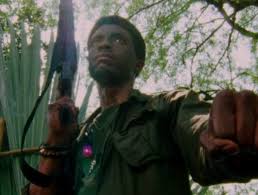
Not Enough Chadwick. Chadwick Boseman is such a dynamic actor and charismatic screen presence, that you’re left wanting when it comes to his character, Stormin’ Norman. Boseman was perfectly cast to play the part of a man who left such an impression in his brothers, they basically deify the man. Norman’s myth looms so large in the four men’s minds over the years, he dominates their lives and conversations. This is partly because Norman was a badass on the field of combat, and partly because he was a charismatic leader who taught them about the Imperialism of America. He’s a towering figure in every aspect of their lives even after so many years of having been killed in combat. The film needed more scenes of Norman showing why the men revered him so much.
Death Scenes. Without giving too much away, there are death scenes in this movie (it’s a war film), but some of the decisions felt, let’s say gratuitous.
All in all, Da 5 Bloods is an impactful and important film, filled with amazing performances, drama, and strange plot twists, all while delivering stark commentary on the plight of the American black man.
It’s the right movie for our times. And it’s time that Spike Lee gets fully recognized as the most brutally honest story-teller and filmmaker of our day.
Chris Joseph (@ByChrisJoseph) is a host of the Five Reasons comedy podcast, Ballscast. He’s written about sports and movies for Deadspin, Miami New Times, CBS Sports, and several other outlets.