Leo Messi’s injury history explains World Cup hesitation
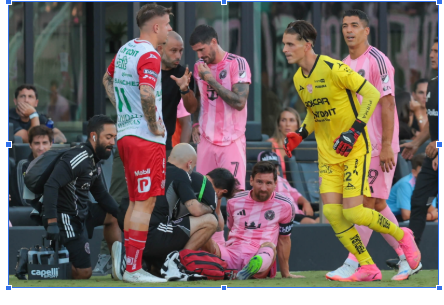
Inter Miami’s preseason hadn’t gone quite as planned – during one of their three matches in South America, Lionel Messi picked up an injury, which caused the postponement of a friendly against Independiente del Valle in Puerto Rico on February 13. Leo himself recorded a video apologizing to Puerto Rican fans, which is a really lovely gesture.
Thankfully, the league’s spring calendar isn’t too packed and there are mostly one-week gaps between matches, so Leo shouldn’t miss plenty of action anyway.
Still, Messi’s recurring injuries – even though most of them are minor – have become a worrying trend. They could also be the reason why the 38-year-old is still undecided about his 2026 World Cup participation.
Let’s analyze Leo’s recent injury history in more detail.
Below are all of the Argentine’s setbacks since 2024. Eight injuries, 127 days on the sidelines (and counting), 14 matches missed. Actually not too many for a player of his age, but one thing that instantly catches the eye is the number of hamstring injuries – they make up half of the total number of setbacks.
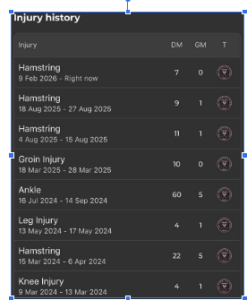
Interestingly, the last time Messi had suffered from hamstring injuries before March 2024 was in September-October 2019 when he was still at Barcelona. And before that, the latest hamstring injury dates back to 2014, so this was surely uncommon in the Argentine’s career.
Why has he picked them up so often in recent years?
Think of the hamstring as the emergency brake of a car. For Messi, whose game is still built on low-center-of-gravity turns and sudden stops when he’s on the ball, those “brakes” are used more than almost any other player on the pitch. When he tries to beat a defender in a dribble – and Leo loves taking on multiple players in a single episode – his hamstrings are often under maximum pressure.
The age factor is surely important too. Messi’s muscle fibers naturally lose their “snap” with time, becoming less like a fresh rubber band and more like a piece of sturdy leather – strong, but liable to crack if stretched too quickly.
Even though Messi doesn’t run a lot during a game, it’s often a high-intensity sprint when he does. Forcing a cold muscle into an explosive 10-yard dash is the perfect recipe for a strain.
Leo’s first hamstring strain at Inter Miami came in August 2025 when he played against Necaxa – and that’s when real problems began.
When a muscle heals, it often forms scar tissue, which is less flexible than original muscle fiber. Under the explosive stress of a sprint or a long-range shot, that “stiff” section is more likely to pull or tear again – which is why recurring hamstring injuries become more likely. Medical data shows that once an athlete suffers a hamstring strain, the risk of recurrence is 2.7 to 5 times higher.
It doesn’t necessarily have to do with age. One good example is the latest Ballon d’Or winner, Ousmane Dembele. Once he suffered a hamstring injury at Barcelona in May 2019, they became a regular part of his injury record – he picked up five more while at Barca and keeps suffering from them at PSG.
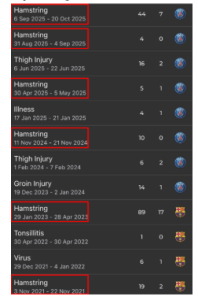
Other notable examples include Zlatan Ibrahimovic, Karim Benzema and Ryan Giggs – due to recurring hamstring issues, they had to reinvent their physical maintenance to survive their 30s (and 40s in Zlatan’s case).
Finally, scheduling and traveling play their part too. In 2025, Messi played close to 50 matches across all competitions, which included long-distance travels for friendlies, Club World Cup, CONCACAF Champions Cup and Leagues Cup clashes, let alone the fact that US teams generally cover broader distances than European ones, and Leo also has to play for Argentina occasionally. Weather conditions don’t help much – playing 90 minutes in high-humidity environments (like Florida) causes faster muscle dehydration, which directly correlates with muscle fiber brittleness.
Inter Miami’s medical team take a “day-to-day” approach regarding Messi, as pushing him too early could sideline him for months instead of weeks. And since we’re already in February, all this could be particularly important to his chances of participating at the World Cup.



Leave a Reply
Want to join the discussion?Feel free to contribute!