Tua Tagovailia's poor play is holding the Dolphins back.

Pressure Point: Dolphins keep hopes alive despite Tagovailoa’s baffling decline

The Miami Dolphins may wear aqua-and-orange, but they are fool’s gold to their fans.

Here they go again making a show of late-season contention. They’ve won three in a row and four of their past five to reach the fringe of the wild-card race.

The network keeps showing them in the graphic of playoff hopefuls, and I can’t help but laugh.

Did that look like a playoff team that had everyone biting fingernails to the quick in fending off (barely) a young, rebuilding 2-9 Saints team 21-17 Sunday at Hard Rock Stadium?
Not when the quarterback is your biggest liability.

The regression of Tua Tagovailoa has been nothing short of baffling, and he’s gotten worse as the season has progressed. This latest head-scratching performance was up there among his most inept.

Tagovailoa outplayed by Saints rookie

That was underscored late in the fourth quarter when Fox color analyst Mark Schlereth suggested the Dolphins completely remove all passing plays from the offense and just hand the ball to De’Von Achane for the remainder of the game.

He wasn’t being facetious. His point was well founded.

Tagovailoa not only threw his league-leading 14th interception of the season, he was off target nearly all day.

There was a crisp throw to Jaylen Waddle on a crossing pattern for a 22-yard gain and a strike down the middle to tight end Greg Dulcich for 21 yards. That was about it for well-thrown balls.

The key to success for the Dolphins this season was supposed to be Tagovailoa staying healthy. He’s done that, making every start, and it’s been to their detriment.

Sunday he was outplayed by Saints rookie Tyler Shough, and it wasn’t particularly close. Shough, making his fourth career start, is a work in progress, but he showed athleticism that Tagovailoa doesn’t possess and threw two second-half touchdown passes in rallying the Saints from a 19-0 deficit to within a two-point conversion in the final minutes.

Tagovailoa loses his accurate touch

In years past, Tua’s ability to throw accurately helped offset his shortcomings of middling arm strength and mediocre mobility.

This season, he’s lost his touch, and that was evident throughout Sunday’s game. He started by overthrowing Cedrick Wilson Jr., who had a step advantage on a deep route. Then he botched a short toss on an inside screen near the Saints’ goal to Achane, who could have waltzed into the endzone. Instead the Dolphins had to settle for one of four Riley Patterson field goals.

In the second half Tua threw behind Julian Hill on a third-down play when the Dolphins were trying to answer the first Saints touchdown. Later, he floated a pass in the endzone to Darren Waller, who ran out of room.

It wasn’t merely that his passes were off the mark, so was his judgment. Most glaring was the long pass into double coverage for Waddle that was intercepted. He overlooked Achane who was open.

Tagovailoa finished the day 12 of 23 for 157 yards, with a paltry passer rating of 55.9.

Tua’s subpar stats don’t lie

He was sacked four times, which often happens when his first read is covered and protection breaks down. Shough, like almost every quarterback the Dolphins face, has the ability to scramble out of trouble and make a play. Tagovailoa, lacking elusiveness, tends to panic and take drive-killing sacks.

Schlereth wasn’t the only viewer preferring to see the ball in the hands of Achane, who rushed for 134 yards against the Saints to become the 11th Dolphins back to surpass 1,000 yards in a season, the first since Jay Ajayi in 2016.

Achane scooted 29 yards around the right side to cap an impressive opening touchdown drive. Tagovailoa’s subpar play, particularly in the red zone, had a lot to do with the Dolphins settling for field goals the rest of the day.

“Definitely starts with me, with my performance, with how I distribute the ball,” Tagovailoa said in his postgame interview.

Tagovailoa is currently 23rd in the NFL in passer rating, but first in interceptions. The Dolphins needed a lot more from their $53.1 million (per year) quarterback in a make-or-break season for the Mike McDaniel regime.

McDaniel didn’t exactly bestow a vote of confidence on Tua when he had him let the clock run down to end the first half with a field goal rather than take a shot at the end zone.

Are Dolphins setting up another late-season flop?

Nonetheless, this midseason surge following a dreadful opening month has lifted the 5-7 Dolphins to the edge of hope.

It’s a familiar Build Me Up Buttercup scenario that has led to too many final month letdowns by this franchise.

Are you going to fall for the fool’s gold again, Dolfans?

The Dolphins travel next Sunday to face the 3-9 Jets, fresh off a walk-off field goal win over the Falcons. Then they’re on the road again at the Steelers, home against the Bengals and Buccaneers, and finish at the Patriots.

It’s not totally implausible, when you have one of the league’s premier offensive performers in Achane. Blocking up front has improved, right tackle Austin Jackson added to that in his first game off injured reserve. Waller’s return adds another weapon with game-changing ability.

Meanwhile, Anthony Weaver’ defense, led by Jordyn Brooks playing at an All-Pro level, has elevated its play. Against the Saints, the defense had four sacks, a fumble recovery and an interception by Rasul Douglas, plus Minkah Fitzpatrick’s pick and 98-yard return for two points on the Saints’ last conversion attempt.

The main stumbling block is at quarterback. Unless Tagovailoa dramatically reverses course and elevates his play over the remaining five games, this team isn’t going anywhere.

Craig Davis has covered South Florida sports and teams, including the Dolphins, for more than four decades. Follow him on the site formerly known as Twitter @CraigDavisRuns.

What’s next for Devin Haney?

Devin Haney’s new status as the WBO welterweight champ following his surgical takedown of Brian Norman Jr. has set up big plans for 2026. His career was on the line as allegations of being a “shot fighter” surrounded him like flies around a carcass, but he took on the hardest bout available and is on his way back to the top. 


Despite Conor Benn’s insolence ringside and former partner Eddie Hearn, also the chairman of Matchroom Sport, trying to steal headlines in Riyadh, Saudi Arabia, belittling his work post-fight, it was Haney’s first real step in getting respect back from peers and the public. His reputed “pillow fists” were as fast as ever and had enough pop to drop Norman, leaving him with a confused and embarrassed expression for failing to deliver on his promise to wound Haney. 


The champ is ready to take on anyone, yet a rematch with Ryan Garcia is irresistible. They have unfinished business in the wake of the tainted first match, in which Garcia tested positive for Ostarine, a banned substance that stimulates muscle growth. He was also overweight, which cost him the chance to earn the WBC super lightweight title, regardless of whether he won, before anyone knew he had a separate advantage, but Haney accepted payment for that missed prerequisite.


The once-suspended pugilist also has questions about how good he is, and says he’s going to fight WBC welterweight champion Mario Barrios first. Claiming that belt would add extra credibility to a rematch by making it a unification, but it’s no guarantee for either man. Don’t forget that Garcia was ordinary on weight without PEDs, and Barrios didn’t have enough horsepower to beat 46-year-old Manny Pacquiao, as they went to a draw in July. Barrios is  decent but not the fighter he once was and hasn’t been since a brutal fade with Gervonta “Tank” Davis in 2021, in which he was stopped in round 11.


Assuming Garcia gets by Barrios and doesn’t blow the loot again by getting upset, like he was against Rolando  “Rolly” Romero in May, it will be his opportunity to rebuild his reputation from being a dirty fighter, too. Even with the facts against him, that reality still bothers Garcia, as evidenced by his taking personal shots at respected boxing journalist Dan Rafael for posting about his misdeeds.  


He’s lucky he didn’t have to earn the fight, and that Haney wants to punish him badly enough. One thing’s for sure: if Garcia gives us sloppy seconds from his fight with Romero, there’s no telling how his career will resuscitate. Still, as much as he probably has the underhand, Haney still has to prove he can take a hurtful shot to the mouth because Norman didn’t make it clear. Perhaps Romero can risk his WBA belt and oblige, keeping both of them busy, because Haney’s father Bill, mentioned him as a desired next opponent and that confrontation is no easy work. 


Additionally, a clash with Romero would give Haney some more rounds to get back to form. He could use them, as there were moments he took his foot off the gas against Norman.  


Haney and Garcia split six amateur fights and the former became a champion in a third division as a pro on Nov. 22 (lightweight, super lightweight and welterweight), while the latter has never been at the top. Their names will be tied together forever, so hopefully Part Two gets made, and it’s worth remembering. 


Mateo’s Hoop Diary: Heat’s fourth-quarter comeback fails at home against the Pistons


The Heat couldn’t punch the gas until it was too late and got put down by the first-seeded Pistons, who were on the second night of a back-to-back. They got to their hotel at 4 AM Saturday and still unloaded the most digits (76) in the lane that Miami had surrendered all season, and it was Duncan Robinson’s first visit back to Kaseya Center. He showcased how valuable he is without the 3-pointers. 


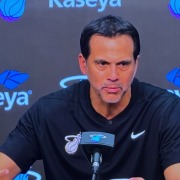
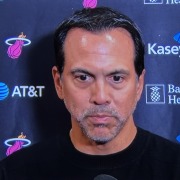
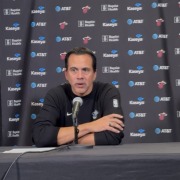
Coach Erik Spoelstra said, “Defensively, for us, it just felt like we were on our heels and passive for the majority of the night. There was a segment with our second unit where it really kind of changed the feeling of the game for five minutes, six minutes… but defensively, it took us a long time to be aggressive.” 


Their defense was unfastened by repeated drive-bys, conceding 22 of Detroit’s 36 first-quarter points in the lane. It was the equivalent of watching someone in the ring get tagged by endless lead rights to the dome. The Pistons even went on a 13-0 run while Cade Cunningham was getting his rest, taking a 36-23 lead into the second frame. The Heat were lucky not to be down further, as a good slice of their points came at the line and their visitors soiled seven possessions with turnovers. 


The Pistons were still sloppy, taking care of the ball in the second quarter, but it made no difference because the Heat were afflicted by another monsoon of paint strikes. Cade Cunningham was undaunted by any scheme, piercing the lane for half (5) of those shots at close range.


Herro got denied violently by Isaiah Stewart at close range and was docile until the fourth quarter.


The Heat went to halftime down 71-59. They were outscored in the paint by 20 (42), but had another stimulus at the charity line that prevented the game from slipping into dangerous territory. The deficit subsequently swelled before Norman Powell’s marksmanship helped cut it to 10. But the Pistons kept bodying them like a tall middleweight in a fade with a short, natural welterweight, and raised the gap back to 17 going into the fourth.


Andrew Wiggins’ rim pressure and shot off a pick-6 was keeping Miami’s heart pumping on offense. Then Davion Mitchell stepped up, picking up three steals, Adebayo made two shots in the lane, Herro swished three treys and Powell poured in a layup and three huge freebies with under two minutes left. Yet their 44-point late burst was diluted as Cunningham breached the lane for a short jumper with 20 seconds left, putting the Pistons ahead by four. He even swiped the ball, and it bounced out of bounds off Powell’s leg, on the following possession.


The Heat lost 138-135. Spoelstra said, Detroit showed us, you know, why they’ve been number one in the East so far. We’ve been an up-and-coming team, but that was a different level for big parts of the game.”  


Game Notes:

  • The Pistons were minus Jalen Duren and Caris LeVert, and their lowest-scoring quarter was the fourth, with 30 points. Tobias Harris channeled vintage Carmelo Anthony, roasting smaller players; Cunningham logged 25 points on 56% shooting on attempts from short, middle and long range; and three Pistons had between eight and 10 rebounds.


  • Jaime Jaquez Jr.’s absence opened the door for Nikola Jović to get extra time off the bench, but he was invisible, except when getting dusted or turning it over, which included a worthless pass into Ron Holland III’s hands, creating a pick-6. Instead, they got premium production from Ware off the bench.


  • Their 33 free throws were the third-most they’ve made this season. Wiggins was perfect on nine attempts, and three other Heatles made between four and seven.


  • Herro and Mitchell combined for zero baskets in their first 10 attempts. Herro’s starting lineup integration resulted in the third-straight night the offense looked washed, as they had one of their lowest-scoring first halves. This time it was courtesy of Detroit’s speed and size making it nasty, but that changed in the fourth. 


  • Robinson nailed three 3-pointers, including one in the corner in Herro’s eye, but most of his shots were recorded at the rim. He notably had five assists against one turnover. 


Mateo’s Hoop Diary: Heat show off new starting lineup and hold off the Bucks in Emirates Cup play

Plans for Tyler Herro and Norman Powell starting together were conceived ages ago, and it finally got its first real test run in Emirates Cup play as the Heat squeaked by the Bucks for their sixth straight win. The visitors sans Giannis Antetokounmpo torched the small-ball lineup, but were contained to 37.9% shooting late.


“We played some bad basketball today,” Bam Adebayo said in his on-court interview. “We need to fix that before it gets too late, but for the most part, it came down to stops, and we did that.”


It’s no surprise Milwaukee was able to hang because someone usually steps up in these situations, and it was Myles Turner for them. He turned into vintage Kareem Abdul-Jabbar until the fourth quarter, tallying 24 digits on 60% accuracy. 


Norman Powell never got going, and neither did the transition offense as the crew even had its second-straight low-scoring first half despite six Heatles tallying multiple baskets (53-47). Adebayo and Kel’el Ware led them with four field goals apiece, but one of the crew’s biggest problems was making only 21% of their 3-point attempts.


Their three trifectas, inside pressure leading to four baskets at close range and getting to the line for eight attempts, making seven, prevented the Heat from letting control slip away in the third quarter.


Herro subsequently surged in the fourth quarter, scoring in transition, ripping a triple behind Ware’s down screen and slashing the half-court lane for two floaters. Then Adebayo made a jumper at the nail and a floater in the lane, giving them a five-point lead with under a minute left. They offset Ryan Rollins and Bobby Portis’ six paint baskets in the period.


The Heat (13-6) won 106-103, and it was the first time they’ve had a full roster healthy this season. Additionally it was their sixth game decided by five points or fewer. Their record in those games is 5-1.


Coach Erik Spoelstra now has 800 regular-season wins as the man in charge. He said, “It’s fitting that it comes on the eve of Thanksgiving. I just feel incredible gratitude for this organization and all of these years.”


He also said he’s looking forward to the team practicing on Friday to “fine-tune some things.”


Game Notes


  • The Heat’s starters were ahead 22-20 at the first substitution. They showed why they could be dangerous as a small unit, but size killed them. Spoelstra was not pleased with the Heat’s multiple efforts against post-ups. “I think we could have made those a lot more difficult.”


  • Six Heatles logged between four and nine baskets yet the offense wasn’t flowing like it was pre-Herro’s return. He’s a major addition to something that was working, so getting everyone in sync will take some time. Aside, in spite of their transition frequency (20.2%) being in the 85th percentile, they only scored 115.8 points per play, good enough for the 39th percentile, per Cleaning the Glass.


  • This was the 11th time the Heat (32) have had at least 30 assists (10-1). Most of the playmaking came from Davion Mitchell, who recorded nine assists against three turnovers, and Herro, who had seven assists and two giveaways. 


  • They used all 10 players in the first quarter. Nikola Jović never got any minutes, and Jaime Jaquez Jr.’s were cut to 17 despite a decent night. Keshad Johnson was shelved, too, since Andrew Wiggins returned from his hip flexor injury.


  • Ware wasn’t looked to for points in the second half, but he still hit the boards (4) and came away with a steal and block.

Miami Hurricanes Thanksgiving Viewing Guide

The Canes are going to need help to get into the College Football Playoffs. While that is a load of crap, it is the reality of the situation. So, over this holiday weekend, sit back, relax, and know who to cheer for (or against).

The At-Large Route

In order for Miami to make it as an at-large, they need to get up to 9th to be totally safe, and at least 10th.

If Texas Tech is upset in the Big 12 championship game by a BYU team that is behind Miami, both teams would likely go and the Big 12 would be a 2-bid league. That’s the only scenario where Miami needs to be 9th.

If Miami gets to 10th without getting in front of BYU, they should be okay. The 11th and 12th seeds with be the ACC Champion (provided it is not Miami) and a G5 team.

So the Canes need 2 things:

  1. 2 or 3 teams in front of them to lose AND drop behind Miami
  2. No one behind Miami to jump them

All of this assumes that the Canes beat Pitt on Saturday. Without that, none of this matters and I’ll see y’all in Orlando for the Pop Tarts Bowl.

Since this is a viewing guide, I will organize this chronologically.

Friday, November 28

The Canes definitely want Mississippi State to win this game. A 2-loss Ole Miss team would theoretically have a worse resume than Miami. However, there is a complication here. Ole Miss’s singular quality win was over Oklahoma. These teams are currently back-to-back in the standings. Will they really leave Ole Miss out of the playoffs in favor of a team they beat by 8 on the road? I’m skeptical (and I also understand the irony, but so far, the only place they’ve been willing to ignore head-to-head is with Miami and Notre Dame).

No brainer, Canes want Kansas to win. Utah is one spot behind the Canes and Miami only moved in front of them this week.

I’m not even going to pretend that Georgia would drop below Miami even with a loss. They’re basically a lock. With that said, Georgia Tech snatching a high profile SEC win can’t hurt the conference’s reputation. This is in this section versus the ACC section because it has no bearing on the ACC standings.

The Canes want Texas A&M to win this. They’re a lock regardless, and while Texas looks to be a bit too far back, the Canes would prefer not to look over their shoulder at the Longhorns coming off a quality win.

Saturday, November 29

This is similar to the discussion with A&M and UT. Ohio State is a lock and Michigan is a few spots behind the Canes (with losses to USC and OU), but leave nothing to chance. Hopefully OSU handles them to remove a potential landmine.

If West Virginia can somehow pull off this upset, it would all but guarantee that the Big 12 is a one bid league. That means that the Canes are likely only needing to move up 2 spots since the winner of Texas Tech and BYU would be the automatic bid (both are currently in front of the Canes) and the loser would be behind the Canes.

It’s a long shot, but a Central Florida win would eliminate BYU from at-large consideration. They would still be in play for an automatic bid, however, and if the Big 12 ends up a 2-bid league, a loss here won’t help that much.

Oregon’s resume is not very strong, and a loss to Washington would make things interesting. Would they fall all the way out of the playoffs? Probably not, but one can hope.

This would be one of the few, guaranteed to help, somewhat plausible results. If LSU beats Oklahoma, Oklahoma will surely fall out of the playoffs with a 3rd loss and open a spot up for the Canes.

This is a “don’t trust the committee” game, but a Tennessee win over Vanderbilt will prevent the Commodores from jumping the Canes.

This is the less plausible version of LSU-Oklahoma. If Auburn beats Alabama, Alabama will be eliminated with a 3rd loss.

We all know what Stanford is having seen them play. This isn’t happening. Ironically, ND winning would help the Canes’ resume, but for some reason Notre Dame to has a worse record than them despite Miami winning when they played, so Miami is hoping for a Stanford miracle.

The ACC Route

Outside of the moving up 2-3 spots and claiming an at-large spot, Miami can still win a convoluted tiebreaker and go to the ACC Championship Game in Charlotte. This is how Miami makes the ACC Championship Game:

Note: The SportSource Analytics Rankings are not public, however the Canes would in theory rate out well against SMU and Duke since I believe this doesn’t just account for conference games. Georgia Tech would be muddier, but the Canes’ metrics are generally good, so one would hope they would win those tiebreakers. 

This table shows the games and results that get the Canes to Charlotte. The ones in yellow will fall back on the SportSource Analytics Rankings.

Saturday, November 29th

Obviously, Miami needs to win this game or the rest of the day will be spent drowning sorrows in copious amounts of alcohol.

This could play a role in some of the multi-team tiebreakers to keep the Canes out of a situation where the SportsSource Analytics Rankings are used. This is by far the least impactful of the ACC games, but Syracuse winning would remove all but one of the Analytics Rankings tiebreakers.

This is the first major competitor for the Canes. If Wake Forest beats Duke, that will put 6 permutations into play for the night session of games. If Duke wins, the Canes aren’t out, but that means they are down to 2 scenarios.

This is another big one. If Duke won earlier, then Virginia Tech must beat Virginia to keep the Canes’ chances alive. If Syracuse and Wake Forest have already won (along with the Canes), then the Canes would clinch with a VT win.

This one is big for tiebreakers. NC State beating UNC is actually present in 5 of the 8 scenarios that put the Canes into Charlotte, and irrelevant in 2 others. This will be running concurrent to the UVA game, but if Duke won earlier, this becomes a must win for NC State.

And the nightcap…on net, Cal beating SMU is what the Canes want, but there is an oddball scenario where Duke, UVA, NC State, and Syracuse have all lost and SMU winning is actually better because it puts the Canes in Charlotte whereas an SMU loss would mean it goes to the Analytics Rankings.


Vishnu Parasuraman is a show host and writer for @FiveReasonsSports. He covers the Miami Hurricanes Football for @SixthRingCanes Miami Hurricanes Basketball for @buckets_canes , and Miami Hurricanes Baseball for @CanesOnDeck as part of the @5ReasonsCanes Network. You can follow him on twitter @vrp2003

Miami Hurricanes

Miami Is One Win Away From a Historic Farce

The Canes have been here before, most recently in 2000. They beat FSU, but FSU went to the title game that year.

Notre Dame is also sympathetic. In 1993, Notre Dame beat FSU, but FSU was given the shot at undefeated Nebraska in a de facto National Title game, which they won.

The reaction to each of these injustices was reformation. They rolled out new systems (The Bowl Alliance, The Bowl Coalition, The Bowl Championship Series). They then recalculated formulas. But eventually, they went to a committee and codified the importance of head-to-head. It was the only way to ensure that head-to-head results took precedence among comparable teams.

The Previous Holders Of The Crown

The 2023 Florida State Seminoles went 13-0. They had their best season in years and were headed to the playoffs.

But in a Week 12 blowout victory over North Alabama, QB Jordan Travis got injured.

FSU went on to win the last 2 games at rival Florida and against 14th ranked Louisville in the ACC Championship Game.

They literally did everything asked of them.

When the playoff bracket was announced, however, they were left out.

Why? Well, in parallel to the latest reformation in college football, money infected the sport, and in particular, a corrupt relationship between the SEC and ESPN developed. ESPN invested billions of dollars in the SEC being the “best” and used their giant megaphone to make sure everyone knew it. And they had results to back that argument up. From 2006-2012, the SEC won 7 National Titles in a row. By the time 2023 rolled around, the SEC had won 4 consecutive National Championships again and ESPN’s family of networks had become their de facto propaganda arm.

It was in that cauldron that FSU’s 2023 found themselves burning.

As ESPN and the College Football Playoff Committee would tell the story, Jordan Travis got injured, FSU was clearly not a Top 4 team anymore, and while unfair, they were justifiably left out of the playoffs. 

The problem with that is that it is a load of complete crap. 

  • In Week 12, Jordan Travis got injured. FSU was then ranked behind Washington.
  • In Week 13, they proved they could beat Florida without him, and moved to 4th with Ohio State losing to Michigan.
  • In the final standings, they somehow tumbled ended up 5th despite beating 14th ranked Louisville

What happened? It wasn’t the injury to Jordan Travis. It was SEC money.

The previous week, the 4 teams in were Georgia, Michigan, Washington, and Florida State. All 4 undefeated. Then Alabama upset Georgia. So what, just swap Georgia and Alabama, and you’re good to go?

Except they couldn’t. Why?

Because head-to-head was so sacrosanct that they would not dare put Alabama in and leave a Texas team that beat them out (Texas was in the Big 12 at the time).

The correct, merit-based seeding was Michigan, Washington, FSU, Texas. But they could not leave out the SEC. Too much money. Merit be damned. But just as important was head-to-head. So Florida State was sacrificed to the altar of Greg Sankey. You can’t put Alabama in front of Texas (head-to-head is too important!) and you can’t leave out the SEC (even if they deserve to be left out), so Florida State has got to go.

That’s why, absurdly and insanely, and still unjustifiable to this day, the 7th ranked team was ranked 3rd the following week for beating the 18th ranked team while the 4th ranked team was ranked 5th for beating the 14th ranked team with the justification being that a player that was injured for weeks at that point was still injured. 

Between Money and Merit, Money Is King

College football was always a convoluted mess. Opinion polls determined champions for a majority of its history. Over the years, the sport evolved from a regional sport into a national sport. And with it, focus shifted more and more to a meritocracy. A national sport needed a proper National Champion.

The 4-team CFP playoff (which has now been expanded to 12-teams) was a step towards reinforcing that meritocracy.

But something happened in parallel. Money drove conference expansion and consolidation. When the BCS first rolled out in the late 90s, there were 6 major conferences: the ACC, Big East, Big 10, Big 12, Pac 10, and SEC. First the Big East died and years later the Pac 10 followed it. The Big 10 and SEC emerged as bloated money machines, with TV partners in tow.

As College Football strived towards a goal of meritocracy it became harder and harder to compare teams as even teams in the same conference played radically different schedules.

So the committee came up with metrics and convoluted reasons to rank teams a certain way. But in reality, it all flows back to money. The Big 10, the SEC, and Notre Dame get the benefit of the doubt. Even when teams like Oregon and Ole Miss don’t play a tough schedule, they’re fine. The Big 12 and the ACC are second-class citizens.

It’s why, before a single ball is kicked, regardless of result, you can go ahead and allot 8 spots (at least) to the SEC, Big 12, and ND. Those are automatic. You might not know the specific teams, but there is no result that will convince the committee otherwise. They come in with that bias, the propaganda money machine reinforces that bias, and there is no evidence allowed in. The logic for the chosen teams is reverse engineered starting from a place of making sure those 2 conferences and Notre Dame are taken care of. If the playoffs were to start today, the teams would be 5 SEC, 3 B1G, ND, 1 ACC, 1 Big 12, 1 Group of 5. Just as intended.

The system is not just inherently flawed, its inherently unfair by design. The humans were initially introduced to prevent on field results from being ignored. They’re now in place to make sure the money goes where it is supposed to, and then they’ll figure out how to justify it. 

The Burden of Proof

With 1 week left in the regular season, there are several teams vying for a few playoff spots. You can make arguments for or against several of them. The subjectivity of analysis will always lend itself to these variances. And with the disjointed nature of current scheduling, direct comparisons are almost impossible to make.

ALMOST.

That’s what makes this Miami-Notre Dame situation so bizarre. On paper, this is the easiest decision. 2 teams with the same record, one beat the other, the team that won should be ahead, right? Head-to-head is sacrosanct, right? It’s so important that you’re 2 years removed from punting FSU out of the playoffs to avoid applying head-to-head to Alabama and Texas and leaving the SEC out in the cold.

The committee is choosing to ignore it anyway. Just to contextualize how bizarre this is, everywhere else in the ranking discussion, it’s a given that head-to-head trumps everything else.

https://x.com/tmj6810/status/1993490978507047126?s=20

Georgia is also ahead of Ole Miss and Oklahoma is ahead of Alabama on head-to-head right now. No one would ever consider swapping those teams, because that would ignore the on field results. And to ignore head-to-head would be inconsistent with the selection committee’s protocol:

While there is no definitive way that Strength of Schedule is calculated, Notre Dame’s schedule is stronger than Miami’s (After Miami plays Pitt and Notre Dame plays Stanford, that gap will close). According to ESPN, Notre Dame has the 12th Strength of Record while Miami has the 15th.

https://x.com/WillManso/status/1993487197576872396

Image

And in terms of common opponents, there will be FOUR by the end of the season. Yes, by some fluke with the ACC-ND scheduling agreement, ND happened to hit 4 of the same ACC teams as Miami. That makes the comparison even easier for the committee.

But wait, there’s more. So if ND played Miami, and 4 common opponents, what are the 7 games that they played where they proved that head-to-head should not be the decider? They played Texas A&M, and lost. They beat USC, Navy, and Boise State. Those are good teams and good wins. Nothing spectacular, but relevant. And the other games? They played the 3 winless in conference P4 teams (BC, Purdue, and Arkansas).

That is the resume. And it’s not a bad resume.

But it’s also nowhere near enough to warrant overriding who won the actual game when these 2 teams played. If that logic is good enough for literally every other instance in the rankings, it’s good enough here. The arguments against it are generally circular and look ridiculous when applied elsewhere.

  • Imagine BYU being ranked ahead of Texas Tech because BYU has a better loss.
  • Imagine Alabama being ranked ahead of Oklahoma because we *know* who would win if they played again.

Any attempt to explain it quickly falls apart because it requires us to pretend that these 2 teams didn’t play. It also requires that we place the burden of proof on Miami to prove that the head-to-head should count. That is completely backwards. Notre Dame should have to prove why the head-to-head should not count. And nothing in their resume says it should not.

If Louisville is so bad, why couldn’t Notre Dame do what Louisville did and win at Miami? The reason the on field results matter, the reason head-to-head is a tiebreaker in every sport, is because it is inarguable. That is the case in every other sport, and it is here now. All signs will redirect back to “Notre Dame played Miami and lost to Miami.”

Instead, the Selection Committee, Notre Dame, and ESPN would have you believe that Miami needs to do something extraordinary to get in front of Notre Dame. Beating them is not enough. They started this process by ranking Miami too low (18) and then repeatedly have moved the goal posts for what Miami has to do to “move up” (a phrase that should not exist because they are supposed to re-rank teams weekly). In the last 2 weeks they went from head-to-head matters if Miami and ND are in the same group to never mind, we’re going off vibes.

And yet by repeatedly shifting the goal posts the Selection Committee has managed to distract from the central question. Why does Miami have to do anything to prove they’re better than Notre Dame? THEY BEAT THEM ON THE FIELD. 

Notre Dame should have to prove why the head-to-head should be ignored, and losses to Miami and Texas A&M, and wins over USC, Navy, Boise State, 4 common opponents with Miami (3 at this time, they’ll each play the 4th this weekend), and 3 p4 bottom feeders who have combined to win zero conference games is not even close.

“Trust me bro, I know they’re better” is an absurd standard. 

If the rankings were reversed, it would be non-controversial. “Miami is in front cause they played and Miami won.”

As Andy Staples said, “they played a game, their resumes are very similar, and you’re taking the team that lost and putting it ahead of the team that won, which doesn’t make sense.”

If Miami loses to Pitt (which is certainly possible, Pitt is a good team), then the conversation becomes moot. And that might be where it ends up, with Miami falling flat on its face in Pittsburgh on Saturday. But it’s important to contextualize why this conversation becomes moot. If Miami were to lose to Pitt, it would mean:

  • Notre Dame has a better record than Miami
  • Notre Dame has a dominant win over a team that beat Miami

That will invalidate the head-to-head, and rightly so. That’s what it looks like when head-to-head is overridden by other factors.

But if the Canes win, they will:

  • Have the same record
  • Have won the Head-to-Head
  • Have 4 common opponents that both teams went 4-0 against

And they will almost certainly be behind Notre Dame based on what people *know* would hypothetically happen if these teams were to play again instead of what actually happened when they did play. As Brad Pitt (playing Billy Beane) said in Moneyball, “You don’t have a crystal ball…’When I know, I know, and when it comes to your son, I know.’ And you don’t. You don’t.”

That’s the beauty of sport. When we think we know, we often don’t. The results on the field rule the day. Or at least that used to be the case.


Vishnu Parasuraman is a show host and writer for @FiveReasonsSports. He covers the Miami Hurricanes Football for @SixthRingCanes Miami Hurricanes Basketball for @buckets_canes , and Miami Hurricanes Baseball for @CanesOnDeck as part of the @5ReasonsCanes Network. You can follow him on twitter @vrp2003

Mateo’s Hoop Diary: Tyler Herro’s back, so who comes out of the starting lineup?

Tyler Herro was rusty for a quarter but picked up where he left off from last season as a gunslinger. He said postgame that he could have easily waited two more weeks to come back, but that Monday was circled on the calendar.


He wants to come into the starting five and let those guys be themselves, but one of them is probably getting benched. It’s hard to imagine coach Erik Spoelstra being thrilled about having to demote one of the guys who has been a big part of the team defying early expectations, especially when he talked about enjoying it a bit after winning in Philadelphia on Sunday. Keep in mind, they find themselves on a 54-win pace. 


Herro will also be getting a lot of crunch-time minutes over others, which will test the group’s unity. It’s one thing for everyone to say the right things publicly, and it’s another when there is another player who needs touches and is eating into a system established by others.


Off the bat, Adebayo and Wiggins aren’t going anywhere because they are athletic two-way players, and Powell has been the top dog in the scoring department, so he isn’t either. This leaves Davion Mitchell and Kel’el Ware to choose from. 


Mitchell is logging a sparkling 4.89 assist-to-turnover ratio. He may be short for a hooper, but he’s built like a football player, so he’s not a small guard. He’s become his best self as a slasher and cutter in the paint’s in-between area (3-10 feet) and is a dependable point-of-attack defender. He hasn’t missed any nights, and his starting record is the same as the team’s this season (12-6).


Kel’el Ware had some rough moments, but he had made amends by turning into Superman lite and hasn’t had below 14 rebounds in the last five outings. His record as a starter is 10-4, and the team is 6-2 when Bam Adebayo and him start together. Yet it may be Ware who slides to sixth man. 


The Heat have bought into playing fast and are first in pace (106.14) and first in average speed offensively (5.24). An initial lineup of Mitchell, Herro, Powell, Wiggins and Adebayo would be smaller, yet it would lean into the speed. Don’t count on monstrous fastbreak numbers like Pat Riley’s Lakers had, but this could be Spoelstra’s version of Showtime. Not even those Big Three teams that won back-to-back titles were higher than 16th in pace, and the Jimmy Butler-led squads were never above 27th (2019-20).


Herro can be hidden by guarding the corner man or the player with the weakest handle who isn’t a big. He would be next to four good-to-great defenders. 


Ware will still get minutes with Adebayo, but using him off the bench could turn into a serious advantage, facing off against other reserves or tired starters. 


Ware was given a taste of what will one day be his spot. Don’t forget that Adebayo and Herro didn’t become full-time starters until years three and four because Spoelstra isn’t into premature rewards. In the meantime, if he becomes a part of the bench mob, starring in his role will get him plenty of minutes and paid the big bucks when it’s contract negotiation time. 


Mateo’s Hoop Diary: Tyler Herro shined in his return, and the Heat’s defense bailed them out against the Mavericks

A little closer to comfort for their liking, but the Heat put down the Mavericks in Tyler Herro’s return, winning their fifth in a row and giving top overall pick Cooper Flagg a warm welcome to the league by holding him to 12 points on 35.7% shooting. Their half-court offense was neutralized, but they made up for it by denying the Mavs prosperity in the lane. 


Each side started in the mud, but Kel’el Ware was the team’s first-half MVP, pulling down 10 rebounds and scoring 15 points on rim attacks, including two lobs and a few 3-point shots. And next was Herro, who missed his initial four attempts because he was pressing. He went on to close the half on a quick flurry, making his next four shots, racing in transition and blowing by them for two floaters.


Ware’s scoring cooled off in the next half, but his pursuit of rebounds did not, recording eight more. Herro’s run then extended, and his consecutive shots reached nine without a miss, on step-back jumpers and drive-bys. After the game, Jaime Jaquez Jr. said, “It was like he never left.”


Naturally, the Mavericks erased the Heat’s 11-point fourth-quarter lead, and Herro lived up to his name, dribbling into the lane, making three floaters. Bam Adebayo subsequently iced the game with two freebies after. 


The Heat won 106-102 on their worst 3-point shooting night of the season (18.5%). Ware made three of the team’s five treys. Pelle Larsson and Keshad Johnson had the other two. Their record is now 12-6.


Ware said in the locker room about Herro, “Y’all seen what he can do last year. For him coming back doing that his first game back after being away for awhile, is something special. I’m just looking [forward] to the next few games.”


Game Notes


  • The Heat’s 106 points are the second-lowest output of the season, after 18 games. Keep in mind that last year’s club logged below 106 points 24 times. They played significantly slower than normal, at a slightly above-average pace, yet the defense did a lot of bailing them out. They held the Mavs to 83.9 points per 100 half-court plays, which is good enough for the 16th percentile. Adebayo said post game, “We are going to always hang our hat on getting stops. 


  • Dallas’ biggest threats in the fourth quarter were P.J. Washington, Max Christie and Flagg, as they combined for 18 points. The Heat’s biggest stop of the night came with the game tied at 49 seconds left. Adebayo intercepted the sideline inbound, which resulted in Herro burying a 10-foot floater over Washington, the man who turned it over.


  • Norman Powell was ruled out because of a groin strain. He is the Heat’s best 3-point shooter, aside from being a dependable inside scorer. While the offensive struggles wouldn’t have been as severe with him playing, there is more to this story.  The team was tight because of the weight of the night. Six of their seven missed free throws were in the first half, four belonging to Adebayo.


  • Johnson had another fine game, infusing the team with hustle as he defended and crashed the glass in nearly 18 minutes, totaling seven points, three rebounds, including two offensive. He plays hard because, as the 11th man in the rotation, they sometimes don’t know when they’ll get minutes again, and his opening remains while Andrew Wiggins (hip flexor) and Powell are out. 


  • Monday’s win completes the Heat’s third back-to-back set of the season. The only one of those lost (5-1) was the match in Los Angeles against the Lakers on Nov. 2.

Devin Vanterpool develops into two-way player, fueling Florida Atlantic’s hot start

In an era of college basketball teams reloading through the transfer portal and changing both their identity and postseason prospects year after year, it is refreshing to see that the player currently leading the Florida Atlantic Owls in every major statistical category is one who was recruited and developed.

Sophomore guard Devin Vanterpool leads the Owls in points (16.2), rebounds (6.4), and assists per game (3.2). He is also averaging 1.2 blocks and 1.8 steals per game.

“It all starts with the defense end, caring that much to guard so much, and that hard to get a stop on defense,” Vanterpool said. “It definitely creates offense.”

A year ago, Vanterpool played 30 games off the bench as a freshman, averaging only a bucket and a board in eight minutes per game on an FAU team that finished the season in the NIT. His emergence has coincided with the Owls’ 4-1 start to the season.

FAU second-year head coach John Jukas said Vanterpool has transformed from a defensive specialist to a two-way player.

“A lot of people focus on his offense and his growth,” Jukas said. “I would hope the very first thing you say about that man, besides him loves the FAU Owls, he’s very coachable and a wonderful kid, besides him being a great human, he’s a two-way player, not an offensive guy.”

In the Owls’ first-ever meeting with Pacific to start the Sunshine Slam on Nov. 20, Vanterpool scored 12 points with five rebounds, three blocks, and two steals. During that game turned out to be an 82-59 landslide victory for FAU, who as a team recorded nine steals and eight blocks.

“We all just play defense and stack stops,” Vanterpool said. “It helps me play my offense from there.”

The block party against Pacific was shared by forward Devin Williams, who had three of his own, as well as Euro centers Maxim Logue from France and Vincent Neugebauer from Germany, who each had a block. Vanterpool said “knowing and trusting that our bigs are going to come over and make a play” has also been instrumental in helping his defensive game.

“I was fortunate to wall up and get a couple blocks,” Vanterpool said. “Nico was able to wall up and set me up for a block. So just walling up and trusting our bigs.”

FAU takes on undefeated Loyola Marymount in the Sunshine Slam at Daytona Beach on Monday night. The Lions (6-0) are led by Myron Amey Jr., a fifth-year senior guard who, despite not starting in any of the first six games, has averaged 17.5 points and 4 rebounds per game. He most recently scored a season high 29 points in a 78-74 overtime win over UC Santa Barbara.

FAU’s next home game will be against St. Bonaventure on Sunday, Nov. 30.

Mateo’s Hoop Diary: Heat’s rebounding, bench play and Norman Powell’s eruption were too much for the 76ers

The Heat survived the 76ers, thanks to its strong bench play, locking up the glass and four players scoring between 18 and 32 digits, closing out their two-game road trip undefeated. They sped away each time their hosts got within striking distance and have now won eight of their last 10. 


With Tyler Herro out but nearing a return, and Bam Adebayo having missed six games in a row earlier in the month, the team has to feel very grateful for its 11-6 record as Thanksgiving approaches. 


Another hot start for Norman Powell ended with a glittering stat line: 32 points on 61.1% shooting, with four rebounds and one assist, and they even fouled him thrice on 3-point attempts. Clippers coach Tyronn Lue must want to flip over a desk whenever he thinks back to how his team traded him for a bag of chips, or how he played him below 27 minutes per game for two seasons.


The Heat’s assault was too much to handle, scoring 21 of their first 37 points in the lane.  They also logged at least 70 first-half points for the sixth time this season. A good chunk of the action was Jaime Jaquez Jr.s post ups and drives plus Kel’el Ware’s interior takes over, to go along with six offensive rebounds.


Their 3-point shooting and interior efficiency cooled off in the third quarter after reaching a 14-point lead, and they subsequently went into the fourth quarter up six. Then Jaquez plus Powell ripped to the cup for five baskets, and Adebayo buried two floaters  while they denied Philadelphia almost everything outside of three feet from the hoop. 


The Heat won 127-117 and set a new season high in rebounding (58).


Coach Erik Spoelstra is going to smell the roses a little bit. “I don’t think anybody two months ago thought we’d be sitting third in the East. It’s not everything, but it’s something. I want our guys to enjoy it.”


Game Notes


  • Philadelphia’s 3-point shooting fell apart in the second half, converting 26.3% of attempts. Tyrese Maxey remained their biggest threat, spraying jumpers and bolting to the rim. 


  • The Heat have an advantage because they get good playmaking at all times. Davion Mitchell had 12 assists against one turnover, Pelle Larsson had eight dimes with two turnovers, and Jaquez had seven helpings with four turnovers off the bench. It adds a bit more to the offense when they share the court, as they are strong paint attackers and adept passers. 


  • Ware and Adebayo combined for 29 rebounds, and 11 were offensive. On top of that, the bench had 43 points, 22 of them from Jaquez, against Philly’s reserves, who dropped 44. 


  • The Heat totaled 72 paint points, tying their second-most of the season. They are 4-0 when scoring at least 70 in the lane. 


  • The Heat’s biggest concern was missing 10 free throw attempts. Notably Powell, who is a 90% free-throw shooter, missed three. Larsson makes 82.9% and he missed three, too.