Tag Archive for: Miami Marlins

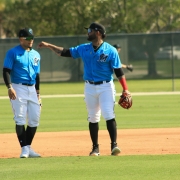
Jonathan Villar, right, works with Isan Diaz on the first day of spring training. Villar, an infielder, could end up in center field. (Craig Davis for Five Reasons Sports)

5 Marlins Roster Tidbits as Summer Camp Continues

The Miami Marlins have split their 60-man player pool workouts between Marlins Park and their facility in Jupiter, FL. While there’s been some movement back-and-forth by a few players, for the most part, players expected to be on the 30-man Opening Day roster are practicing at Marlins Park. There’s nothing set in stone yet, but there’s certainly growing clarity for the Marlins roster.

Here’s a look at five tidbits from recent media availabilities that are clues to the Marlins roster on Opening Day.

Jonathan Villar’s Versatility

The Marlins roster received a significant upgrade when the team landed Jonathan Villar this offseason.

In 2019, Villar slashed .273/.339/.453 and posted a 4.0 WAR over 162 games for Baltimore. He started 158 of them at either second base or at shortstop. Villar brings durability, defensive acumen and consistent offensive production.

“When you trade for Jonathan, that’s one of those moves as a manager that you’re like ‘Yes’ right away,” Marlins manager Don Mattingly said. “He gives you a guy up top. He’s a switch-hitter, power and average, steals bags. A guy that’s exciting up top.”

Defensively, though, it’s unclear what position Villar will man day-to-day.

According to Mattingly, Villar could bounce “back and forth between centerfield, second base, shortstop and DH.” He also has experience playing third base.

Villar said he’s “here for the team” and the possibility of playing multiple positions is one he’s ready for.

“You have to prepare mentally and physically every day. I’m prepared for whatever comes.”

Villar admitted some discomfort working in centerfield and said judging line drives has been particularly difficult early on. However, his spot in the lineup is all but assured.

“I still like him up top in the order,” Mattingly said, citing Villar’s combination of power and speed. The addition of the DH to the National League simplifies things for the Marlins, as Villar is an option there.

Marlins Roster: Fifth Starter Competition

Prior to Spring Training’s COVID-19 shut down, the frontend of Miami’s pitching rotation seemed set. While he hasn’t announced the Opening Day starter, Mattingly admitted they’ve settled on one.

The assumption at this point is that 2019 All-Star Sandy Alcantara will get the Opening Day nod in Philadelphia. From there, it’s likely that Caleb Smith, Pablo Lopez and José Ureña will follow in some order.

Mattingly mentioned the team leans toward a regular five-man rotation. They’ve kicked around the idea of piggybacking but have ruled out a six-man set.

“I think we will probably try to settle on five [pitchers] and feel good about that, knowing that we have depth moving forward with the other guys,” Mattingly said of the staff.

The fifth spot candidates are: Jordan Yamamoto, Elieser Hernandez, Robert Dugger and Nick Neidert.

While most seemed to view it as a two-man race, Mattingly was quick to add the 23-year-old righty into the mix. He said Neidert’s in a “position to stay.”

In five minor league seasons, Neidert sports a 3.20 ERA, 1.14 WHIP and an 8.1 K/9 rate over 460.2 innings pitched. He features a 90-93 mph sinking fastball that pounds the bottom of the zone. His deceptive delivery can fool hitters.

In six innings pitched this spring, Neidert gave up only one earned run. Yamamoto surrendered three earned runs over eight innings pitched. Hernandez gave up six earned runs in his 11 innings. Dugger was the best of the bunch this Spring, not giving up any runs over 9.2 innings of work.

Isan Diaz

Don Mattingly came out on Wednesday in support of Isan Díaz as not only the Marlins current second baseman, but also the second baseman of the future.

“He’s the guy,” Matting said. That’s reassuring for the 24-year-old Puerto Rico native, especially considering his struggles in 2019.

After a rousing debut that saw Diaz connect on a home run against Jacob DeGrom, much to the delight of his father in the stands, hitting didn’t come as easily for him as it did in Triple-A. Diaz finished his 2019 stint with the Marlins with a .173 batting average and .259 on-base percentage in 201 plate appearances.

The struggles continued this spring, as he managed to slash just .103/.235/.103 over 34 plate appearances.

“We look at Isan as our second baseman,” said Mattingly. “Not only now, but we think he’s going to be the second baseman of the future.”

This vote of confidence comes after the Marlins brought in a productive offensive force in Villar that could play Diaz’s position.

“His track record shows that he’s gonna hit” Mattingly said. The manager acknowledged that it wasn’t great for Diaz last year, but that he “had spurts, had moments.”

Mattingly likened Diaz to Brian Anderson as some who “sees the ball well, gets himself good pitches to hit. Sometimes maybe a little too passive, but knows the strike zone, is capable of using the whole field, has got a clean swing.”

Learning from these experiences will be key for Diaz. He’s viewed as the second baseman right now, but an extended struggle may force Mattingly’s hand in a truncated season.

Marlins Roster: Bullpen Shakeup

Last season, the Marlins featured one of the worst bullpens in MLB. Miami relievers posted the fifth-worst ERA (4.97), strikeout-to-walk ratio (2.11) and save percentage (55.1). Their WHIP (1.45) was seventh worst. Relievers blew 22 save opportunities and surrendered a .235 batting-average-against and .343 on-base percentage.

“You look at our overall bullpen performance, and it was not good,” said Marlins president of baseball operations Michael Hill in December.

The biggest addition for the bullpen in 2020 was 35-year-old Brandon Kintzler. The 11-year MLB veteran signed a one-year, $3.25 million deal with the Marlins.

Kintzler has taken a mentor role with this young group. He’s stressed value of routines and expressed that “this generation throws way too much” and that they’ll have to “figure out how to be a bullpen guy the big leagues.”

The bullpen turnover has also seen the addition of 31-year-old Brad Boxberger. Boxberger has 77 career saves, 3.59 ERA and 1.30 WHIP over MLB eight seasons, including a league-leading 41 with Tampa Bay in 2015. In 2018 with Arizona, he registered 32 saves.

Among the other additions stands Yimi Garcia. The 29-year-old five-year MLB vet posted a 3.61 ERA and 0.87 WHIP over 62.1 innings pitched with the Los Angeles Dodgers. A power arm, Garcia throws strikes and avoids walks, two things that will help this bullpen.

These veterans will help the development of younger arms like newcomers Stephen TarpleySterling Sharp, Alex Vesia and Nick Vincent. They’ll join incumbent relievers Jeff BrighamAdam ConleyRyne Stanek and Drew Steckenrider.

Kintzler is the presumptive closer come Opening Day. Mattingly also heralded Boxberger as one of the experienced arms in the ‘pen. Garcia impressed this spring, and Sharp is a Rule 5 pick who will need to be on the Marlins roster to be kept.

Mattingly also seems high on Vesia, the left prospect who sported a 41 scoreless inning streak recently.

“There’s plenty to like. Everywhere he went he had success.” Mattingly said Vesia “pitched with confidence” & “has some moxie about him,” noting “He’s on the attack. He’s not afraid. He’s a strike thrower.”

Monte Harrison

Heading into Spring Training, Monte Harrison stood among the options for centerfield. He competed with Lewis Brinson and Magneuris Sierra, among others, for the spot.

Over 27 plate appearances before the COVID-19 shut down, Harrison swung the bat well. He slashed .364/.481/.500, had six RBI, three doubles and a team-leading six stolen bases.

“Monte looks good,” Mattingly said. “He’s swung the bat good here. Plays with energy, plays fast. He’s aggressive.”

Mattingly called Harrison a “mega-talented kid.” The 24-year-old came to Miami as part of the Christian Yelichdeal and has a lofty ceiling. His combination of speed and strength reinforce his all-around tools. He has an 84 percent success rate with stolen bases over his minor league career and could be a 30-30 guy at the Major League level.

“Monte’s worked really hard to continue to improve,” Mattingly said.  “And he’s going to continue to improve and get better. We’re happy with the strides he’s been making. Obviously, the new summer camp puts him back in the equation.”

Max Meyer

Max Meyer Throws First Bullpen for Marlins

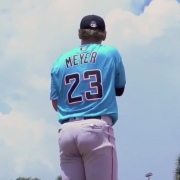
Max Meyer toed the rubber for the first time in a Marlins uniform on Tuesday. Miami’s most recent first round pick, Meyer joined the 60-man player pool after signing his contract. As part of the pool, Meyer joined the workouts in progress at the team’s training facility in Jupiter, FL.

“The juices were flowing a little bit being the first time back on the mound and especially in the Marlins uniform was pretty special,” Meyer said of the afternoon session. “It was really fun to be out there for the first time in uniform.”

Max Meyer Adds Another High-End Arm to the System

Meyer became the latest in Miami’s line of high-end arms in the system. The 21-year-old sports a fastball that touches 99 miles-per-hour and tops out at 102 MPH. The “out” pitch, though, is a devastating slider. According to Keith Law of The Athletic, Meyer was “the most major-league ready player in the draft.”

Similar sentiments were echoed by Marlins director of amateur scouting DJ Svihlik. “That’s the most athletic college pitcher in this Draft, with the most electric stuff, and he’s just about Major League-ready.”

The Marlins took Meyer out of the University of Minnesota. As a member of the Golden Gophers, he posted a 2.13 ERA with 11.4 K/9 against 2.5 BB/9 over 148 innings in his career. Prior to the COVID-19 shut down, he pitched 27.2 innings with a 1.95 ERA.

There were some concerns with Meyer’s size. (He’s listed at 6-foot, 185 pounds, but says he’s added weight since). But he profiles with favorable comps to former CY Young winner Tim Lincecum and 3-time All-Star Roy Oswalt.

Being associated with those names, as well as the possibility of a quick MLB debut, could be seen as added pressure, but Meyer doesn’t feel that way.

“I don’t really think about that too much honestly,” Meyer admitted. “I can’t control any of that, so I’m just gonna keep doing what I have been doing, working out, throwing. I’ll be ready for whatever happens.”

JJ Bleday Reacts to Meyer’s Bullpen Session

Meyer’s first bullpen session was limited to 20 pitches, which he said were mostly fastballs with some changeups mixed in.

Fellow top-prospect JJ Bleday stood in on a few of Meyer’s pitches and came away impressed.

“The first thing I noticed right off the bat was how athletic he is,” Bleday said. “He’s got confident body movements. He pounds the zone, and he’s pretty calm, cool, collected on the mound. As a position player that’s what I like to see out of a pitcher.

“It was just fun standing in on him,” Belday said, who never faced Meyer in college, “that was cool.”

Bleday complimented Meyer’s athleticism, saying it “speaks volumes. You don’t want to be just a pitcher, you want to be the guy that makes that play when the guy drops a bunt and he’s definitely got that ability and that athleticism.”

Much of Meyer’s athleticism comes from his experience as a two-sport athlete. Meyer grew up in Minnesota and spent his whole life playing hockey. In college, Meyer would spend his winter breaks playing hockey every day.

“It’s definitely a big part of my life and I feel like I kind of bring that bulldog mentality on the mound. I was a pretty physical player in hockey, so I kinda get fired up when I’m out on the mound.”

Among the Other Prospects

In Jupiter, other top pitching prospects surround Meyer. Sixto Sanchez, Edward Cabrera, Jorge Guzman and Braxton Garrett all pop the catcher’s mitt with velocity.

“I’ve been looking at the arms and I feel like the balls just fly out of these guys’ hands. It’s unbelievable honestly,” Meyer said of the other pitchers. “There’s definitely some good competition to throw against.”

Meyer admitted that draft day was a blur and called meeting Marlins CEO Derek Jeter “unbelievable. I’m so happy to be a part of this organization led by all these top guys up here. It’s been unbelievable.”

There’s no doubt Max Meyer features as a major part of Miami’s future, be it as a starter or closer. He joins a prolific set of pitching prospects who have the Marlins’ outlook on the rise.

“It’s a fun group of guys,” Meyers said of those in Jupiter. “They got a lot of good arms here and some good bats, so it’s gonna be fun.”

Mattingly's media availability

5 Takeaways from Mattingly’s Media Availability

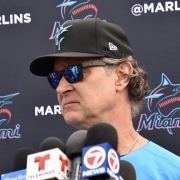
On Monday afternoon, the Miami Marlins made manager Don Mattingly available to local media. Touching on a number of interesting topics, Mattingly’s media availability lasted nearly 30 minutes via Zoom.

Here’s a look at 5 Takeaways from Mattingly’s Media Availability.

Mattingly’s Media Availability: COVID-19 Concerns

MLB, as well as the NBA, MLS and NHL, is trying to get games going in the safest way they can manage. Some players, like Dodgers SP David Price, Rockies OF Ian Desmond, Nationals 1B Ryan Zimmerman, and Braves SP Felix Hernandez and OF Nick Markakis, have opted out of the 2020 season, citing COVID-19 concerns among other reasons. The Marlins, who are nestled in a current COVID-19 hotspot, have been measured with their precautions and procedures.

Some of those concerns were addressed during Mattingly’s media availability.

“We see the news,” Mattingly said. “[But] we haven’t had that feel here, haven’t had that vibe that guys are nervous about playing. Maybe it’s just our age or our group.”

Mattingly went on to say the entire team had testing done for the virus Monday but noted they “feel fairly safe.”

He explained the team is taking precautions seriously, maintaining social distance and wearing masks when possible, and using hand sanitizer. Mattingly also indicated that should the test results take too long, or the results themselves show a spread, the team could shut down its facilities like the Nationals and Astros.

“I feel fairly confident,” Mattingly said about the prospect of the 2020 season. “I feel like there’s still some kinks that we’re working out with testing and getting results back. But I am confident that we’ll get that together and get this thing off the ground.”

Prospects On the Rise

The Marlins 60-man player pool featured a number of the franchise’s high-end prospects. While many of those players are still a ways away from the big leagues, some have been invited to Marlins Park for the summer training camp.

Both Jesús Sánchez and Lewin Díaz stand among Miami’s top-10 prospects and both arrived at Marlins Park on Monday. Sanchez sports a smooth left-handed swing with power potential as a right fielder. Diaz towers as a first baseman at 6-foot-4 and features serious power in his bat.

“You feel good about both of these kids,” Mattingly said of Sanchez and Diaz. “Both are physical kids that got a pretty good feel for hitting.”

During Mattingly’s media availability, the manager hedged on whether either, or both, would make their MLB debut this season.

“You know sometimes that timetable can shift a year here or here or there, but I like both of these guys. I’m pretty confident both are going to be successful.”

One prospected who’s on the short-list to make the active 30-man roster is lefty relief pitcher Alex Vesia. The 24-year-old impressed by posting a 1.62 ERA with 138 strikeouts over 100 innings while advancing to Double-A during his first two pro seasons.

“Everywhere he went he had success,” Mattingly said. Miami’s manager noted Vesia pitches “with confidence” and “has some Moxie about him. He’s on the attack, he’s not afraid, he’s a strike thrower. He’s looked really good.”

Pitching through Spring Training this March, Vesia sported a nearly 41 scoreless innings streak that caught people’s eye. He could be part of a revamped bullpen that desperately needed an upgrade.

Last season, the Marlins featured one of the worst bullpens in all of MLB. Miami relievers posted the fifth-worst ERA (4.97), strikeout-to-walk ratio (2.11) and save percentage (55.1). Their WHIP (1.45) was seventh worst in MLB.

Jonathan Villar’s role

The Marlins added utility infielder Jonathan Villar this offseason. The move came with questions, though, as Miami features regulars at all of Villar’s positions.

Villar performed at a high rate for the Orioles over the last two seasons. In 2019, he slashed .273/.339/.453 and posted a 4.0 WAR over 162 games for Baltimore. He started 158 of them at either second base or at shortstop. Villar brings durability, defensive acumen and consistent offensive production.

One of the major storylines heading into Spring surrounded Villar’s role with the club. The addition of the DH to the National League simplifies things.

“I still like him up top in the order,” Mattingly said, who views Villar as an offensive sparkplug. According to the manager, Villar could bounce “back and forth between centerfield, second base, shortstop and DH.”

Although the team lists Villar as an infielder, Mattingly indicated Villar continues to see work in centerfield. The team, though, had hoped to get him more reps there during Spring Training.

Ballpark Changes

Marlins Park experienced renovations this offseason, with the addition of an artificial playing surface and altering the dimensions.

Offseason additions of players with a little pop, like Villar, Jesus Aguilar, Corey Dickerson and Matt Joyce, will help exploit these changes.

Mattingly noted the organization looks for players who can hit first, with power potential as a secondary concern. They team wants to avoid players with high strikeout rates and big power. They’d rather someone who is “productive in a lot of different games in different ways.”

Between the new dimensions and the new hitters, Mattingly did say they expect to more home runs this season. He referenced Villar hitting over 20 home runs last season, as well as Aguilar’s power. He also mentioned Jorge Alfaro and Brian Anderson’s development as hitters.

“I think the ballpark obviously will play just a tick smaller,” he said, noting it’s not playing like a hitter’s park during recent batting practice sessions. “I think the park plays fair.”

Mattingly’s Media Availability: The Schedule

The Marlins face one of the most difficult schedules in MLB for 2020. This gauntlet features six teams who were above .500 last season, and only two teams who were below.

“You got good teams you’re going to face with the American League East. We always deal with Tampa, who are obviously really good this moment. Yankees are always good, Boston’s always good. Toronto’s young and coming [and] Baltimore’s a little bit like us.

“Your main thing is: Get yourselves ready to play.”

Despite the difficult slate, Mattingly expressed the team’s confidence. The sprint metaphor for this season seems apt. While the best teams usually win out in a 162-game season, in a 60-game stretch, anything can happen. Even the 1993 Marlins won 30 games over a 61-game sample during their expansion season.

“In a 60-game season, there is a lot of momentum. You go 8-4 out of the gate, you’ve played 20 percent of your season, and you put pressure on teams.”

The Marlins will open the 2020 season on in Philadelphia, then play a home-and-home four-game set with Baltimore.

“I know we’re gonna be playing good teams,” Mattingly said. “Everybody has a chance to in this scenario.”

Mattingly said his staff has largely settled on an opening day starter, but he did not name the pitcher.

Most assume it will be 2019 All-Star Sandy Alcantara taking the mound on July 24th. After Alcantara, the Marlins should roll out some variation of Caleb Smith, Pablo López, José Ureña and either Jordan Yamamoto, Elieser Hernández or perhaps prospect Nick Neidert.

Mattingly mentioned the team has talked about a regular five-man rotation. They’ve also kicked around the idea of piggybacking but haven’t discussed going to a six-man set.

Piggybacking could have four starters on limited pitch-counts (maybe 75 or so), followed by three or four long relievers with a pitch-count around 50. This model is common in the lower levels of the minor leagues. The team could implement a piggybacking tandem with just the fifth slot in the rotation.

“I think we will probably try to settle on five [pitchers] and feel good about that, knowing that we have depth moving forward with the other guys,” Mattingly said of the staff.

During Mattingly’s media availability, he went on to discuss how the truncated nature of the schedule limits his ability to be patient with struggling pitchers and hitters.

“You don’t have time to like try to search for it and try to milk guys along, get guys in the groove. You’re going to look for guys to get in the groove right away. And you’re going to be making some decisions based upon some early results with guys, which may be fair or unfair but that’s the way it works when you’re in a pennant race. You’re playing guys that are hot guys are getting it done.”

“We need to win every game. You got to play like you’re gonna win every game,” Mattingly said of the team’s mindset for 2020. “Every game is important, every play is important, every out is important, and just go after it in that way.”

Marlins roster

5 Takeaways from the Marlins Roster Reveal

The Miami Marlins are faced with a difficult task in 2020, though there are plenty of reasons to watch the team this season. The team has one of the most difficult schedules in MLB. Over the weekend, the Marlins roster reveal began with the announcement of 57 of the 60 spots for their player pool.

But now that Miami’s 60-man set for the 2020 season has been announced, it’s time to take a look at 5 takeaways from the Marlins Roster Reveal.

Marlins Roster: Pitching Prospects in the Pool

Miami sports one of MLB’s strongest farm systems. While there are plenty of solid bats in the minors, the strength of the system sits on the mound. The team’s top prospect, Sixto Sanchez, is among the 60 players in the 2020 pool.

While Sanchez might not break camp with the team, the 21-year-old right hander could very well make his MLB debut this season. The combination of command and stuff makes Sanchez one of the best pitching prospects in all of baseball. Likely headed to Triple-A Wichita after Spring Training, he had a shot at the bigs in 2020.

The other top-end pitching prospects in the pool include: RHP Edward Cabrera, LHP Braxton Garrett, RHP Jorge Guzman, RHP Jordan Holloway, RHP Nick Neidert and LHP Trevor Rogers. It’s unlikely all of these players make their debut, especially considering it’s unclear what the 2020 season will do for a player’s service time.

Cabrera, Garrett, Neidert, Rogers and Sanchez are all among the Marlins’ top-10 prospects, according to MLB Pipeline. While Miami’s starting rotation seemed all but set by the time Spring Training was postponed, there’s a shot that Neidert, the 23-year-old righty who came over in the Dee Gordon deal, could steal a spot in the rotation.

Marlins Roster: Positional Prospects in the Pool

Although the Marlins farm system is loaded with excellent arm talent, there are a number of position players who are high-end talents and future franchise cornerstones. JJ Bleday, Jazz Chisholm and  Jesús Sánchez are numbers two, three and four, respectively, among the Marlins’ top prospects.

All three are 22-year-old left-handed hitters. It’s only a matter of time before they make their MLB debuts. Having them among the 60-player pool affords Miami the option of bringing them up. Chisholm seems the closest to the Majors at this point, considering his position at shortstop, as well as his power and speed.

The other top position prospects in the pool are José Devers, Lewin Díaz, Jerar Encarnacion and Monte Harrison. At 23-years-old, Diaz sports a power left-handed bat that could be a fixture in the Marlins lineup for years to come.

Harrison is primed to break camp with the team this summer. At 24-years-old, the centerfielder features all-around tools, including speed, arm-strength and defense. During Spring Training, Harrison slashed .364/.481/.500 over 22 at-bats. He also registered six stolen bases and should push Lewis Brinson for a starting spot.

Devers and Encarnacion are unlikely to break camp with the club, though Encarnacion projects as a future DH.

Marlins Roster: Options at DH

With the addition of the designated hitter to the NL, the Marlins find themselves with an extra bat for their lineup. This will simplify manager Don Mattingly’s lineup construction. The team’s free agent signings seem prescient now that they can include a DH every day.

The Marlins added Jesús Aguilar, Matt Joyce and Jonathan Villar this offseason, and each one can man the DH. Interestingly, Miami lists Villar as an infielder. This may indicate he’s no longer being considered for an everyday spot at centerfield. Traditionally a middle infielder, Villar could compete with Isan Díaz and  Miguel Rojas for their spots at second base and shortstop.

Should Aguilar win the job at first base, Mattingly could turn to  Garrett Cooper. Cooper has struggled with injuries throughout his Marlins career, so DH might suit him well. Other options for DH include: Harold Ramirez, Sanchez and Encarnacion.

Free Agent Snubs

The Marlins spent some money this offseason, bringing in quality veterans to help speed up the rebuilding process. Among those signees was 3-time All-Star Matt Kemp, who the Marlins signed to a minor-league deal in the offseason, and “switch-pitcher” Pat Venditte.

Kemp came to camp as an option for both outfield and first base. Unfortunately, the 14-year vet didn’t make much of an impression during spring training, where he slashed just .143/.200/.143. Kemp may benefit from the new DH rule in 2020, but it’ll be with a different team.

Venditte signed a minor-league deal with Miami this offseason. The ambidextrous Venditte can throw with either hand for the Marlins, thus the “switch-pitcher” label. But he’s had limited success in the majors during his career. His signing was seen as a potential solution to MLB’s new three-batter minimum for relief pitchers.

Among the top prospects that did not make the Marlins roster pool are: Peyton Burdick, Victor Victor Mesa and Kameron Misner.

Alternative Training Site

The Marlins are one of the luckiest teams in MLB, despite being nestled in a state riddled with coronavirus cases. Miami’s spring training complex, Roger Dean Chevrolet Stadium, is in nearby Jupiter, FL. This will be the team’s alternative training site

The majority of the players in the roster pool will report to Marlins Park for training. However, nearly 20 of them will instead make their way to Jupiter. The players assigned to Roger Dean are unlikely to make their MLB debut in 2020, but will see plenty of personal development.

Among the players reporting directly to Jupiter are: C Will Banfield, Bleday, Cabrera, Devers, Lewin Diaz, Encarnacion, Guzman, Holloway, RHP Humberto Mejia, Jesus Sanchez and Sixto Sanchez.

Having those prospects in Jupiter will allow the team to continue the training for them. Intra-squad games and practices will be allowed. This is especially valuable considering the likelihood of a minor-league season remains low.

First-round draft pitch Max Meyer will also be sent to Jupiter for the summer training camp. Four of the Marlins’ top prospects (Chisholm, Harrison, Neidert and LHP Alex Vesia) are among the 40 who’ll start training at Marlins Park.


2020 Marlins

5 Reasons to Watch the 2020 Marlins

MLB and the MLBPA finally got it together. The public had long since turned on billionaires and millionaires squabbling amid a global pandemic, unprecedented unemployment and pushes for social change and justice. Reports flooded out once the two sides agreed to a semblance of a season in 2020. Now, baseball fans can turn some of their attention to what was once the national pastime. And South Florida can support the 2020 Marlins, because, hey, you never know.

The Miami Marlins have struggled to find their footing in South Florida despite a pair of World Series championships. Years of incompetent ownership, boarding on villainous at times, gave way to a new group seeking to reshape the franchise’s fortunes.

The Marlins have transformed their operation, not only on the field but also in the community. The team sports a diverse set of voices from CEO Derek Jeter to GM Mike Hill and COO Caroline O’Conner. They’ve been active during the pandemic, participating in food distribution drives and other community outreach programs.

On the field, the Marlins are coming off a 105-loss season, but the future is bright. Heady trades and considered free agent signings have helped retool the farm system, which is now considered among the best in the league. The Major League product should be improved as well.

With a new season on the horizon, here are five reasons to watch the 2020 Marlins.

1 – 2020 Marlins Schedule Sprint

The schedule for the 2020 Marlins will be no joke. The team has amongst the most difficult schedules across baseball’s new landscape.

Miami will face their NL East counterparts 40 times. They’ll face AL East opponents the other 20. Last season, the Marlins posted a 24-52 record against the NL East. Their only winning mark came versus Philadelphia (10-9). The Marlins had losing records against Atlanta (4-15), the Mets (6-13) and Washington (4-15). Also, Miami was swept by the Tampa Bay Rays (0-4).

For 2020, this schedule will be a gauntlet. The defending champion Nationals may have lost their MVP candidate (Anthony Rendon), but they still sport three aces. The Braves built a strong team with stars. And the Phillies spent aggressively in free agency, while the Mets hold a loaded pitching staff.

Tampa Bay won 96 games in 2019 and sport three aces of their own. The Yankees have perhaps the deepest roster in the AL. Oh, and after winning 103 games, they added Gerrit Cole, who’s coming off a 20-5, 2.50 ERA, 326-strikeout season.

Boston is retooling its roster and neither the Blue Jays nor the Orioles can say they’re more talented than Miami. That said, six teams on the Marlins schedule averaged 93 wins last season.

2 – 2020 Marlins Youth Movement

The Marlins have a talented young core. Those players are being paired with savvy veteran additions, while top-shelf prospects near the big leagues. All this combined for Miami’s manager, Don Mattingly to say the 2020 Marlins will “make some noise.”

Miami’s roster holds a number of young, capable players. Isan Diaz, Jorge Alfaro and Brian Anderson all look like foundational talents. The pitching staff sees the likes of all-star Sandy Alcantara take the hill every fifth start. Caleb Smith and Pablo Lopez demonstrate the depth of the rotation.

These players will soon be supplemented by prospects. Monte Harrison, Jazz Chisholm, Lewin Diaz and Jesus Sanchez are all nearing the bigs. Jerar Encarnacion and JJ Bleday, among others, are sharpening their skills in the minors and have bright futures.

Pitching prospects like Sixto Sanchez, Edward Cabrera, Braxton Garrett and the newly drafted Max Meyer have the franchise’s fortunes on the rise.

The team added utility sparkplug Jonathan Villar and outfielder Corey Dickerson to provide veteran leadership and production.

Although an expanded 30-man roster, which will be reduced as the season progresses, could see some of these prospects make their Major League debuts, it’s unlikely for most. Players will accrue a full year of service time in this abbreviated season. This may keep the Marlins from calling up some of these prospects in order to maintain an extra year of contract control.

3 – Universal DH

It’s a long time coming for the National League, but the Universal DH will finally be deployed across the baseball landscape. Although some purists see this as a negative, the Universal DH will certainly help the 2020 Marlins. (Here are 5 Reasons the Marlins Benefit from a Universal DH.)

Sure, the Marlins have had success in the past with pitchers at the plate, but not recently. Long gone are the days of Chris Hammond and Dontrelle Willis. Jose Fernandez connected on two career home runs, but it’s been more than four years since a Marlins pitcher hit one out.

Since 2015, Marlins pitchers rank 14th out of 15 NL teams in On-Base Percentage (.137) with over 1515 Plate Appearances. In addition, they sport the highest strikeout rate of all NL teams (45 percent).

Among the free agent signings for the Marlins this year, outfielder Matt Joyce and first baseman Jesús Aguilar could both fill this role. If Aguilar mans first base instead, Garrett Cooper could see time at DH. Signing veteran catcher Francisco Cervelli could also mean that Alfaro will get a break from catching duties for a turn at DH.

All of this can only help a lineup that connected on the fewest home runs and second-fewest runs scored in baseball last season.

4 – New Rules

One of the complaints against baseball has long been the games are too long. In recent years, MLB has instituted certain rules to accelerate the pace of play, including limiting the amount of mound visits a team can make. But playing without a clock means games could last for hours beyond the normal window of time.

This season, in an effort to reduce the number of pitching changes and, in turn, cut down the average time per game, MLB instituted a rule change that requires pitchers to either face a minimum of three batters in an appearance or pitch to the end of a half-inning, with exceptions for injuries and illnesses.

In addition, Jon Heyman of MLB Network reports that MLB will implement a rule in which extra innings games will feature innings starting with a runner on second base. This will expedite the ending of games given that the schedule will be so tight this year. Long games will create greater problems this year than they normally would.

The runner-on-second rule has been in place in the minors for two seasons. It premired in the World Baseball Classic, then was tested in the Gulf Coast and Arizona Leagues. In 2018, all minor leagues adopted it.

Under the rule, the runner at second will be the player in the batting order position previous to the leadoff batter of the extra inning. So, usually, the player who made the last out in the previous inning or a pinch runner for that player. If the placed runner scored, it’s considered an unearned run.

The Marlins have decent speed up and down the lineup, and an expanded roster would mean even more speed for Mattingly to deploy. This could help the Marlins improve on 7-9 record in extras last year.

5 – You Never Know

An MLB team has gone from worst to first 13 times since 1990. Despite winning two World Series championships, the Marlins have never won the NL East. They might need to do so to ensure their postseason spot.

In their 27-year history, the Marlins had 11 years when they started the season’s first 60 games at .500 or better. Last season, their record at the 60-game mark was 23-37. Teams won’t have the luxury of a slow start to this season since it’s a sprint.

Washington went from a 19-31 record through 50 games last season to a World Series championship, so strange things have happened before. Even the expansion Florida Marlins had a 61-game stretch in 1993 where they won 30 games.

Unfortunately, MLB didn’t expand the playoffs from 10 teams to 16, which had been discussed in prior iterations of the potential deal with the MLBPA. It’ll be three division winners plus two wild cards per league in the postseason.

For the 2020 Marlins, they’ll want to target 35 wins or so for a possible playoff berth. It won’t be easy, considering the schedule. If the Marlins find themselves out of contention as the trade deadline nears, they could flip some of their veteran talents, like Villar, Aguilar or new closer Brandon Kintzler, for prospects to help the rebuild.

Universal DH

5 Reasons the Marlins Benefit from a Universal DH

Amid the contentious talk of Major League Baseball playing its 2020 season is a rule change that some traditionalists object to: a Universal DH. While some National League teams would have roster work to do in order to address this contingency, the Miami Marlins are not among them.

The Designated Hitter (DH) is something the American League adopted in 1973, and now it appears as if the National League may add it in advance of the new collective bargaining agreement for 2022. Players know it can prolong careers, while general managers see it as an opportunity to prevent pitchers from unnecessary injury exposure in the batter’s box or on the base paths.

Recast in the light of this development, offseason moves from the Marlins now seem prescient. The addition of hitters like Jesus Aguilar and Matt Joyce, even Matt Kemp, point to potential candidates at the position.

Sure, the Marlins have had success in the past with pitchers at the plate, but not recently. Long gone are the days of Chris Hammond and Dontrelle Willis. Jose Fernandez connected on two career home runs, but it’s been more than four years since a Marlins pitcher hit one out.

Since 2015, Marlins pitchers rank 14th out of 15 NL teams in On-Base Percentage (.137) with over 1515 Plate Appearances. In addition, they sport the highest strikeout rate of all NL teams (45 percent).

Should MLB come to an agreement with the Players Association for a truncated 2020 season, and should that agreement include this rule change, here’s a look at five reasons a Universal DH will benefit the Marlins.

Universal DH: Helps Solve the Outfield Logjam

The Marlins have 10 players for three positions. Of those 10, one, either newly signed Jonathan Villar or the returning Brian Anderson, will man third base. Anderson is the odds-on favorite to start in right field. Free agent addition Corey Dickerson will probably patrol left, though Miami manager Don Mattingly may elect to sit Dickerson versus left-handed pitching.

That leaves seven players for one spot. Even with an expanded 30-man roster and a 20-man taxi squad, that’s too many outfielders to carry. But with a DH in the lineup, the likelihood of these players sticking with the club increases considerably

Harold Ramirez and Matt Joyce immediately become options for consistent plate appearances. Jon Berti can remain in a super-utility role, and Magneuris Sierra sees his chances of staying with the franchise improve dramatically. Sierra’s out of minor league options and would need to be traded or released if he doesn’t make the team.

This also means the battle for center field, between Lewis Brinson and Monte Harrison among others, might not see the loser banished to Triple-A.

Universal DH: Frees Up First Base

When the Marlins claimed Jesus Aguilar off waivers this offseason, most took it as a signal that Garrett Cooper may be destined for the outfield or the bench. Although Aguilar will need a bounce-back season, the former All-Star put up the best numbers of his career while playing for the Milwaukee Brewers in 2018. In 149 games, he slashed .274/.352/.539 with 35 home runs and 108 RBI.

Injury struggles led Mattingly to imply, back in December, that Cooper’s not an everyday player. In 107 games last season, Cooper slashed .281/.344/.446 with 15 home runs and 50 RBI. He started 66 games at first, and 31 games in right, with two turns at DH.

One of these two is likely the everyday first baseman, while the other can man the DH spot. Matt Kemp saw some time at first during Spring Training, and, at this stage in his career, he profiles more at DH than outfield.

There’s also a longshot for a 23-year-old prospect Lewin Diaz to play first. The six-foot-four Diaz came to the Marlins from Minnesota as part of the Sergio Romo trade last year. He’s a lefty with plenty of pop in his bat.

Universal DH: Jorge Alfaro

Jorge Alfaro landed with the Marlins as part of the J.T. Realmuto trade, coming to Miami with pitching prospects Sixto Sanchez and Will Stewart. In 2019, he connected on 18 home runs and drove in 57 runs over 130 games. Injuries affected Alfaro’s overall performance, but he showed promise handling the pitchers.

The addition of veteran catcher Francisco Cervelli, as well as the option to DH, should help Alfaro avoid some of the nagging injuries that wear on a catcher during a season, even a shortened one. Having Cervelli as a tutor should help Alfaro defensively, where he needs some improvement, and with calling a game.

Positioning Alfaro as DH and Cervelli as catcher immediately improves Miami’s defense. And while Cervelli isn’t known for his plate production, his 19.2 percent career-strikeout rate means he should put the ball in play more often than not.

James Rowson & the Future

Miami added James Rowson to Mattingly’s staff this offseason Not only will the former Minnesota Twins hitting coach be the Marlins bench coach, but he’ll also work with hitting coach Eric Duncan. These two have been tasked with developing a program to improve every level of the organization at the plate. And being from the AL, Rowson is very familiar with deploying a DH.

Last season, Rowson’s Twins hit a league-best 307 home runs. The Marlins? A paltry 146, a league worst. Minnesota sported one of the most potent offenses in MLB, and his signing with the Marlins may prove to be the best offseason addition of the year. The addition of a Universal DH will only aid in that development.

For the future, a prospect like Jerar Encarnación profiles well as DH. Encarnación was one of 13 Marlins prospects selected to participate in Captain’s Camp, and during Spring Training he flashed his potential power at the plate, connecting on an over 400-foot blast in his second at-bat. At 21-years-old, he could still use some minor league seasoning, but the DH spot may speed up his arrival to the bigs.

Yasiel Puig?

Yasiel Puig is on the record stating that the Marlins were among the teams to make him a contract offer. He rejected Miami’s advances, in part, because he wanted a bigger contract. Playing in a city with deep Cuban roots might mean fans would place unrealistic expectations on him.

Puig had an uneven 2019. Overall, he slashed .267/.327/.458 between stints in Cincinnati and Cleveland. Prior to the trade, Puig connected on 22 of his 24 homers for the year. But afterwards, his batting average and on-base percentages improved dramatically (.297/.377).

Having a DH slot would allow Miami to bring in this high-profile name to excite the fan base. If Puig performs well, once fans are allowed in again, there could be an attendance spike not seen since the days of Jose Fernandez on the mound.

Who Should the Marlins Pick First?

Quick Overview

With the 2020 NFL Draft over, the 2020 MLB Draft is now around the corner and the Marlins need to get their first pick right. The Marlins are now in the third year of their rebuild since Derek Jeter took over as CEO in 2017 and he’s done a great job at bringing in talent back into the organization.

The team should draft a pitcher in the first round to make up for trading Zac Gallen and Chris Valimont last season. Gallen was very highly regarded before making his MLB debut with a 9-1 win-loss record and a 1.77 ERA during his 2019 minor league season. Chris Valimont hasn’t seen an inning above A-Ball but he has shown promise during his time in the minors posting a career 3.79 ERA in 156.2 innings pitched.

Who Should the Marlins Draft at #3

The Marlins have the third overall pick in this year’s draft, but who should they use that pick on? My pick would be Emerson Hancock out of the University of Georgia. Hancock is ranked as the fourth-best prospect and the second-best pitching prospect in this years draft. Two reasons why I think the Marlins should draft Hancock over Asa Lacy who is the top pitching prospect in the draft. Velocity and command. Hancock has a better-rated fastball and his command is rated better than Asa Lacy. 

A look at Hancock below courtesy of @BaseballAmerica

Emerson Hancock

Emerson Hancock is a 6’4 right-handed starting pitcher out of the University of Georgia. He was originally drafted in the 38th round of high school by the Arizona Diamondbacks. He features a fastball that he uses to frequently pound the strike zone as well as three offspeed pitches that scouts consider to be “plus pitches” because he has the ability.

His fastball sits around 94-97mph but it can top out at 99mph with movement. Despite not using his changeup much, he is still able to locate it pretty well. His wipeout pitch is his slider that sits around the mid-80s with some nasty break. The only downside to Hancock is that he injured his lat his sophomore year of college.

Scouts compare Hancock to Tigers 2018 #1 draft pick Casey Mize, similar size as well as similar pitch repertoire as well as both missing time their sophomore year of college with injuries.

In my opinion, Hancock is the best pitcher in this draft and the Marlins should take the opportunity to draft him if he is still available at #3, which I do fully anticipate him being available.

A look at Hancock’s knee-buckling pitches below courtesy of @PitchingNinja

Marlins roster

Predicting the Marlins Opening Day Rotation

The Marlins rotation enters the 2020 Spring Training with an abundance of starting pitching options. However, there are only five spots up for grabs, maybe even six if Don Mattingly sees fit. Nonetheless, spots in the rotation are limited but, who would take those spots? Let’s start off with who SHOULDN’T be in the rotation on opening day.

Who Shouldn’t be in The Rotation

First is Jose Ureña. Ureña does have decent numbers as a starter but I don’t think he should even be with the Marlins on Opening Day. He would just be taking a spot from a more deserving prospect such as Sixto Sanchez. A trade would be preferable before the start of the season but if not, another move to the bullpen would be sufficient.

Second would be Elieser Hernandez. Don’t get me wrong, Hernandez was one of our best pitchers last year and when he was called upon to be a starter, he didn’t disappoint. However, I think he should be moved to the bullpen. With his experience as a starter, he could be used in a long-relief type of position while refraining from taking a starter spot from a promising prospect.

 Who Should be in The Rotation (In Order)

Sandy Alcantara should definitely be the Opening Day starter for the Marlins after his All-Star season in 2019. He was electric, exciting to watch, and the fans loved to watch him pitch because more times than not he gave them a performance worth watching. He was the Marlins’ only representative at the 2019 All-Star game in Cleveland.  He finished the season with 3.88 ERA while logging 197.1 innings pitched, 151 strikeouts, and batters hit for a .241 average against him. Not too shabby for his rookie year. A look at Alcantara below. (via @Marlins)

The second spot in the rotation should go to Caleb Smith. Smith had a promising first-half for the Marlins during the 2019 season. In 13 starts he accumulated a 3.50 ERA, 88 strikeouts and hitters were only hitting for a .201 average against him. He was receiving national media attention for the success he was having as the Marlins’ ace before he went down with an injury in early June. After spending a month on the injured list, he wasn’t the same when he came back. Smith finished the season with a 10-11 record, a 4.52 ERA while logging 153.1 innings pitched with 168 strikeouts. Video of Smith below. (via @Marlins)

The third rotation spot should go to Pablo Lopez. Pablo has great stuff and has showed promise when he is on the field. Lopez was placed on the injured list on June 19th and didn’t return to the rotation until August 26th. Before going on the injured list, Pablo was 6-5 with a 4.23 ERA with 73 strikeouts in 76.2 innings pitched, he was doing quite well was showing much promise before going down with a shoulder injury yet again. A look at the movement of Pablo’s pitches below.               (via @AugustineMLB)

The fourth rotation spot should be where Jordan Yamamoto will end up. Yamamoto shined during his first six starts he started with a 4-0 record with a 1.59 ERA in 34 innings pitched with 34 strikeouts. He was also receiving national media attention because of the hot streak he was on during his first six career starts. Towards the end of July, he started to have command issues and his numbers began to spiral downhill which was expected to come from a rookie starting pitcher. Nobody expected his hot streak to last the rest of the season. A look at Yamamoto attached below. (via @MLBPipeline)

The fifth rotation spot in my honest opinion should go to Marlins top prospect Sixto Sanchez. Sixto is ranked as the 5th best starting pitching prospect in all of baseball and is ranked 22nd in MLBPipeline’s top 100. He spent his 2019 season in the minor leagues and he was impressive. In 103 innings pitched, he accumulated an 8-4 record with a 2.53 ERA while striking out 97 hitters. He is a ground-ball producing machine but his ability to control all of his pitches including his offspeed such as a changeup and breaking balls while having plus movement on his fastball that constantly reaches triple digits. Sanchez will be placed on an innings plan and where better place to monitor that the innings plan is being followed than in the major league rotation.

A look at Sixto is below. (via @Jasenelpartido)

Related:

Recap of The Marlins Offseason Before The 2020 Season

The Marlins have had a rather successful offseason despite not reeling in any of the prized free agents. From the start, attracting big free agents such as Gerrit Cole, Stephen Strausburg, and Anthony Rendon was never in the Marlins plans for this offseason. Bringing in veterans on short term deals while upgrading the line-up has been the plan. Low risk, high reward.

Staring The Offseason 

To start off their offseason, the Marlins designated two players for assignment, J.T Riddle, and Tayron Guerrero. J.T Riddle elected free agency while Tayron Guerrero was claimed off waivers by the Chicago White Sox. The Marlins grew weary of Guerrero’s inability to throw strikes consistently. throwing 100mph does no good if it isn’t in the zone. Designating Riddle for assignment was to make room on the 40 man roster.

Adding Bats

After subtracting two players from their team, it was time the Marlins added to their team. The team made a trade with the Baltimore Orioles to acquire Jonathan Villar for Minor League left-handed pitcher Easton Lucas.

Villar hit for a .274 average, 24 home runs, 73 runs batted in, and he stole 40 bases for the Orioles last season. Villar has the speed and power combination that is perfect for Marlins Park especially now that the fences have been brought in. His power side is hitting from the left side and hitting a home run to left field is easier to do than to right field.

Villar can play a multitude of positions including second base, shortstop, third base, and some outfield if he needed to.

Shortly after acquiring Jonathan Villar from the Orioles, the Marlins claimed first baseman, Jesus Aguilar, from the Tampa Bay Rays off waivers. The Marlins needed to fill a power hole in their line up. They ranked last in all of Major League Baseball in hitting home runs and desperately need some power bats in their line up.

Aguilar did not have a spectacular year last season but he does have a reputation to be an elite power hitter like he was in Milwaukee back in the 2017 season. He hit for a .236 average, 12 home runs, and 50 RBIs last season for the Rays.

With the hiring of new hitting coach/offensive coordinator  James Rowson, it’s possible that we see an upstep in production from underproducing hitters like Aguilar.

Hitting the Free Agent Market

After making trades and claiming players off waivers, the Marlins finally dug into the free-agent market. They started off free agency by bringing in strike-throwing reliever Yimi Garcia on a two-year deal. Garcia was previously with the Los Angeles Dodgers and in 62.1 innings pitched, he posted a 3.61 ERA with a .178 opponent batting average against him.

After signing Garcia, the Marlins went and signed more bats. Bringing in outfielder Matt Kemp on a minor league deal with an invite to spring training. Kemp hardly played last season but in 2018 he hit for a .290 average while hitting 21 home runs and driving in 85 RBIs and leading the Dodgers to the World Series.

The first biggest free-agent signing made by this new ownership is the signing of outfielder Corey Dickerson. The Marlins signed Dickerson to a two-year $17.5 million dollar deal. In 2019, Dickerson hit for a .304 average, 12 home runs, and 59 RBIs in 260 at-bats.

The Marlins recently signed veteran catcher Francisco Cervelli to a one year contract. Cervelli will provide a veteran catcher presence and will help develop our young pitchers into potential aces. 

Rule 5 Draft

The Rule 5 Draft wasn’t very exciting this year. The Marlins’ biggest move however from the draft was selecting RHP Sterling Sharp from the Washington Nationals. Sharp is an excellent pickup who will go directly into the Marlins bullpen to start the 2020 season if he is healthy. Sharp produced a 3.53 ERA in 58.1 innings pitched while allowing only ONE homerun. He is a groundball specialist and will prove to be very useful for the Marlins bullpen needs.


Who is a Perfect Fit for Marlins?

The Marlins are determined to sign impact bats to help bolster their lineup of young players this offseason. The only question is who should they sign? There have been reports that the Marlins are interesting in bringing in free-agent outfielders Nicholas Castellanos, Avisail Garcia or perhaps a reunion with Marcel Ozuna. However, in my opinion, the one option that I believe would be more cost-friendly for the club after they burned $22 million dollars to release Wei-Yin Chen would be Yasiel Puig.

Puig hit for a .267 average while belting 24 home runs and driving in 84 RBIs during the 2019 season. His stats may not be eye-opening but for a Miami lineup who struggled to hit for power, it could be the boost they need for more run production. They say hitting is contagious and when Puig gets going, so does the rest of the line-up. (Video credit to @Starting9)


So, why would the Marlins go after Puig when Castellanos, Ozuna, and Garcia are on the table? Puig is from Cuba and Miami who has a vast Cuban population would go well together. Puig has a lot of energy and could provide a spark that the team along with their fans have been missing.

Fans from all over love Puig because of the antics he performs on the field, whether he’s on the opposing team or not, fans cheer him on because of his electric personality. His competitive nature brings some enjoyment and an energy boost to the long nine-inning games. Everyone knows Yasiel Puig, and to be quite honest with you, his name alone could draw in more fans to Marlins Park. 

Whether the team is down or up, Puig plays the game with the energy as if it was Game 7 of the World Series. If the Marlins do take a chance on Puig, he would be the first Cuban born player on the team since Jose Fernandez. Believe me, the Marlins and their fans need a player like Puig. They should not overlook his ability to bring up the energy and to mentor the younger players. Speaking of his energy and the World Series, here’s a video. (credit to @SportsCenter)

He has played on the game’s biggest stage more than once so he has the experience that many players don’t and the Marlins could use that to their advantage in developing their young core. He has been through his failures and has been able to overcome them and he has had his successes. Providing lessons on how to overcome those failures and to sustain those successes would be a huge lesson that Puig would be able to provide.