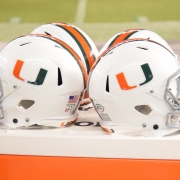
Miami Hurricanes land pair of athletic brothers for ’23 class

The Miami hurricanes received commitments from a pair of brothers on Thursday night. Four-star athlete Robby Washington and three-star linebacker Bobby Washington both committed to the program on Thursday night. This was first reported by Andrew Ivins of 247Sports.

Robby is the eighth overall athlete in the 2023 class, and the 16th overall player in his class from the state of Florida per the 247Sports Composite Rankings. Bobby is the 50th overall linebacker in his class, and the 97th overall player in his class from the state of Florida per the 247Sports Composite Rankings.

Measuring in at 5-foot-10, 170 pounds, Robbie played both the running back and wide receiver positions in high school. As a receiver, he shows tremendous athleticism. He is able to make things happen after the catch, and is able to use that athleticism to make plays. He does a nice job of adjusting to balls in the air, and has tremendous agility when catching the football.

What can Bobby bring to Miami Hurricanes?

Bobby Washington does a good job of tackling in the open field. He can identify a play quickly, and takes good angles in order to make a tackle. The fact that he is a good open-field tackler is important. Matchups are won and lost in the open field. Measuring in at 6-foot-3, 205 pounds, Washington as the agility needed in today’s offensive-minded game of college football. In addition to being versatile, he is also physical. He immediately wraps up and is able to make a sound contact on tackles.

The 2023 Miami Hurricanes recruiting class is continuing to rise the class ranks 19th nationally and third overall in the ACC per the 247Sports Composite rankings. Robby is now the highest-rated commitment in the class.

Overall, the Miami Hurricanes were able to get a pair of good athletes. Robby should add an immediate spark to the offense, while Bobby adds additional physicality to the defense.  Thursday was indeed a successful day for the Miami Hurricanes.


For business window graphics, interior office signage, custom flags, custom banners and sign repair, reach out to SignsBrowardFortLauderdale.

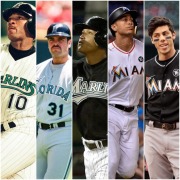
Marlins blockbuster trades

Marlins Blundering History with Blockbuster Trades

The Miami Marlins have long been negatively associated with the term ‘fire sale.’ Too often in the franchise’s history, ownership groups (yes, more than one) gutted a talented roster to save money. The team trafficked in hope with prospect packages, parting with players in their prime. The Marlins sabotaged local support by blundering these blockbuster trades throughout their history.

This week, the book closed on yet another blundered blockbuster. The Marlins designated Isan Diaz for assignment to open a roster spot for the newly signed slugger Jorge Soler. The Yelich deal stands among many failures for the Fish over the years.

There’s no singular reason behind Miami’s seeming inability to “win” these transactions, beyond bad luck and maybe misguided management. Some of the moves paid off in short bursts, but over time, most soured on them.

The Marlins find themselves on the cusp of contention once again and could be nearing another blockbuster trade. These days, Miami’s in a position to bring in the All-Star talent rather than part with it. But so far, the Marlins have balked at the cost of premium prospects demanded by other clubs. Given their blundering history with these deals, it’s easy to understand why.

Marlins First Foray into Blockbuster Trades

The first of (too) many blockbuster trades in Marlins history dates back to the club’s inaugural season. On June 24, 1993, the Marlins made their first in-season trade as a Major League franchise.

Florida acquired 24-year-old All-Star Gary Sheffield and left-handed pitcher Rich Rodriguez from the San Diego Padres. In exchange, Florida sent rookie reliever Trevor Hoffman, as well as minor league arms Andrés Berumen and José Martinez, to the Padres.

Marlins Return on the Trade

Sheffield’s impact with the Marlins was immediate. He became the early face of the franchise, thanks to his bat wag and long balls. He and closer Bryan Harvey were the team’s first-ever All-Stars.

Over parts of six seasons in Miami, Sheffield hit 122 home runs, with a .288 batting average and .970 OPS, and drove in 380 runs. He earned two All-Star berths and won a Silver Slugger. Most importantly, he helped the Marlins win the 1997 World Series.

This information alone seemingly tilts this blockbuster trade in the Marlins’ favor—that is, until you factor in Hoffman’s place among the all-time greats. No one could have predicted Hoffman’s Hall-of-Fame future, something Sheffield’s still waiting on (though he shouldn’t be). It’s not a clear win for the Fish, nor an abject failure.

Unforeseen Cost for the Fish

Hoffman came to the Marlins in the 1992 expansion draft. With the eighth pick, Florida plucked the relief pitcher from the Cincinnati Reds organization. He made the Marlins’ inaugural roster as a set-up man for Harvey. But after just three months (and his first two career saves), Hoffman became the centerpiece in the return package for the Padres.

San Diego put on a fire sale of their own in 1993, trading away Tony Fernandez and Darrin Jackson before dealing Sheffield. The Padres later dealt Fred McGriff and failed to sign draftees Todd Helton and Troy Glaus. They let catcher Benito Santiago go in free agency. (The four-time All-Star signed in Florida and started the franchise’s first game.) San Diego stopped short of trading Tony Gwynn.

New Padres general manager Randy Smith wanted Hoffman as part of the trade for Sheffield. Smith had come to the Padres from the Colorado Rockies, where he’d helped prep for the ’92 expansion draft where Florida had found Hoffman (Berumen and Martinez, too).

Then-Marlins GM Dave Dombrowski offered Berumen, Matt Whisenant, and Darrell Whitmore, but Smith insisted on Hoffman. Florida acquiesced, surrendering a reliever who’d been projected as a catcher in the pros and played shortstop and third base before transitioning to the bullpen.

Hoffman overcame changing positions, injuries, and diminished fastball velocity to become MLB’s all-time saves leader in 2006. With his “Bugs Bunny” changeup as an out-pitch, Hoffman helped San Diego make five playoff appearances, including a trip to the 1998 World Series.

Hoffman finished his career with 601 saves and seven All-Star berths, twice finishing runner-up for the NL Cy Young award. Mariano Rivera broke the career saves record in 2011, but Hoffman’s still No. 2 all-time. The nearest active closer (Craig Kimbrel) remains more than 200 saves away.

The Curious Case of Catcher Mike Piazza

People forget Mike Piazza’s five-game stopover in Miami during the summer of 1998, but it happened. (There’s video proof.) Following the ‘97 World Series championship, the Marlins front office celebrated with the first fire sale in franchise history.

That winter, Florida traded away Moises Alou, Kevin Brown, Jeff Conine, Al Leiter, Robb Nen, and Devon White in a series of deals. For the Marlins, those not-quite blockbuster trades netted just A.J. Burnett, Derrek Lee, and (the original) Jesús Sánchez.

Florida started 13-28, then opted to continue the payroll purge. On May 14, 1998, the oddest of these Marlins blockbuster trades went down. Florida shipped a disgruntled Sheffield, as well as Bobby Bonilla, Charles Johnson, Jim Eisenreich, and Manuel Barrios to the Dodgers for Piazza and third baseman Todd Zeile. LA absorbed $83 million in salaries with the deal.

Piazza played a grand total of five games with Florida. He registered five hits and five RBI over 19 plate appearances before getting flipped to the New York Mets. The Marlins sought to shed even more payroll, having no intention of signing Piazza to an extension.

These blockbuster trades were part of a larger scheme involving TV rights and the franchise’s sale. According to then-Dodgers GM Fred Claire, Fox executives negotiated the trade hoping to incentivize then-Marlins owner H. Wayne Huizenga to sell them his controlling stake in SportsChannel Florida (now Bally Sports Florida), which he did in November of 1999.

On May 22, 1998, Florida traded Piazza to the New York Mets for outfielder Preston Wilson, and pitchers Geoff Goetz and Ed Yarnall. Zeile played 66 games with the Marlins in 1998 prior to a trade that sent him to the Texas Rangers for two minor league pitchers who never made it above A-ball.

Marlins Seed Next World Series with these Blockbuster Trades

For the Marlins, the blockbuster trades in 1997 and 1998 provided the team with the ammunition to make another World Series run in 2003. Burnett and Lee came in those deals, and the Marlins used pieces from the Piazza trade to land a few more. A look at the MLB Trade Trees website shows this move even branches to the 2022 starting rotation, leading to the acquisition of Pablo Lopez.

Wilson headlined the return for the Marlins in the Piazza trade with New York. Wilson proved to be a serviceable player for the Marlins, finishing second in the NL Rookie of the Year running in 1999. Playing parts of five seasons in Miami, Wilson hit 104 homers, drove in 329 runs, and stole 87 bases for Florida.

On November 16, 2002, the Marlins traded Wilson with Vic Darensbourg, Charles Johnson (again), and Pablo Ozuna to the Colorado Rockies for Mike Hampton and Juan Pierre. That trade morphed into something of a three-deal deal involving the Atlanta Braves, who got Hampton two days later. The Marlins took on $30 million of Hampton’s salary but offloaded more than $50 million sending out Wilson and Johnson. The Marlins got Tim Spooneybarger from Atlanta and cash from Colorado.

As for Yarnall, he never pitched for the Marlins, but headlined a trade package to the New York Yankees in 1999. That deal landed Florida third baseman Mike Lowell. Goetz, meanwhile, never made it to the Majors despite being the No. 6 overall pick in the 1997 amateur draft.

The Worst of the Marlins Blockbuster Trades

The worst of the Marlins blockbuster trades over the years is the Miguel Cabrera deal. On December 4, 2007, Florida shipped Cabrera and another franchise-favorite, Dontrelle Willis, to Detroit for a package of prospects

The return included a pair of Top-10 prospects in outfielder Cameron Maybin and left-handed pitcher Andrew Miller. In addition, the Marlins received catcher Mike Rabelo, and right-handed pitchers Burke Badenhop, Dallas Trahern, and Frankie De La Cruz.

Cabrera provided a spark as a rookie for the Marlins’ World Series-winning club in 2003. He ascended quickly, becoming one of the best hitters in baseball. All told, Cabrera played parts of five seasons with the Marlins and finished with four All-Star berths, 138 home runs, and 523 RBI. He slashed .313/.388/.542 with the Fish.

But the penny-pinching of Jeffery Loria and David Samson ultimately outweighed Cabrera’s (and Willis’) production. Cabrera made $7.4 million in 2007 and stood to make $11.3 million in 2008. That figure proved to be untenable for Loria and Co., so they looked to flip Cabrera while the star still had a few seasons of team control.

The Marlins tinkered with their roster following the 2003 World Series. The team had a budding star in Hanley Ramirez, who they’d acquired in the Beckett/Lowell trade with Boston in 2005. This mistakenly led the Marlins to feel Cabrera was expendable. The same was true with Willis, since the team felt comfortable proceeding with young arms in Josh Johnson, Ricky Nolasco, and Anibal Sanchez.

Disastrous Return for Florida

Once Cabrera became available, teams offered the Marlins prospect-laden packages common in blockbuster trades. Negotiations pitted the Los Angeles Angels, Dodgers, and Tigers in a bidding war. From the Dodgers, the Marlins sought pre-arbitration prospects like Chad Billingsley, Matt Kemp, Clayton Kershaw, and James Loney.

Florida reportedly had an agreement with the Angels for Howie Kendrick, Ervin Santana, and Jeff Mathis. The team then approached Detroit, whose owner coveted Cabrera. Tigers (and former Marlins) GM Dave Dombrowski hoped to keep Detroit’s top prospects out of the deal but eventually came to terms once the trade expanded to include Willis.

Then-Marlins president David Samson admitted years later Florida lied to the Dodgers at that point, hoping to land Billingsley and Kershaw. LA didn’t bite, and the Marlins dealt with Detroit.

Despite being highly-touted prospects, both Maybin and Miller flopped with the Fish. Maybin struggled in his first stint, hitting .257 with 151 Ks over 144 games. He’d become a serviceable fourth outfielder, but not in Miami. He won the 2017 World Series with Houston.

Miller posted a 5.89 ERA over 58 games with the Marlins. The team traded Miller to Boston in 2010 for Dustin Richardson, who never pitched in Miami. Miller went on to be a two-time All-Star and win the 2016 ALCS MVP as a reliever in Cleveland.

Badenhop proved to be the best Marlin from this disaster. In four seasons with Florida, he posted a 4.34 ERA. Rabelo played 34 games in Miami, hitting .202. De La Cruz pitched in just six games with an 18.00 ERA. Trahern never made it to the bigs.

Cabrera, meanwhile, enters his 20th MLB season on the cusp of 3,000 hits, having hit more than 500 home runs. He’s a surefire first-ballot Hall of Famer.


Marlins Move Off Stanton’s Contract

Once they agreed to a “landmark” 13-year, $325 million contract, Giancarlo Stanton and the Marlins seemed destined for divorce. The onerous deal hung like an albatross on the franchise. So, when Loria sold the team to Bruce Sherman and Derek Jeter’s ownership group, it was only a matter of time before the club embarked on its latest fire sale.

On December 11, 2017, the Marlins completed another of these blockbuster trades, sending Stanton and cash to the Yankees. In exchange, Miami received infielder Starlin Castro, pitcher Jorge Guzman, and shortstop Jose Devers.

The Marlins cited a lack of organizational depth when shipping off the most productive player in franchise history. Stanton left Miami the career leader in over 15 statistical categories, including home runs (267) and RBI (672). He’s the only player in Marlins history to win NL MVP, doing so in 2017 when he hit a club-record 59 homers.

The player-return for Stanton paled in comparison to his production. Castro, who many assumed would be flipped in another deal, played two productive seasons in Miami before leaving in free agency. Guzman, who once ranked as high as No. 6 in the Marlins system, struggled to make the transition to the Majors (27.00 ERA in 2.2 IP) and is now in the San Francisco Giants system.

Devers came in as the No. 13 prospect for Miami and made his MLB debut last season. The 22-year-old slashed .244/.304/.317 with five RBI and seven runs scored. A shoulder injury sidelined him in July and he’s likely bound for Triple-A in 2022.

The true “win” for the Marlins with this, the most unpopular of the blockbuster trades, was monetary. The move nearly cleared the books for the new owners, with New York assuming about $250 million of Stanton’s contract.

Yelich Trade Ended Completely One-Sided

The same offseason in which the Marlins dealt away Stanton, Miami also shipped off another young slugger, Christian Yelich. While the Marlins had the budding star on a team-friendly contract, Yelich wanted no part of the rebuild. Publicly, the Marlins claimed they wouldn’t consider moving Yelich, or their other controllable young talents in Marcell Ozuna and J.T. Realmuto, but we all know how that turned out.

On January 25, 2018, a month after the Stanton deal, and after fielding offers from several teams, the Marlins dealt Yelich to the Milwaukee Brewers for several prized prospects. The headliner in the return package for Miami was one of baseball’s top prospects at the time, outfielder Lewis Brinson. A local product, Brinson was a consensus top-20 prospect, considered to have both a high floor and a high ceiling given his tools.

The other prospects in the deal were Isan Diaz, Monte Harrison, and Jordan Yamamoto. At the time, Harrison ranked No. 49 overall with Baseball Prospectus and No. 75 with Baseball America. Diaz checked in at No. 85 on Baseball Prospectus’ list. Yamamoto projected as a backend starter in the bigs.

At least a dozen teams were in on Yelich. The Marlins wanted Ronald Acuña Jr. from Atlanta, but the Braves declined. The other team that reportedly got close to a deal with Miami was the Toronto Blue Jays. But Toronto refused to include Vladimir Guerrero Jr. in the return package.

The Marlins found themselves in a difficult position with Yelich in 2018. Although he was locked into a team-friendly deal, the relationship between Miami and Yelich had “soured” and was “irretrievably broken” following the latest fire sale.

Prospects Flop in Another of Marlins’ Failed Blockbuster Trades

Milwaukee presented a prospect package intriguing enough to the Marlins, despite their initial desire to keep Yelich. Miami couldn’t pry away top prospects from other teams but felt Brinson neared that level. Unfortunately for the Fish, he didn’t.

Over four unremarkable seasons, Brinson managed just a .203 batting average with 296 strikeouts over 1,056 plate appearances. Miami finally designated Brinson for assignment on November 30, 2021. The 27-year-old later signed a minor league deal with the Houston Astros.

Harrison never found his footing with the Marlins, either. He appeared in 41 games for Miami, hitting just .175 with a staggering 47 percent strikeout rate. Miami designated Harrison for assignment earlier this month after claiming 29-year-old Yoan López, a right-handed reliever, from the Philadelphia Phillies.

Yamamoto impressed in his initial run with the Marlins, posting a 1.59 ERA through his first six starts. But he flamed out after that. Yamamoto sported a 6.65 ERA over his final nine starts in 2019, then an 18.26 ERA over four games in 2020. Miami eventually traded Yamamoto to the Mets in 2021 for minor league infielder Federico Polanco.

Diaz once looked to be the Marlins’ second baseman of the future, winning the team’s 2019 Minor League Player of the Year award. He hit nearly 100 homers during his time in the minors and raked at Triple-A for the Fish. But that success at the plate never translated to the bigs.

Over parts of three seasons, Diaz posted a .185 batting average, striking out 139 times over 501 plate appearances. Miami designated the 25-year-old for assignment this week. Diaz peaked during his MLB debut, homering off Mets’ ace Jacob deGrom while his father was being interviewed on the TV broadcast.

The Marlins Other Blockbuster Trades

Considering this Marlins franchise has undergone three fire sales (with three different ownership groups), there’s no shortage of blockbuster trades. Over the years, Miami’s traded away an All-Star team, including two players in the Hall of Fame with more headed that way. In those fire sales, the Marlins made moves sending away notable players with the returns being hit-or-miss over the years.

The Beckett Trade

Following their first fire sale in 1998, the Marlins drafted Josh Beckett with the No. 2 overall pick in the 1999 amateur draft. They signed him that September and nearly two years to the day later, Beckett made his MLB debut. Beckett eventually became the staff ace and earned the 2003 World Series MVP after dominating the Yankees on short rest to win that championship.

But two years later, wanting to shed payroll again, the Marlins found a trade partner willing to take on cash. On November 24, 2005, they traded Beckett, Lowell, and Guillermo Mota, to the Red Sox. Florida received highly-touted shortstop prospect Hanley Ramirez, and pitching prospects Jesús Delgado, Harvey Garcia, and Anibal Sánchez.

The kicker was Boston’s willingness to take on the $18 million owed to Lowell. That kept Beckett from going to the Texas Rangers, who offered All-Star third baseman Hank Blalock, one of their two top pitching prospects, Thomas Diamond or John Danks, as well as shortstop prospect Joaquin Arias.

This trade goes down as a “win” for both clubs, considering the cash savings and production for the Marlins and the 2007 championship Beckett and Lowell brought Boston. Beckett would become a three-time All-Star with the Red Sox, finishing second in the ’07 AL Cy Young voting. Lowell earned an All-Star berth and World Series MVP in ’07.

Ramirez went on to win NL Rookie of the Year in 2006 and became the best shortstop in baseball for a short period of time soon thereafter. Delgado and Garcia did little of note with the Marlins, but Sanchez proved valuable. Over parts of seven seasons in Miami, Sanchez posted a 44-45 record with a 3.75 ERA. On September 6, 2006, Sanchez threw one of six no-hitters in Marlins history.

The (Other) Hanley Trade

In 2007, the Marlins built around their budding star, Hanley Ramirez, at the expense of Miguel Cabrera. Ramirez would earn three All-Star berths and finished runner-up for NL MVP in 2009 after leading the league in hitting that season.

But the drop-off from those heights was precipitous. Ownership went all-in on the team entering their new ballpark but quickly pulled the plug in 2012. Ramirez, whose effort (and production) waned, grew disgruntled with his move to third base. He pouted and eventually found himself (and the remaining $37 million on his contract) shipped to the Dodgers

The Marlins sold low on Ramirez but the club had had hopes on contenting just as Ramirez’s play dropped off. Sending nearly $40 million to LA prevented a meaningful prospect return for Ramirez. Miami received pitchers Nathan Eovaldi and Scott McGough. Eovaldi would eventually become an All-Star pitcher, just not for the Marlins. McGough pitched in six games for Miami in 2015, posting a 9.45 ERA. The Marlins waived him prior to the 2016 season.

This trade came two days after Miami dealt Omar Infante and Anibal Sanchez to the Tigers for Rob BrantlyBrian Flynn, and Jacob Turner. This mini fire sale preceded a full roster tear down that winter.

Marlins Win the Ozuna Trade

Wins for the Marlins in blockbuster trades are rare, but this was one. Miami flirted with trading Marcell Ozuna in both 2015 and 2016, with owner Jeffery Loria reportedly having bad blood with Ozuna and his agent, Scott Boras, stemming from Ozuna’s demotion to Triple-A. Boras claimed that was done to stall Ozuna’s service time. Ozuna stayed with the Marlins thanks to backing from (then) new manager Don Mattingly and new hitting coach Barry Bonds. (Yes, that Barry Bonds.)

At least 10 teams showed interest in Ozuna those winters, with the Marlins making offers to both the Texas Rangers and Cincinnati Reds. In 2015, the Marlins neared a deal to send Ozuna to the Seattle Mariners. Miami coveted right-handed pitcher Taijuan Walker and had an interest in left-handers James Paxton and Roenis Elias.

Ozuna stayed though, becoming an All-Star in 2016 and 2017, winning both a Gold Glove and Silver Slugger awards in ’17 after hitting 37 homers with 124 RBI. The Marlins parlayed that success into a franchise-changing prospect package from the St. Louis Cardinals.

Just three days after the Stanton trade in 2017, the Marlins sent Ozuna to St. Louis for pitchers Sandy Alcantara, Daniel Castano, Zac Gallen, and outfielder Magneuris Sierra. Factor in the fact that Miami later flipped Gallen to Arizona for shortstop Jazz Chisholm Jr., this stands as the most successful swap to date.

At the time, Sierra was the highest-ranked prospect in the deal (No. 6), followed by Alcantara (No. 9), and Gallen (No. 14). Sierra never developed beyond his blazing speed, but Alcantara’s become one of the best starting pitchers in the NL. Even Castano’s been a serviceable starter at times, and flipping Gallen for Chisholm means the Marlins finally have their second baseman of the future.

The Realmuto Trade

The last of these blockbuster trades for the Marlins is the J.T. Realmuto deal. The young catcher also wanted out of Miami amid the fire sale in 2017, but he didn’t get his wish until two offseasons later. Coming off his first All-Star appearance and a Silver Slugger award, and with (more importantly) a lucrative contract extension looming, Realmuto finally got his ticket out of Miami.

The Marlins reportedly sought at least one high-end prospect, as well as a catcher with MLB experience. There was no shortage of suitors for Realmuto. The reported asking price for LA started at Cody Bellinger, then lowered to a prospect package including Gavin Lux, Trevor May, and either Keibert Ruiz or Will Smith.

On February 7, 2019, Miami sent Realmuto to the Philadelphia Phillies in exchange for catcher Jorge Alfaro, pitching prospects Sixto Sánchez and Will Stewart, and international bonus slot money.

Jury’s Still Out On Sánchez

As the No. 27 overall prospect at the time, Sánchez headlined the return. The oft-injured starter appeared at the 2019 Futures Game for Miami and made an impressive MLB debut in 2020. But a right shoulder injury kept him from pitching in 2021. He’s still rehabbing from surgery and likely will start in Triple-A.

Alfaro proved serviceable if frustrating over his three years in Miami. He hit .252 in his Marlins career but struck out 289 times in 253 games. Alfaro had his moments, but never found the necessary consistency at the plate. The team tried changing his position in an effort to get his bat going, but even those efforts fell short. The Marlins dealt Alfaro to the San Diego Padres in December.

Stewart has struggled as a left-handed starter in the minors. He’s currently with the Major League team in Spring Training, with mixed results so far.

Realmuto, meanwhile, remains one of the top catchers in baseball. With the Phillies, he’s earned two more All-Star berths, a Gold Glove, and a Silver Slugger. Had Miami also pried third baseman Alec Bohm from the Phillies (they asked for him), Marlins fans might feel better about this one. Right now, the fate of this trade rests squarely on Sixto Sánchez’s shoulders.

Another Blockbuster on the Horizon?

The Marlins seem on the cusp of contention once again. Led by a strong starting staff, with exciting young offensive players in the mix, Miami could make a push for the postseason in 2022. But there are holes in this roster still, most notably, in center field and the bullpen.

Marlins general manager Kim Ng called acquiring “a center fielder who is an offensive threat” the team’s “primary objective.” After failing to re-sign Starling Marte this offseason, the Marlins pivoted to trade targets, including Pittsburgh Pirates All-Star center fielder Bryan Reynolds.

Talks reportedly stalled once the Pirates insisted upon Miami including both highly-touted prospects Max Meyer and Kahlil Watson in the deal.

The Marlins also had talks with the Oakland Athletics for outfielder Ramon Laureano, who still has 27 games remaining on his 80-game PED suspension from last season. The A’s reportedly had an interest in Marlins outfield prospect JJ Bleday and were willing to include relief help for Miami.

Trade discussions also took place between the Marlins and Toronto regarding their outfielder, Teoscar Hernández, but the Blue Jays made other moves instead.

It’s no surprise Miami would hesitate to trade away some of their more highly-rated prospects. For fans, considering the Marlins’ spotty history with these deals, there’s a level of PTSD. Sure, there’s a chance one of those prospects is eventually an All-Star, maybe even a Hall of Famer. But players like Reynolds are known commodities that can help this club win now and for the foreseeable future.

It’s time for the Marlins to try another one of these blockbuster trades.
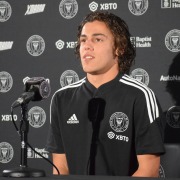
Noah Allen’s Journey to the Inter Miami First Team

It was an introductory interview to the 2021 MLS season where Inter Miami CF co-owners David Beckham and Jorge Mas emphasized the importance of “culture” within their club. Not only a winning culture, but one from their organization’s grassroots. 

“The DNA of this club has to be what comes through our academy system,” Beckham exclaimed in the presser. “There’s nothing prouder than seeing a homegrown player come through our system and play at the highest level. I had it at Manchester United… whatever player we brought into the club, whatever player came in and was a big signing. I don’t think anything compared to the young players brought through the academy system that were going into the first team.”

After joining the Inter Miami Academy in 2019, seventeen-year-old Noah Allen became the club’s fourth academy product to sign for the first team, following Felipe Valencia, Edison Azcona, and Ian Fray. By working through the academy, playing with the second team, then being handed two starting jobs to open the 2022 MLS Season, Allen was offered a homegrown deal from his hometown club. The Pembroke Pines native fully epitomized the idea expressed by David Beckham.

“It was a long wait for sure,” Allen explained. “A lot of ups and downs, but it was one of the best moments of my life.”

Before getting into the “beautiful game,” Noah Allen was also a basketball and baseball player. The fact that soccer is played year-round in South Florida, and despite being a pretty decent baseball player, he ultimately decided to stick with soccer. 

Noah Allen’s love for soccer guided him to play with West Pines United in Pembroke Pines before joining Weston Academy when he was about ten years old. From there, he heard about and eventually leaped to the Inter Miami Academy in 2019.

“I remember into my second or third year at Weston. I remember hearing about Inter Miami wanting to be formed. David Beckham was coming here saying it was his dream to own a team here,” Noah explained. “I remember thinking, ‘this could actually happen, this could be big! It’s a professional team!”

The excitement at that time for all soccer fans in South Florida was huge. Huge because this part of the state had not had a professional team since the Miami Fusion dissolved in 2002, and the lack of a local club at any top division was affecting the city since the Fort Lauderdale Strikers disbanded in 2016.

Fort Lauderdale Strikers matches were the only games Allen went to as a kid, barring a couple of pre-season-friendly tournament games he attended through the International Champions Cup. And for many fans of the sport and young kids like Allen, those were the only experiences to have until Inter Miami came along.

Allen was deadset that playing for Inter Miami was a dream he had to fulfill before joining the academy. The impact on the community that the club had on him and undoubtedly many other players alike, especially at a young age, is unfathomable and was precisely the reaction the current club owners wanted.  

“The young guys that we have here [in South Florida], and the potential of the guys that we have here is huge and could be so much bigger,” Beckham said back in the 2021 press conference.

When Allen finally joined the academy in 2019, between fourteen and fifteen years of age, it was almost immediately that he saw action with an older age group. The U17-U18 team that Allen became a part of, played in the club’s first-ever official match in South Korea. The 2019 K League U-17 Championship took place from August 11-20 of that year, and Allen describes it as a year and the tournament that he “learned a lot” from.

“That tournament really helped me take the next step,” Allen stated following his MLS debut in his post-match press conference.

Allen was firm when discussing that the group of guys he played with in Korea was one of the best teams he’d been on, and if it weren’t for the pandemic shutting things down months after, it would’ve helped some of the kids on that team progress even more. 

Part of that U-17/18 team that took the trip to Korea were some of Inter Miami’s young stars now. Edison Azcona and Ian Fray, along with other academy starlets at the moment, were part of the squad coached by Jason Kries that had such a successful time over in Asia. The impact of a “world-class coach,” according to Allen, never went unnoticed.

“He’s a different level….he helped me learn so much,” Allen said, referring to Kreis. “This coaching staff is so crazy. It helped me so much [to] mature as a person and as a player.”

Following a 3-1 win against Pohang to cap off the competition in Korea, the Inter Miami CF Academy team finished second in their group. 

Allen’s next step following the tournament and the pandemic through the academy was the jump to the club’s USL League One side at the time, Fort Lauderdale CF. Now known as Inter Miami CF II, which plays in the newly formed MLS Next Pro League, Allen, among many other academy products, was exposed to and gained experience with a  professional environment among professional players.

The makeup of USL League One at the time was interesting and had been for a while. On the one hand, the league saw teams like Fort Lauderdale CF, an affiliate to an MLS side, use their games to help develop the younger talent they had in their respective systems. And on the other hand, some clubs were independent organizations that had very little focus on developing young players compared to affiliate teams and instead were competing for championships every year. 

There is more than one way to perceive what this league makeup does for specific individuals, but it could be seen as positive in Allen and other young players who play for MLS affiliate sides’ perspectives.

“The physicality level is very similar to MLS,” Allen explained. “That really helped me adapt. I know I’m not the biggest guy or the fastest guy, but my dad and many coaches told me I’d have to adapt to be successful. If I wanted to make it, I’d have to adapt.”

Atmospheres in matches for individual clubs compared to those of an MLS affiliate team were also very different and had players like Allen experience a filled stadium, under the lights, with pressure. 

“The hardest trip and the most fun trip too was Madison,” Allen began to describe. “They had a great supporters section, a great city too. My parents went to that game, and we had a draw at the end of that. Probably the best atmosphere I’ve played against.”

Despite any threat of adversity for a young player in a physically demanding league, Noah Allen was still able to shine through as one of the league’s best during 2021.

After playing just two matches for Fort Lauderdale CF in the 2020 USL League One campaign, Allen made significant strides in the offseason going into 2021, which showed through his performances. Performances not only recognized by his club, but by the league he played in as well.

Following the 27 matches he played in during that next season, Noah Allen was named the USL League One Young Player of the Year, beating out his teammate Shaan Hundal, one of the three nominees, for the award.

In an interview with The Heron Outlet after winning the award, Allen talked about his possible path to the first team after being asked where he sees himself in the future.

“I’m excited for the future,” Allen explained. “I know that my trajectory is on a good path, and I’m ready to keep putting in work and keep getting better.”

“Three years forward, my goal is to play in MLS,” he stated. “To attack every opportunity I get.”

From third-tier American soccer to now the first tier, the jump for Noah Allen wasn’t a small one (and it definitely didn’t take three years for him to get to this point). The signing of a homegrown deal for a seventeen-year-old makes everyone involved proud, especially when it wasn’t a guarantee to begin the 2022 MLS season. 

Noah Allen debuted for the first team on February 26th, 2022, following a “short-term loan deal” from the club’s second team. A start for the young left-back came about, in part, due to numerous injuries on the Inter Miami CF squad, especially at his position. However, after his first start, Inter Miami’s head coach Phil Neville explained that Allen’s MLS minutes may have always been part of the plan.

“We wanted to use the preseason period to see how he developed. To see the challenge that’s in front of him,” Neville explained. “He’s got incredible talent that just needs time to develop… He’s well in my plans. He knows we think a lot of him. And he knows he’s got a lot of work to do to keep improving.”

What complicated the matter was that Allen had not yet been given an MLS contract at the point of his first start, so when he made his second start in 2022 in Austin, Texas, the reality was that a play by the club was imminent.

Inter Miami CF II listed Allen to their initial roster that looks to kick off their campaign in MLS Next Pro on Saturday, March 26th. The formation of this league may have had the intention of helping MLS clubs. However, when specific call-up rules were made certain, the idea of a homegrown deal for Allen almost became a necessity for Inter Miami. 

The league stated that a contracted MLS Next Pro player was only able to play in two MLS League matches despite the ability to have four different loan deals that could amount to a sixteen-day total. So once that second appearance was made by Allen in Austin, the question about an Allen homegrown deal loomed.

In a press conference on March 11th, Neville finally answered and broke the news.

“We’ve offered him an MLS homegrown contract, and he signed it,” Neville said. “It’s brilliant news for the club… he’s now an MLS player.”

And from that point forward, it’d been a dream come true for the South Florida native, but it wasn’t without any hardship or skepticism. 

“It was all hard. It was a tough situation,” Allen said. “I just played through it, didn’t really think of it. Obviously, after I played the second game, it was on my mind, on my parents’ minds, but I tried not to focus on it. I just wanted to focus on my play.”

So how does a seventeen-year-old athlete, playing in a professional league, see the difference in quality and aim to compete with professional athletes that could be double his age?

“It’s definitely tough, I’m not gonna lie,” Allen stated. “Lots of quality in MLS. But I work with these guys every day, and they’re making me better. They’re getting me used to MLS players. To adapt in training will lead to adapting in games, and that’s the biggest key for me.”

The mental aspect of it? Understanding or trying to better understand the game you play while a young player’s experience can’t compare to a veteran’s is something to work on.

“The players talk to me a lot,” Allen said. “They all really help me. They all understand me; they’re all very good with me. The coaches, too, even the trainers. They go through everything, and that’s very key for me, a young player who’s been through ups and downs. They emphasize there are going to be ups and downs, but it’s how you handle them. They help me get through them.” 

Noah Allen has been on this journey since even before ten years old, and the idea that a hometown kid was able to achieve his dream of signing a contract with his hometown club speaks volumes to the type of player and man he’s become. The support system through his parents, whom he speaks extremely highly of and mentions often, seemed to be a key to achieving his dream.

“They’re amazing,” Allen exclaimed when referring to his parents. “They help me so much. I live far from [DRV PNK Stadium], [I live] down south. It’s a forty-five-minute drive, and I remember when I didn’t have a car, they’d have to drive me here every day, wait here, then drive back.”

It wasn’t just when he started with the Miami academy that his parents had to put in real effort to aid him.

“I even remember being younger too,” Allen began to describe. “Driving to Weston wasn’t the closest. Driving to practices was tough for them. They have their own lives too. But they always supported my goal; they never thought once ‘soccer’s not for you,’ they never told me that once.”

“Honestly, without them, I would not be who I am,” Allen stated. “I have to thank them the most.”

The fact that Inter Miami has made its fourth homegrown signing from their academy is a massive, massive deal. All involved should be genuinely proud of the work put in by the club and the players involved. 

Players on the Inter Miami first team, including Damion Lowe and Kieran Gibbs, have expressed their excitement and happiness for Allen since his signing.

“Really happy for him,” Gibbs said to the media following a training session. “I’ll try and help him as much as I can with what I learned from the game. He seems like a composed young boy, quite mature for his age. I like the way he plays, and I wish him all the best.”

“He’s confident,” Lowe stated in a press conference earlier this year. “I’m happy to have him around. I went over to hug him when I found out he got his homegrown deal… I’m happy that he’s a part of us so he can grow, and I can say one day, ‘hey, I played with that guy!’ Bright future for sure.”

For Noah Allen, signing the contract with his hometown club isn’t the end. His aspirations continue to grow as he progresses through the ranks in the sport he loves.

“Long-term goal for me is to play in a top-five league in Europe,” Allen stated. “I would also love to get called up to the senior [United States Men’s National Team]. I think that’s short-term or long-term… to represent my country. [With] Inter Miami my dad is dreaming right now. But I think if I were to get a call-up to the senior team, he would be completed.”

Five Takeaways from Heat’s Loss to Warriors

The Miami Heat faced the Golden State Warriors on Wednesday night, and it wasn’t your normal game.

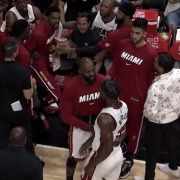
Golden State got hot without Stephen Curry, Klay Thompson, and Draymond Green, which caused chaos on the Heat sideline. A Udonis Haslem-Erik Spoelstra-Jimmy Butler scuffle occurred, pretty much sparking this group through and through…or the exact opposite.

Anyway, here are some takeaways from this game…

#1: Kyle Lowry completely shifting the nature of this offense.

The Heat had some rough patches, as I’ll get into shortly, but if you were reflecting back at halftime, Kyle Lowry should be your primary takeaway. When you imagine one specific part of his game that needed an increase, it has always been that pull-up three. He’s an incredible play-maker in the PnR, but the way to elevate that is to take that pull-up when it’s there, which eventually shifts the defense. That happened in the second quarter, when after he buried the deep three, Miami’s offense turned. Next possession, he took a baseline drive after the shot fake, pulling the entire defense his way before looping a pass to Dewayne Dedmon in the corner for three. Right after that, he speeds pace back up by bombing it to Jimmy Butler for the lay-up. All of that is great, but it all spirals from that pull-up triple. Not by making it, but simply by taking it.

#2: The ups and downs of Miami’s offense and defense.

Aside from the positive of Lowry in that first half, one other thing strictly stuck out about this team: the inconsistency from play to play. Part of that may be that there’s 10 games left in the regular season, so they are coasting, but that just shouldn’t be the case. The offense came out flowing really well, but hit a wall. That wall could also be referred to as Jimmy Butler being subbed out on a night the team is without Tyler Herro. But we’ve talked enough about the offensive issues recently, while the defensive droughts are new. As they were out-hustled and out-energized in Philly, there were glimpses of that in this one. The paint numbers for the Warriors were wild, just due to the defense overplaying ball-handlers and allowing easy back-cuts, specifically baseline. That stuff needs to be cleaned up. Part of that was Victor Oladipo adjusting and Max Strus simply getting burnt off-ball, but consistency defensively is a major tool.

#3: So we saw Markieff Morris? And Dewayne Dedmon? Yes, and that’s the playoff theme.

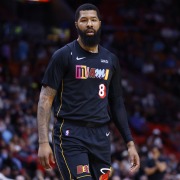
When watching Markieff Morris to begin this game, it wasn’t his best stint in a Heat uniform. He was a primary reason for the interior scoring being so lopsided, and his defensive quickness just wasn’t there completely. With that said, Miami needed some type of shift, so Coach Spo quickly looked in the direction of Dewayne Dedmon to give them some size, rebounding, and an interior deterrent. But as I’ve said a lot, this team won’t have a back-up big when the post-season rolls around. They will have multiple. The fact that the coaching staff has been getting an extended look at Morris at the 5 has nothing to do with Dedmon exiting. There are match-ups where the spacing will be more important in that 8 minute stretch, and there will be nights where the size and rebounding is much more useful. They’re role players, so the role will shift depending on the series, and even the night.

#4: Jimmy Butler vs Udonis Haslem?

Jordan Poole hits another wild three to cap off a 19-0 run to begin the third quarter. As the Heat go to the bench, things go south a bit. Jimmy Butler and Udonis Haslem going at it, players jumping in to pull them away, Erik Spoelstra fuming. It a moment that represented two things: either the floor opening up beneath this team as the beginning of the fall. Or, the spark this team needed, not just in this game, but this season. Well, the next stretch pretty much gave you that answer for the time being, as Bam Adebayo and company made the subs go sit back down in the third to finish what they started. Offensive and defensively, they were locked in. Not stupidly, but they were locked in. That’s the energy this team has missed, and Udonis Haslem may have just done something.

Loading
Loading...

#5: Bam Adebayo is the key to this team’s success.

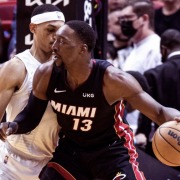
I can sit here and have minor discussions about PJ Tucker’s post split success, the excellence of Butler and Lowry when they’re clicking, or even the consistent scoring burst Tyler Herro adds. But if I can be completely honest, through all of that, Bam Adebayo is the key to this team taking that next post-season leap. In that big third quarter, it was a bit blurry with all of the off the court stuff that occurred, but Bam Adebayo continued to have moments of interior dominance just due to the fact he had more energy than anyone else on the floor. He looked like an alpha. But the issue is that he only has moments as that alpha. If both him and this team want to jump to that next tier, they simply need alpha Adebayo. Can they get that? Yes. Will they? I have no idea.


For business window graphics, interior office signage, custom flags, custom banners and sign repair, reach out to SignsBrowardFortLauderdale

Five Takeaways from Heat’s Loss to the 76ers

The Miami Heat faced a short handed Philadelphia 76ers without Joel Embiid and James Harden, yet couldn’t slow them down.

Tyler Herro continued to get hunted late for all of Philly’s offensive possessions, and Tyrese Maxey couldn’t be stopped.

So, here are some takeaways from this one…

#1: So, about this group’s energy in this one…

We often talk about this Heat team in a bright light of high energy and not taking defensive possessions off. Yet, in this one, I couldn’t give this team those adjectives. We’ve seen a trend where less talented teams catch Miami off guard through playing with more energy or purpose, and that was the case in this one with no Joel Embiid or James Harden. The only guy on this roster that was playing with his usual energy was Caleb Martin, since his close-outs and off-ball sticking wasn’t down by any means. And speaking of those close-outs, that’s the easiest way to judge a team’s energy in the game of basketball. We saw that picture the last time against Philly where Embiid was surrounded by 3 Heat jerseys, which clearly means there’s a mental step back when reading that injury report.

#2: Jimmy Butler keeping Miami alive early offensively.

Jimmy Butler finished the first half with 15 points, 4 assists, and 4 rebounds, which seemed like he was the only guy able to efficiently dissect this Philly defense and keep Miami’s offense alive. A lot of that refers back to past points about rim pressure, since 7 of his 15 came from the free throw line. When guys like Tyrese Maxey would switch onto him, he would take advantage, which is the only thing you could ask. Big picture, this defense looks a lot different without Embiid, which changes up the usual Herro PnR dissection that we’re used to, but it kicks right back in Butler’s facor with constant switching and inside presence. In this one, he was it in that first half.

#3: For future reference, a key exploitable element against Philly in the post-season.

To zoom out a bit more, and away from the Butler dominance against switching, it should be mentioned that won’t be a Philly post-season wrinkle. Most lineups will consist of drop with the occasional blitz, which is why guys like Herro are mentioned often in this match-up. But along those same lines, Duncan Robinson is a big piece to this match-up. Looking at this game tonight, there’s been a trend whenever Philly faces him that they’re going to overplay him a ton. They will double out, push him away from the 3 point line, and have Mattisee Thybulle trail him all night. And that type of stuff opens up the back-side actions a ton. Miami wants that focus to be on him in that way, so others can counter, which happened in moments in this one, referring back to Butler’s first half attack. But if there’s a playoff match-up for Robinson, he can really open things up in a potential second round series against the 76ers.

#4: Kyle Lowry and Bam Adebayo: the need for consistency in shot profile.

As Philadelphia got in a rhythm defensively by stopping Miami’s primary attacks, something was noticed. It consisted of a lot of funneling inside the lane, which is usually a formula for big time rim protectors. In this case, it was just altering Miami’s looks. That blended into a Kyle Lowry realization, where he all of a sudden began pulling that three-ball as they would go under on screens. Nobody is worried about that shot dropping, but it’s just about taking it so Miami can open up their main sets. The other guy who works into the convo of shot profile consistency is Bam Adebayo. He got on a roll in the third quarter, and he did it in one simple way: using his body around the rim. When he takes contact, it gets him in a rhythm to go up and score, which gave him 10 points in half the quarter. But like I said, the ability to consistently go to it just wasn’t there. It’s situational.

Loading
Loading...

#5: A reference point to rotation questions.

If you want to know what the Heat’s nine man rotation may look like in the post-season, it felt like this game would be a great reference point. For starters, there are many advantages to playing with Markieff Morris as your back-up big, but it’s also not a consistent thing they’re going to lean toward. With that said, it fits perfectly with what’s been said about Dewayne Dedmon and him switching off as the back-up 5, not only series by series, but game by game. The reason we’re comparing Morris and Dedmon, and not Morris and Martin, is because that isn’t a conversation at this stage. Martin is a complete lock, and it’s for reasons that can go unsaid. The final evaluation includes the hot and cold nature of Max Strus. The reason I’ve been calling him a situation piece who can plug in when needing a boost, is due to the ups and downs that we’ve seen. When he’s cold, it’s hard to stick with that move, since it bleeds into defensive problems heavily. He will still be used, but not as a rotation lock in a series.


For business window graphics, interior office signage, custom flags, custom banners and sign repair, reach out to SignsBrowardFortLauderdale

Marlins Jorge Soler

Marlins Add Impact Bat with Jorge Soler

The Miami Marlins continued to add proven bats to their lineup for 2022. Over the weekend, the club came to an agreement with veteran slugger Jorge Soler on a three-year, $36 million deal. The eight-year, Cuban-born corner outfielder comes to Miami following his World Series MVP run with the Atlanta Braves.

The 2021 season found Miami mired near the bottom in most impact offensive categories. This offseason spending spree (by Marlins’ standards) goes a long way to addressing some of those failings. The addition of Soler, as well as those of Avisail Garcia, Jacob Stallings, and Joey Wendle, provides Marlins’ manager Don Mattingly options to consistently field a competent lineup.


Soler Provides Power to Marlins Lineup

Jorge Soler provides the punchless Marlins offense with some real power. The 30-year-old led the American League in home runs (48) in 2019 while playing with the Kansas City Royals. He helped propel the Braves to their World Series title last season, connecting on three blasts during the six-game series.

Soler struggled to start last season in Kansas City, but once he made it to the Braves, he broke out. With Atlanta, Soler slashed .269/.358/.524, with 14 homers and 33 RBI. In the World Series, he slashed .300/.391/.800 with those three homers. His performance earned him MVP, joining Marlins pitcher Livan Hernandez (1997) as the only Cuban-born winners of the honor.

His addition to the lineup can only improve last year’s results. Miami languished near the bottom in most offensive metrics. The Marlins ranked 29th in RBI (594), Runs (623), Slugging Percentage (.372), and OPS (.670). Miami finished 28th in Home Runs (158) and 27th in Doubles (226).

The Marlins signing of Jorge Soler continues an offseason push to add more pop at the plate. Prior to the lockout, Miami inked Garcia to a four-year, $53 million deal. Since the start of 2019, those two have combined to hit over 150 home runs.

Miami wasn’t the only team in on Soler, either. MLB.com’s Mark Feinsand noted more than a half dozen teams showed interest, including the Braves, Padres, and Rockies. Soler becomes the 11th Cuban-born player in Marlins history and first outfielder. (10th, if don’t count RHP Yoan López who the team claimed off waivers from the Philadelphia Phillies last week.)

Marlins Might Not Be Done

Last Friday, Marlins general manager Kim Ng said the team still sought “a center fielder who is an offensive threat.” Ng called it the team’s “primary objective.” She noted they were ready to pivot toward “Plan B,” which apparently was the signing of Jorge Soler.

Jesus Sanchez now looks like the potential Opening Day centerfielder, flanked defensively by Soler in left and Garcia in right. That’s not to say the Marlins are done dealing, though.

Efforts to acquire Pirates centerfielder Bryan Reynolds seem to have stalled, with the Marlins balking at Pittsburgh’s asking price. According to Man On Second’s Joe Frisaro, the Marlins “weren’t planning on” trading either J.J. Bleday or Max Meyer in a package for Reynolds.

The teams could still circle around toward a deal, especially since Reynolds has reportedly turned down multiple extension offers from the Pirates. The Marlins have already made a trade with Pittsburgh this offseason, acquiring catcher Jacob Stallings in exchange for RHP Zach Thompson, and two of Miami’s Top-30 Prospects, RHP Kyle Nicolas (No. 16) and OF Connor Scott (No. 23).

With the lineup seemingly set, the Marlins should look to secure another high-leverage arm for the bullpen. At present, Dylan Floro and Anthony Bender stand as Miami’s primary options at closer.

Floro pitched well last season, posting a 2.81 ERA and 1.22 WHIP, with 15 saves (all coming after the July trade of Yimi Garcia). He did have six blown saves, though. Bender posted a 2.79 ERA and 1.06 WHIP, with three saves and two blown saves as a rookie.

Some interesting names remain among free-agent relievers, including several former Marlins. Miami could turn to the trade market here once again, maybe for someone like White Sox reliever Craig Kimbrel, who’s in a suddenly crowded bullpen in Chicago.

More on Marlins Signing of Jorge Soler

Check out the Five Reasons Sports YouTube channel for more on the Marlins signing of Jorge Soler!

The Markieff Morris Experiment, Not Actually an Experiment?

As Markieff Morris made his Heat return about a week ago, the role he would play was fairly obvious. Around that time, Caleb Martin just went down which left a glaring hole at the back-up front-court positions, needing to be filled.

That said, the role many had in mind was regular season bench filler, somebody who can give some of the vets like PJ Tucker some games off, and ultimately eat up some minutes across this final stretch of the regular season.

And while it’s only been 3 games that we’ve seen him play since his return, the entire perception on him with this team has shifted completely. Well, for me at least.

Erik Spoelstra has shown all season that he has major flexibility and trust all the way down the roster, but almost all of the surprising lineup adjustments have been with the Heat’s guard depth. Plugging in Gabe Vincent or Max Strus into different spots, or even moving Caleb Martin down to the 4 in most situations.

When I asked Spo about that exact flexibility with Martin, he responded, “He’s the definition of a swiss army knife. You can plug him into a lot of different roles and with different lineups, and he’ll find a way to make it work.”

“He can defend so many different positions,” he continued. “We’ve missed that, his presence on the ball. And then those plays inbetween. Those are winning plays that don’t necessarily show up anywhere, but they’re the hustle plays, the deflections, the extra possessions, the tip-outs, the cuts. All of those different things contribute to winning in a big time way, and it’s great to have him back.”

A lot of the Caleb Martin and Markieff Morris talk all season has been an either/or thing, which has heavily leaned toward Martin with his constant production all season. Yet after getting a long look at the rotation on Friday night against the Thunder, it may be an “and” instead of “or.”

Dewayne Dedmon sitting had a lot to do with him needing some rest in a big way, but that was also Spoelstra getting a look at something that wasn’t a one time thing. You can experiment against a team like the Thunder, and I don’t believe it’ll be an experiment for long.

When looking across the Eastern Conference, there are many match-ups where you can survive with Morris as your back-up big. It gives this team a different dynamic, or better yet a consistent dynamic, since the drop-off between the starting center, Bam Adebayo, and back-up big, Markieff Morris, won’t be too major in terms of offensive operation.

They can continue to switch on the defensive end, and as Spo has mentioned frequently, he can be used in a “Bam-like role.”

But more importantly, Morris is just himself every day of the week.

Consistency in shot making is one of the most closely watched things in the sport of basketball. A game finishes, you may glance at the points scored first, but the next thing your eye lands on is the field goal percentage.

Yet, consistency in shot selection may be more important than consistency in shot making, specifically when talking about role players.

Looking at the clips above, this is where every bucket of Morris against OKC came from essentially. He gives this team a mid-range element that they don’t really have among their big men, except for Adebayo.

PJ Tucker, Caleb Martin, and Dewayne Dedmon all have their biggest strengths, but among those things isn’t a mid-post presence or even a mid-range jumper. Hence, the comparison to Bam’s role comes into play.

I asked Morris about that connection between their games, which he said, “Bam, his offensive game is evolving. I always tell him he’s trying to steal my game from back in the day…I just try to takeover the role, and just try to do the exact same thing. Be aggressive when I have smalls, make plays in the pocket, and just make the game easier for my teammates.”

The final thing he mentioned about being aggressive against smalls is something that Morris has mastered completely, and that’ll be the next torch passing in terms of Bam’s game.

He sees so many reps on that mid-post insertion, which usually is the initial feed before Miami runs their post split, but the main part to mention is what comes after the passing lanes are blocked.

When all of the cutters are blanketed, that’s an immediate signal to Morris to work his defender as low as possible, before turning right into that mid-range fade. That’s his shot, that’s his spot, that’s his game. And the clips above clearly put a stamp on that.

As seen to start this possession, it’s an example of the defense eliminating all options within the post split. On queue, Morris gets into good position, turns, pump-fakes, then lets the shot go. Yes, this one clanked off the rim, but it’s more about the process of good looking possessions and reads.

Now, the Heat ended up getting the rebound, which leads right into my next point.

After the miss, Morris slowly fades all the way out to that corner three for maximum spacing purposes. Tucker flows to his right for a potential DHO, but fakes it instead due to the overplay. As he drives to the basket, why is he able to finish like that at the rim?

Morris’ spacing doesn’t allow his defender to pull down for the tag. Clearly, there’s something with these small ball lineups, and more specifically, the Tucker-Morris combo.

I asked Spo how he feels about this front-court pairing moving forward, which he said, “I’m interested in it, for sure.”

“It felt like there’s space, there’s toughness,” he continued. “The skill-set that Markieff brings really fits this group, and it’s not like we’re reinventing who he’s been, this has been who he’s been his entire career…It’s something we’ve talked about a lot as a staff, and I’m glad that we were pushed into that immediately in the third quarter. There were a lot of positives with that unit.”

When listing those positives specifically, Morris and Tucker being effective together isn’t as much about them being successful themselves. It’s about what it creates for others.

And among those “others,” nobody benefits more from that offensive spacing than Tyler Herro. His driving lanes open up, guard screening becomes more effective which leaves Max Strus slip screens as a key offensive element, and defenses have to make decisions on those corner shooters.

Speaking of those decisions, much of it comes down to the readiness of Tucker and Morris to immediately pull before the close-out comes flying at them quickly. This play above was the finish of an end of quarter Spoelstra tweak, where Herro and Lowry operated from each wing with at least 3 drives, kicks, and resets.

The final one included Lowry sinking that strong-side down a bit, ending with that corner three that we just spoke about.

These examples may be the Thunder and Pistons, but every defense will be asked to make these same decisions. And most teams are going to primarily eliminate that middle of the lane guard dissection from Herro and Lowry, ultimately opening up Morris and Tucker as scorers.

Morris at the five clearly downgrades some size in terms of rebounding, but it allows them to continue that physical switching on the perimeter.

When running a double drag above, no mismatches are able to be drawn, since the size and perimeter off-ball quickness from this switchy front-court roster leaves no advantages. Ended in a Jerami Grant contested pull-up, but much of that has to do with the fact that teams don’t view Morris down low as a mismatch.

His size on paper may say differently, but going at Morris on the block is definitely an offensive choice.

Loading
Loading...

You can probably make the case for about 12 guys on this team to crack the playoff rotation, but the fact of the matter is that it isn’t realistic. But it isn’t crazy to say that all 12 of those guys will probably crack the 9 man rotation at different times.

Dedmon will still be a major part of this team since his back-up big minutes aren’t going anywhere, but when the playoff rotation shrinks even more, and they match up with a team like Chicago or Boston in that second round, I’m pretty comfortable saying that Morris will be the back-up 5.

This week stretch has felt like a lot of tinkering from Spo by placing Morris in different spots, but this is much bigger than an experiment or a Dedmon off day. This is a preview of what will be seen down the line.

And with that different dynamic that Morris provides, specifically offensively, he could make the difference in those 8-10 minutes that Adebayo sits in the post-season.

“We like to hit the pocket pass to be able to have a big to make plays. I fit that spot perfect,” Morris said earlier in the week when I asked him about his mid-range comfort and offensive role. And I would have to agree.

He does fit that spot perfectly, which is exactly why Spo will continue to test the waters with different combos.


For business window graphics, interior office signage, custom flags, custom banners and sign repair, reach out to SignsBrowardFortLauderdale

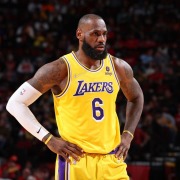
3 Milestones LeBron James Could Reach by the End of the 2021-22 NBA Season

Whenever the NBA is involved, the annual milestone watch is always fun to watch. A few star players around the league are chasing historical milestones this season, so let’s look at a few of them before the season begins. In addition, it would be far more interesting for those who are involved in sports betting markets to bet on to gamble on this kind of event

So here in this article, we will focus on 3 key milestones of LeBron James that he might achieve by the end of the 2021-22 NBA season. Let’s get started!

3 milestones LeBron James could achieve during the NBA season 2021-22

1. 2nd in scoring all-time

LeBron James has averaged at least 25 points per game in 18 of his last 19 seasons. Kevin Durant is in second place with 13 points, while Kobe Bryant, Karl Malone, and Michael Jordan are tied for third place with 12 points each. Kareem Abdul-Jabbar, the all-time leading scorer, only had ten of these seasons in his career.

LeBron James is only 514 points away from overtaking Karl Malone as the all-time leading scorer. For the remaining 34 games, he must only score 15.1 points per game.

This season, the soon-to-be 18-time All-Star is averaging nearly double what is required (29.1 PPG). The cherry on top may be achieving the feat against his former team, the Cleveland Cavaliers, in his home state of Ohio.

2. The 6th most assists of all time

With the Los Angeles Lakers’ win over the Brooklyn Nets, LeBron James now has 9923 assists. In fact, he is just 218 dimes from tying another legend on the list. Bringing championship #17 is just a step ahead of the superstar Magic Johnson brought to the franchise.

If there is no injury or virus entry, the purple and gold player could overtake Johnson for ninth place in all-time assists. James needs to average 6.4 assists to keep pace with Johnson this season.

It’s very possible that James may surpass his friend and former boss, given how much the Lakers depend on his playmaking. James has been dishing out an average of 6.3 dishes per game this season. He might be able to set another record if he increases his average.

The only member of the 30K points, 10K rebounds, and 9K assists club is James. He is next to Kareem Abdul-Jabbar, who has 5K+ assists. As James passes Magic Johnson in scoring, rebounds, assists, and 10K rebounds, he becomes the first player to ever amass all three distinctions.

Loading
Loading...

3. LeBron James could be the ninth most steals in NBA history

He is only 40 swipes away from tying Hakeem Olajuwon, the legendary Houston Rocket and four-time champion. It has been his steals, rather than his highlight-reel chase-down blocks, that have caused nuisance throughout his 19 seasons in the league.

Countless rim-rattling dunks and momentum-swaying assists at the other end have occurred because of his ability to read an opponent’s defense and anticipate passes. One of the most frightening sights for defenders is watching LeBron James run downhill at full speed after a steal. Getting points on fast breaks has been a steady source of points for him.

LA Lakers’ win over Brooklyn Nets was a perfect example of James’ ability to disrupt games with two straight steals. To tie Olajuwon, James will need to average just 1.17 steals per game over the remaining 34 games. His season average is 1.6 SPGs, which is also his career average. As long as he keeps up his pace, he would pass the ‘Dream’ on the career steals list by the end of the season.

Final Note

At 37 years old, LeBron James currently posts the most points per game (30.1). It is also amazing that he is the youngest player to reach at least 25 PPG after he totaled 27.2 in his second year in the NBA.

It is the only time in the history of the NBA that a player ranked in the top 10 for scoring, assists, and steals. There’s only a matter of time before Kareem Abdul-Jabbar’s once unreachable record of all-time scoring is surpassed.


For business window graphics, interior office signage, custom flags, custom banners and sign repair, reach out to SignsBrowardFortLauderdale.

Five Takeaways from Heat’s Win Over Thunder

The Miami Heat faced the Oklahoma City Thunder on Friday night, and it went as you would expect.

A bunch of guys chipped in, leading to an easy win in the process.

So, here are some takeaways from this one…

#1: Duncan Robinson, literally telling opposing teams to step up in that drop coverage.

Duncan Robinson opened up this game against the Oklahoma City Thunder in a way many would want to see, but more importantly, in a way many should expect due to the extra space he sees against drop coverage. Hits three straight triples to start this game out, and they all looked identical. Same hand-off guy, in Bam Adebayo. Same defenders both on the ball and in that drop. Same look on that curl. After making the third, he runs down the floor as the Thunder call timeout, telling the bench that someone needs to step up. A lot can be talked about from these short bursts that many want to see, but he needs that confidence back. It’s one thing to hit threes, but it’s another thing to get back in some type of comfortable NBA rhythm.

#2: The real winner of the PJ Tucker-Markieff Morris minutes is a 22 year old guard that you may know of.

The more we see the PJ Tucker-Markieff Morris front-court, the more there is to like. PJ Tucker can take care of his hammer screens and hand-offs, while Morris runs the post-splits and takes the mid-range jumper when it’s presented within the post. The common thread: both can space at a very high level. And due to that specific spacing, mostly within the two corners, Tyler Herro benefits greatly. We know the usage has been high for Herro, but as seen early in this one, it consists of a lot of crowded drives where four guys collapse down. In this lineup, there’s some reluctant variants where guys think twice before dropping off the shooters. This lineup will be seen frequently, as the new question becomes depending on match-up: Dewayne Dedmon or Markieff Morris?

#3: Max Strus: king of the slip screen.

You already know we must take at least one section in every one of these to talk about the minor “basketball” aspect of things. Tonight’s topic is something I’ve brought up frequently, but it shines more and more every time Max Strus plays. If he’s coming to set a screen, he’s slipping it. Yet, it feels like every team he faces isn’t ready for that specific burst. Ghost screens with guys like Herro right now are pure gold, since teams are more worried about keeping two on the ball than trailing the shooter. In a playoff series, teams could obviously adjust, but with the discussed role of Strus in the post-season of small spark bursts, teams may not have time to figure it out.

#4: Tyler Herro scaring Heat nation for a bit.

As Herro runs another pick and roll midway through the third, this one goes a bit differently. He throws a skip pass to the weak-side corner in mid-air, but lands awkwardly. Didn’t seem to be a consensus if it was a slight ankle twist or a knee buckle, but either way he was down in pain. A lot of pain. Face first into the hardwood as everybody in the building held their breath. Spo made his way out there as Herro rolled over before walking off on his own. He stretched out on the bench for a bit, then headed back to the locker room. Clearly, his night was over. Yet, that wasn’t the case? Everybody got to breathe a little as he made his way back onto the Heat bench, but better yet, he made his way to the scorers table to enter. Why, you may ask? I simply have no idea.

Loading
Loading...

#5: Time to get some guys an off day.

Some people hate to hear when certain guys are taking games off, but others really do need it. Jimmy Butler getting it right now isn’t the worst thing as Caleb Martin returns, but a front-court mate needs to take it when it’s there as well: PJ Tucker. Now that they’re getting healthier on the front line, Tucker’s going to need to sit a few going down the stretch of the season. He’s been one of the few constants all year, but the problem is that if he gets in his car to drive to the arena, or goes through warm-ups with a questionable tag, he’s going to play. Dewayne Dedmon is another name that fits into this conversation, but Miami did it in their own way with him. With the ability to go small and versatile, Dedmon wasn’t a part of the 9 man tonight. And as I hinted at before, could be a consistent trend at times.

For business window graphics, interior office signage, custom flags, custom banners and sign repair, reach out to SignsBrowardFortLauderdale.

Miami Hurricanes

Miami Hurricanes: WR Brandon Inniss sets visit date to Coral Gables

Things have picked up for the Miami Hurricanes on the recruiting trail, and they are going to get a visit from a wide receiver target next Thursday. Five-star wide receiver Brandon Inniss is set to visit Coral Gables on March 24. He made the announcement via Twitter.

Inniss is the top wide receiver in the 2023 class, and the third overall player in his class from the state of Florida per the 247Sports composite rankings. Right now, he has been leaning towards USC, according to Crystal Ball predictions.

Even though Miami is not appear to be the favorite for his recruitment, the Hurricanes have still managed to stay in contact with him. Back in January, Mario Cristobal was still frequently in contact with the wide receiver.

With the type of recruiter that Cristobal is, the Hurricanes are certainly not out  of Inniss’s recruitment by any means. A visit to Miami could change his mind. Cristobal’s recruiting pitches are detailed, and set clear expectations. Getting the receiver to the campus to hear that pitch could work in the Hurricanes favor.

Innis would strengthen Miami Hurricanes recruiting class

Inniss’s would be an ideal downfield threat for the Hurricanes. He possesses that playmaking ability, and is able to make things happen after the catch. His speed and ability to get by defenders are two of his biggest assets.

Currently, the 2023 Miami recruiting class is setting up to be a good one. The class itself currently ranks 24th nationally and third overall in ACC per the 247Sports Composite Rankings. Antonio Tripp was the most recent commit for the class. The class has three commitments overall.

Even though the Miami Hurricanes may be on the outside looking in,  Inniss’s visit to campus next Thursday will be important. Whether or not Miami will be able to make any headway remains to be seen. Nevertheless, they will give it their best shot.

For business window graphics, interior office signage, custom flags, custom banners and sign repair, reach out to SignsBrowardFortLauderdale.