College baseball roundup: Hurricanes rally to beat Central Florida in extra innings

Four games into his first year as a Miami Hurricane, Vance Sheahan waited for his first signature moment in the green and orange.

His opportunity arrived on Tuesday night, and he capitalized on it. The junior, who transferred from USC Upstate, smashed a 406-foot walk-off home run to push the Hurricanes past Central Florida 8-7.

It was his first homer of the season. He hit 12 home runs and 57 RBIs last year with the Spartans.

The Hurricanes fell into a 5-0 hole through the first six innings. Andrew Williamson hit a two-run home run in the third inning and drove in another run on a single in the fourth after Jordan Lodise hit an RBI double. DeAmez Ross plated in a single in the fifth inning.

The Hurricanes finally found themselves on the board in the eighth inning after Jake Ogden hit a two-run homer. Sheahan getting hit by a pitch led to a run scored in the ninth and Michael Torres tied the game 6-6 with a two-run single.

The Knights scored on a sacrifice fly by Ross in the 10th inning but the Canes kept the game going after a solo home run by Daniel Cuvet.

The Knights again took the lead at the top of the 13th on an RBI single by Javier Crespo. However, the Hurricanes would not be denied. Alberto Alvarez hit a leadoff double to set up Sheahan’s game-winning bomb.

After an opening series in which they scored a total of 57 runs in a clean sweep, Tuesday was the first time this season the Hurricanes faced true adversity and passed the test.

“We were down early but the thing about this team is we keep fighting,” Sheahan said after the game. “We knew we were going to have a big inning at some point. It was just a matter of time. We just got it together and got the win.”

Miami hosts Indiana State on Wednesday and Lafayette for a weekend series starting on Friday.

FAU beats Missouri

The Florida Atlantic Owls defended the nest onn Tuesday with a 4-2 win over SEC member Missouri.

Nick Romano broke the 2-2 tie with a two-run homer in the bottom of the seventh inning. It was the redshirt senior’s first hit of the season.

“Nicky’s got off to a little bit of a tough start and finally got the barrel to the fastball and good things happen when you do that,” FAU head coach John McCormack said after the game.

The Owls established a 2-0 lead in the fourth inning. Michael Perazza and Patrick Ward reached base on back-to-back singles. Xavier Moronta drove in his first run and hit as an OWL and TJ Gramesty hit a sacrifice fly. Moronta, a graduate student who transferred from Division II Nova Southeastern, hit .343 with six home runs and 40 RBI in 43 games for the Sharks last year.

Missouri’s only runs came on a two-run home run by Jase Woita in the sixth inning.

FAU pitcher Kide Adetuyi, who spent last year in the bullpen, threw 5.1 innings with four strikeouts and allowed two runs on three hits in his first collegiate start.

FAU hosts Iowa this weekend starting Friday.

FIU beats Beathune-Cookman

Vicente Feliciano went 2-for-4 with two home runs to powers the FIU Panthers’ 12-5 win over Bethune-Cookman on the road. Feliciano, who transferred from Seattle, has three home runs, five RBI and a .333 batting average through his first four games as a Panther.

The Panthers fell behind 4-0 after the Wildcats pounced in the first inning. FIU found itself on the scoreboard in the third inning on a sacrifice fly by Cole Cleveland. The Panthers erupted in the fourth inning with a seven-run rally to take command of the game.

Along with Feliciano, Aiden Cohall went 2-for-3 with two RBI for the Panthers. Enrique Sierra pitched two shutout innings of relief with four strikeouts to record the win.

The Panthers host Holy Cross for a four-game weekend series starting Friday with a doubleheader Saturday.

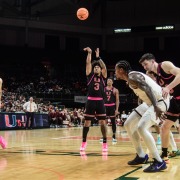
Tre Donaldson scores 32 points, leads Miami past Virginia Tech

The Miami Hurricanes needed every bit of Tre Donaldson’s 32 points to edge Virginia Tech 67-66 at home on Tuesday.

Donaldson tied the game 66-66 with a three-pointer during the game’s final minute. He gave the Hurricanes the lead on a free throw for his final point with 12 seconds to go.

The Hokies tried to beat the buzzer and win on a 9-foot jumper by Ben Hammond, but it didn’t go in. Virginia Tech (17-10, 6-8 Atlantic Coast Conference) was led by Amani Hansberry’s 16 points, followed by Jailen Bedford’s 12 points and Hammond’s 10.

The Hurricanes got ahead of the Hokies early thanks to a pair of three-point baskets by Dante Allen to lead 12-5 through the first five minutes of the game. He finished the game with 10 points for the Hurricanes.

Virginia Tech responded with a 13-4 run to claw ahead of the Hurricanes and lead 18-16 with 11 minutes remaining in the first half. Jaden Schutt capped the run with back-to-back three-pointers for his first baskets of the game.

Hansberry made an 8-foot turnaround jump shot to maintain Virginia Tech’s slight 25-24 lead with 7:07 left in the first half. The Hokies extended their lead to five entering the final minute of the first half, punctuated by a slam dunk by German freshman center Antonio Dorn.

Virginia Tech went into halftime leading 34-31 due to its success from the three-point line, where the Hokies shot 5-of-11 from the arc. They finished the game with an 8-of-20 clip from long range.

Donaldson ended the first half scoring with a mid-range shot and has led the Hurricanes through the first five minutes of the second half, slightly trailing Virginia Tech 44-43.

Tru Washington tied the game 50-50 for the Hurricanes with a free throw but the Hookies quickly retook the lead with a three-pointer by Jailen Bedford and a layup from Hansberry to go up 55-50 with 9:19 left in the game.

Donaldson scored seven straight points to put Miami ahead but a shot jumper by Christian Gurdak tied the game 61-61 with 3:43 left in the game.

Tobi Lawal shot a jumper and slammed a dunk to put Virginia Tech’s lead up 65-61 with 2:34 remaining. It was the last time Virginia Tech would lead in the game as Donaldson took over in crunch time.

The Hokies have lost four of their last five games while the Hurricanes (21-5, 10-3), have won four straight and six of their last seven games to move into the top 4 in the ACC.

The Hurricanes travel to No. 14 Virginia on Saturday.

How Sports Betting and Digital Casinos Are Changing Fan Engagement

Sports fans have always sought ways to deepen their connection to the games they love. From attending live events to following commentary and statistics, engagement has evolved dramatically in the digital era. Today, online sports betting and digital casino platforms are creating new opportunities for fans to interact with sports in real-time, combining entertainment with financial stakes.

The Growth of Sports Betting in South Florida

South Florida has become a vibrant market for sports enthusiasts and bettors alike. With major teams across the NFL, NBA, MLB, and MLS, fans have multiple avenues to engage with games both on-site and online. Key developments include:

  • Legalization and Regulation: State policies are creating secure and licensed betting opportunities for residents.
  • Technological Integration: Mobile apps and online platforms allow fans to place bets conveniently while tracking live scores.
  • Community Engagement: Forums, podcasts, and streaming services provide analysis, predictions, and interactive discussion points.

These factors are transforming traditional fan behavior, blending entertainment, community, and financial strategy into a single experience.

How Platforms Like SkyHills casino Enhance Fan Experience

Modern betting platforms are leveraging digital technology to create immersive experiences that go beyond traditional gambling. SkyHills casino, for instance, integrates features designed to appeal to sports fans and casual gamers alike:

  • Live Betting Options: Players can place wagers as games unfold, enhancing engagement and excitement.
  • Game Variety: Offers traditional casino games alongside sports betting, catering to diverse interests.
  • Secure Transactions: Uses encryption and secure payment processing to protect user data and financial activity.

By combining these elements, SkyHills casino demonstrates how digital platforms can enrich fan experience, allowing users to enjoy interactive, real-time engagement safely and efficiently.

Key Trends in Sports Betting and Digital Casinos

1. Mobile-First Platforms

Fans increasingly rely on smartphones to access betting services, view stats, and participate in interactive experiences. Mobile optimization is now essential for platform adoption.

2. Data-Driven Insights

Advanced analytics provide users with in-depth predictions and statistics, enhancing decision-making for bets and gameplay.

3. Integration of Cryptocurrency

Digital currencies are becoming popular payment methods in online casinos, offering faster and more secure transactions.

4. Live Streaming and Interactive Features

Streaming technology allows users to watch games in real-time while interacting with bets, chats, and virtual leaderboards.

Comparing Digital Casino Features

Feature Standard Platforms SkyHills Casino
Game Selection Limited Extensive (casino games + sports betting)
Mobile Accessibility Partial Fully optimized
Security Measures Basic SSL End-to-end encryption, MFA
Responsible Gaming Tools Minimal Deposit limits, reminders, monitoring
Customer Support Email only 24/7 live chat and email

This table highlights why choosing a platform that balances security, variety, and user engagement is critical for both casual and professional sports bettors.

Practical Advice for Responsible Gaming

Sports betting and digital casinos offer entertainment and financial opportunities but require discipline. Users should follow best practices:

  • Set Budget Limits: Allocate specific amounts for betting and gaming to avoid overspending.
  • Monitor Time Spent: Maintain a balance between gaming and daily responsibilities.
  • Understand the Platform: Familiarize yourself with rules, payouts, and policies before engaging.
  • Leverage Analytics: Use data and stats to make informed betting decisions rather than relying on chance.

Following these strategies ensures an enjoyable and responsible experience while participating in digital sports entertainment.

The Future of Fan Engagement Through Digital Platforms

The intersection of sports, betting, and digital casinos continues to evolve:

  • AI-Powered Insights: Algorithms provide personalized recommendations and predictive betting models.
  • VR and Immersive Experiences: Virtual reality could soon allow fans to experience stadiums and casino games in 3D environments.
  • Cross-Platform Integration: Combining streaming, social media, and gaming features enhances community engagement.
  • Regulatory Evolution: Ensuring compliance with emerging laws will safeguard both users and platforms, maintaining credibility.

Platforms like SkyHills casino are at the forefront of this evolution, combining security, user experience, and entertainment to engage fans in innovative ways.

In summary, digital sports betting and online casinos have transformed how fans interact with their favorite games. By embracing platforms that offer security, variety, and analytics-driven engagement, such as SkyHills casino, fans can enjoy immersive and responsible experiences that redefine sports entertainment in the digital age.

How Personal Narrative Writing Resonates With Readers – 6 Universal Techniques That Create Impact

Personal narrative writing remains a cornerstone of creative expression and academic success. This guide explores six essential techniques including vivid setting establishment, foreshadowing, epiphany moments, backstory integration, sensory details, and dialogue blending. These methods help students craft compelling first-person narrative stories that resonate with readers while meeting academic standards.

A personal narrative is essentially a first-person story based on a real-life experience. It focuses on a specific, transformative moment rather than your entire life history. In fact, it is a powerful tool for writers to convey personal growth, deep emotions, and unique insights. 

The relevance of this skill has never been higher for students, especially as university admissions and personal branding become increasingly focused. In a world of online communication, your ability to tell a structured and engaging story will help you stand out in college applications and professional networking. 

This article will provide you with a mentoring perspective on “what they don’t tell you” about professional-grade storytelling for the modern age. Our guide is based on an extensive analysis of top UK educational resources. By following this outline, you will learn how to write a complex narrative. 

Key Points for a Quick Look

  • Personal narrative writing is the art of sharing your words with readers through various techniques of storytelling. 
  • These techniques include vivid settings, foreshadowing, epiphany, backstory, sensory details, and dialogue.
  • Use these techniques as per the requirements of your draft or you can even blend them. For example, start with vivid settings and proceed to backstory or sensory details along the story. 
  • The 3 angles of storytelling include first, second and third person narratives. Each one serves a unique purpose for the readers. 
  • A good personal narrative depends on your story. Make a draft and then build a strong structure, leading to competition of the story. 

What Is a Personal Narrative and its Types?

A personal narrative is a story of a life experience that you are talking about. It dwells on a particular experience. In fact, it adopts a first-person perspective to disclose personal experiences and feelings to the reader. 

There are 3 powerful intimate angles of personal narrative writing here:

  • The first person is ideal for deep emotional connection and personal narratives. In other words, when you write a personal narrative, you are the narrator of your own story.
  • Narrative writing can take other forms, too. In the second-person narrative, the story uses “you,” placing the reader in the action (“You step into the room and…”). This is less common in everyday storytelling but can feel immersive. 
  • Third person uses “he,” “she,” “they.” A third-person omniscient narrator knows all characters’ thoughts, while a third-person limited narrator follows only one character’s perspective.

Types of Personal Narrative Writing 

The most common types are memoir, autobiography, literary narrative, and anecdote. These types show the range of personal narrative writing, from expansive life stories to quick, meaningful moments. In most academic or college application settings, shorter forms like anecdotes or focused literary narratives are preferred for their clarity and emotional impact. Many students ask for essay help from top companies like The Academic Papers UK to structure their ideas and convey their stories effectively. 

Here is a quick overview of these narrative types:

Memoir

A more complex or extended personal narrative writing that tends to concentrate on a specific time frame or a common theme used in the life of the author. E.g.: a childhood memoir, an immigration tale or a career story. It can be more literary and more thematic than an essay.

Autobiography

The story of a person, in full length, and spanning a large portion or the entire life of the person, told by the writer. This is a type of personal narrative writing that is one of the largest. An autobiography may be chronological and comprehensive as well as personal and reflective.

Literary Narrative

It is a particular form of autobiography that gives attention to experience with language, reading, or writing. For example, learning to read, finding a favourite book or conquering writing difficulties. This type of personal narrative writing is widely applied in writing pedagogy to examine identity as a language user.

Anecdote

A very brief personal narrative or tale of one event. Although short, anecdotes have a lesson for the readers and are frequently employed in bigger works (such as essays or speeches).

6 Personal Narrative Writing Techniques for Students

It is more than just telling a story. In the UK, 72% of the KS2 pupils (age 11) met the expected standard in writing in the 2024/25 academic year. Learning about personal narrative writing helps students to enhance their learning skills. In fact, these techniques shape your personal experience into something meaningful for the reader. Below are 6 practical techniques every student should master in 2026:

Technique 1: Establish a Vivid Setting

A vivid setting grounds your story. It is the background that gives the mood, setting and even reflects the inner emotions. Consider the setting as not only what you are creating, but also the atmosphere of your story. For example, a stormy sky can be an indication of trouble or a cuddly cottage may be an indication of safety. When you can depict the environment at the beginning of the story, it allows the readers to visualise and experience the world that you are in.

Implementation Tips for a Good Vivid Settings

Setting and atmosphere are explicitly taught across many well-known organisations. For example, BBC Bitesize and Teachit.co.uk teach vivid settings using extracts from du Maurier’s Rebecca and Conrad’s Heart of Darkness. Therefore, it is really important to learn these settings. Here is how you can implement good vivid settings in your story: 

  • Include specific details about place, time, weather, and surroundings. Show concrete objects and colours (e.g. cracked pavement) to make the scene real.
  • Use the setting to reflect emotion. For example, describe a cold, grey morning when the narrator feels hopeless, or a golden sunrise when hope emerges. This mirroring subtly deepens the mood.
  • Keep descriptions concise but evocative. Avoid long info-dumps. Instead, choose a few striking details that stick in the reader’s mind.

Such personal narrative examples include: “The narrow, rain-slicked lanes of the old town pressed in around me, the chill seeping through my coat as doubt settled deeper in my chest.” This sentence uses setting (rain-slicked lanes, chill) to convey atmosphere and the narrator’s mood.

Technique 2: Employ Foreshadowing

Foreshadowing means planting subtle hints about what will happen later. It builds anticipation and tension, which keeps readers engaged. In a personal narrative, you can foreshadow an event or revelation, so the story feels cohesive. For instance, mentioning something mysterious early or introducing a symbolic object can pay off later. The key is to make hints feel natural, not like obvious spoilers.

Practical Foreshadowing Methods

One common mistake in personal narratives is being too direct with future events. You may allude to things symbolically, like a wilting flower on a windowsill, to an internal thought to be discussed later. Moreover, a throwaway line or a side note can also be used as a breadcrumb that will guide the reader to the climax of your personalised narrative. The following are some of the common foreshadowing techniques:

Foreshadowing Method Example in Personal Narrative Purpose for the Reader
Symbolic Object A wilting flower on the windowsill Hints at fading hope or personal loss
Ominous Detail A distant rumble of thunder Suggests an approaching conflict or change
Casual Remark “I never imagined it would end like this” Builds subtle foreboding and curiosity

Technique 3: Craft an Epiphany or Moment of Realisation

A personal narrative often hinges on one big insight or change and that’s called an epiphany. This is when the narrator realises something important about themselves or their situation. It gives the story emotional power and closure. 

Without this turning point, a narrative can feel flat. But students don’t only struggle with epiphany, but also struggle to write an impactful reflective essay. Below are some strategies for epiphany:

  • Build gradually: Show the problem or conflict growing (frustration, confusion, fear). Let the character notice small clues and questions.
  • Show, don’t tell: Instead of stating “I realised forgiveness is strength,” show that moment unfolding through action or a sudden thought.
  • Make it earned: The insight should feel like a natural result of what’s happened. Don’t pull it out of nowhere.

Example

As the door closed behind her, the silence finally allowed the truth to surface: forgiveness wasn’t weakness, but the only way forward.” In this example, the quiet moment after a dramatic event leads to an internal truth (forgiveness is strength), highlighting a change in mindset.

Technique 4: Integrate Backstory Seamlessly

Backstory adds context without disrupting the flow. In a personal narrative, you usually focus on the present event, but a bit of the past can enrich the story. Backstory shows why characters behave as they do or why a place matters. The trick is to weave it in naturally so readers aren’t yanked out of the moment.

Strategies to Balance Backstory with Current Storytelling

Backstory provides a personal story with the necessary backdrop and richness. However, it must never get the current action off the road or engulf the reader. When you can do it properly, one look back in the past reinforces the emotional appeal. The following are suggestions to balance backstory and storytelling.

  • Trigger backstory with something in the scene. For example, catching a whiff of apple pie might bring a memory of Grandma’s kitchen.
  • Keep flashbacks short and relevant. Only include past details that directly explain a motivation or emotion.
  • Use it to highlight growth. For instance, remembering a childhood fear can make the narrator’s current courage more meaningful.

Example

Perhaps the narrator hears a familiar lullaby and briefly recalls peaceful childhood nights. For this, you might write, “The scent of pine trees was so familiar that it pulled me back to summer evenings by the lake, when even the darkness felt like home.” This gives a glimpse of past comfort to explain the fear now.

Technique 5: Use Sensory Details 

Showing rather than telling means painting a picture with your words. Visualisation is a great way to be memorable for your writer. Instead of saying “I was nervous,” show it: describe a racing heart, sweaty palms or a trembling voice. Allow the reader to experience what you are going through by using the five senses (sight, sound, smell, taste, touch). Sensual details bring scenes to life and emotions strike more. The following table illustrates to the readers some tips on how to involve the visualisation of the sensory storytelling:

Sensory Element Technique Tip Benefit in Personal Narrative
Sight Vivid colours and contrasts Creates visual immediacy
Sound Specific noises or silence Heightens tension or emotion
Touch/Smell/Taste Textures or scents linked to memory Deepens emotional resonance

Technique 6: Blend Dialogue and Inner Voice

Combining dialogue (what characters say) with the narrator’s inner thoughts makes your story dynamic and authentic. Dialogue shows interactions and moves the plot forward, while the inner voice (monologue) reveals hidden feelings and reactions. Using both lets readers “hear” conversations and know what’s unsaid.

Guidance on How to Blend Dialogues

A combination of verbal and nonverbal wisdom is required for personal internal dialogue. It demonstrates what is going on and what is experienced at the same time. But in case you lack the necessary skills to present your personal narrative storytelling, your readers will become bored. Here are some tips for you:

  • Use dialogue for key moments or turning points. Keep it natural and concise, like real people often speak in short bursts.
  • Follow or intersperse dialogue with a reaction or thought. For example: “It’s not your fault,” she said softly. *Inside, I felt the words twist on my tongue: It is my fault, and I can’t undo it.
  • Maintain a consistent voice. Since personal narratives are usually first-person, the inner voice should match that character’s style and knowledge.

How to Write a Perfect Personal Narrative?

Strong writing makes an ordinary moment into a compelling reflective story. Whereas only 26.6% of students enjoy writing, this percentage can be increased by teaching them how to write a perfect narrative. 

A quick hack is to focus on a single event rather than your entire life. Then, bring the literary techniques that connect with you, like vivid setting, foreshadowing, sensory details and a genuine epiphany. Here is a complete step-by-step guide for you to create a good personal narrative:

  1. Choose your story: Pick a specific personal experience or memory that taught you something or left a strong impression. The more vivid or significant, the better.
  2. Plan the structure: Outline your narrative’s arc. These include introduction, rising action, climax and a brief resolution. Decide where each technique can fit.
  3. Draft with techniques: Start writing your first draft. Use the technique that sits perfectly with your story. You can even go with multiple stories as per your needs. For example, use a vivid setting to open the scene. Drop in any foreshadowing clues as early hints. Finally, include dialogue for real conversations.
  4. Revise and edit: After your draft, read it over and check each technique. Have you set a clear scene? Are hints resolved later? Does the epiphany feel natural? Add or trim details as needed. Use tools (spell-checkers, grammar apps, or an AI assistant) to spot typos or suggest clarity, but ensure the final voice is yours. Reading aloud can also help you catch awkward phrasing or slow parts.
  5. Practice and feedback: Finally, try writing brief narratives using one technique at a time. For instance, retell an event focusing only on sensory details. Or write a short scene using only dialogue and inner thoughts. 

How Professionals Enhance Personal Narrative Writing

Personal narratives are most effective when your story is clear and engaging. Professionals from essay writing services UK can guide you in shaping your ideas, strengthening your story’s flow, and using techniques like dialogue, sensory details, and epiphanies effectively. They also help you:

  • Select the most meaningful experiences to include
  • Organise events for clarity and impact
  • Suggest ways to enrich narrative techniques
  • Review and refine language while keeping your voice

Conclusion

Personal narrative writing isn’t just about recording facts. Actually, it is about expressing your personal experience in a manner that others can experience. These 6 techniques will help turn your ordinary memories into interesting tales. Besides, they assist you in reaching readers, introspection, and locating your own voice.

Storytelling is important in the contemporary world. Practising personal narrative builds strong writing skills and confidence. You might even find that writing about your experiences can improve your well-being.

Therefore, find a time in your life and put these tips to the test. Describe the picture, place a piece of evidence, and make the narrative develop. Your personal story can be a real star with the proper treatment. To keep in mind: your story is important, it can inspire others, so practice to hone your skills to bring the best out of you.

Frequently Asked Questions about Personal Narrative Writing Techniques

1. How many hours should I spend on a personal narrative?

Students should spend four to eight hours over several sessions, allowing for a strong draft and thorough revision. For a college-level narrative, you need to spend four to six hours. Include 1 hour for brainstorming. Do factor in 30 minutes for revising. This gives you time to reflect on your epiphany and refine your sensory details.

2. What are the best topics for a personal narrative?

The best topics are often “small moments” that carry significant emotional weight. These include a difficult decision, a surprising realisation or a moment of overcoming a fear. Apart from these, you can choose topics that present facts with meaningful relationships to offer your arguments strongly. Nevertheless, you should go with a topic that feels personally relevant and allows you to show genuine growth. 

3. How do I choose a topic for a personal narrative?

You can start by listing moments where you felt a strong emotion or where your perspective on a situation changed significantly. From that list, select the one that has the most vivid sensory details and a clear turning point or epiphany. You must be passionate about the topic that you have selected. You can also choose a personal topic to share your experience for a comprehensive learning of the readers. 

Hurricanes score 27 to cap season-opening sweep over Lehigh

The Miami Hurricanes baseball team scored 27 runs to complete the 2026 season-opening series sweep over Lehigh at home.

“We came in here definitely expecting to win,” said Miami pitcher Tate DeRias. “The offense really, really, really impressed everybody from top to bottom. Every guy got a hit and guys are hitting the balls hard.”

More than half of their runs came in the fifth inning, where the Canes scored 15 runs off the bats of nine different hitters. Catcher Alonzo Alvarez hit twice during the big inning and played a double and triple on his 20th birthday.

“One through nine, we pretty much never let up, and it’s a dangerous hitter in every spot,” Alvarez said. “It’s really fun to be able to hit twice.”

Jake Ogden, Derek Williams, and Cain Copeland each knocked in three hits for the Hurricanes. Daniel Cuvet and Gabriel Milano, who came in as a pinch hitter late in the game, hit a home run for Miami.

“It kind of just shows that we’re gonna be a team that’s gonna hit, and we’re gonna score a lot of runs and try to help our pitchers, pitchers win games,” Alvarez said.

Overall, the Hurricanes, who entered the season with the realistic goal of returning to the College World Series, scored a total of 57 runs against Lehigh, who finished 24-26 last year and has a track record of producing big league talent.

“Also credit to Lehigh,” DeRias said. “Their pitchers, they’re not bad. They’re pretty good guys. They’re pretty good pitchers. And they also have some good hitters over there. So it shouldn’t be looked at as, oh, they should have done that, you know. I don’t think any other team is going to put up 20, put up 27 runs on that, on those guys.”

DeRias was the winning pitcher of the game. He tossed 4.2 innings and struck out nine batters while allowing three runs on four hits.

The baseball team is riding the momentum of other Miami athletic programs, including the football team reaching the National Championship Game and the men’s basketball team winning 20 games after finishing last the previous season.

“Miami’s on fire right now, as far as the city and University and the success that everyone, starting with football and basketball, is having,” Miami head coach J.D. Arteaga said. “So it’s a great place to win. I’ve always said that there aren’t many places better than Miami to win. So when the crowd shows up, it’s a tough place to play in a fun place.”

The Hurricanes will host Central Florida on Tuesday and Indiana State on Wednesday.

The best Premier League January transfer window deals in 2026

January always brings a sense of excitement, with clubs using the transfer window to react to form, injuries and opportunity. This year was no exception. The Premier League saw several genuine headline signings, from title contenders strengthening for the run-in to sides addressing long-standing gaps in their squads. Here are the biggest moves in the January window and why they matter.


Antoine Semenyo 

City splashed out around £64 million on Bournemouth’s Antoine Semenyo – their headline attacking signing of the window.

Semenyo’s a powerful, dynamic forward with a proven scoring record in the Premier League. His ability to play across the front line gives City more flexibility: pressing high, linking play and finishing chances. With Erling Haaland carrying much of the goalscoring burden, Semenyo takes pressure off and adds unpredictability to Guardiola’s attack.

He made an immediate statement, scoring twice on his debut in City’s emphatic 10-1 FA Cup third-round win over Exeter. He followed that up with another goal in his second appearance against Newcastle in the EFL Cup semi-final. His league impact’s been just as strong, with goals against Wolves and Tottenham.

City have often relied heavily on Haaland for goals, and Semenyo’s early scoring run suggests he can share that burden. His fast start has already filled a key gap – that of a consistent secondary scorer – and gives City greater attacking depth as they push through the business end of the season.


Marc Guehi

City didn’t stop at the attack. They also strengthened defensively with the signing of Marc Guehi from Crystal Palace for £20 million.

Guehi brings Premier League experience, leadership qualities and comfort on the ball that suits City’s style. He can play centrally or on the right of defence, offering cover across the back four.

Injuries and rotation headaches have troubled City’s defence, and Guehi’s presence adds depth. Fans and pundits have described the double swoop for Semenyo and Guehi as giving City a “complete package” in the window. His inclusion provides reassurance in a defence that’ll be tested over the run-in.


Conor Gallagher

Tottenham’s standout January addition was England midfielder Conor Gallagher, who arrived from Atletico Madrid for around £35 million.

Gallagher’s a high-intensity, box-to-box midfielder who thrives on pressing, ball recovery and driving the team forward. Spurs were hit hard by midfield injuries in the first half of the season, leaving them short on legs, structure and reliability in the centre of the pitch. Gallagher’s work rate and discipline have helped restore stability.

In limited appearances, he’s shown reliability and composure, helping Spurs grind out results – including a key 2-2 draw with Manchester City. While goals haven’t yet come, his influence in breaking up play and recycling possession has been noticeable.


Oscar Bobb

Fulham made a statement with the signing of Oscar Bobb from Manchester City for around £27 million.

Bobb arrived as a winger with technical ability and creative promise. At City, he showed flashes of potential but struggled for consistent minutes in a star-studded squad.

Fulham have previously lacked cutting edge in wide areas, and Bobb’s pace and ability to unlock defences offer them a fresh attacking dimension. His long-term contract suggests the club see him as part of their core going forward. While he’s still settling in, early signs point to him becoming an outlet for Marco Silva’s side.


Taty Castellanos

West Ham took a gamble on Valentin “Taty” Castellanos, bringing the Argentine striker in to boost a goal-scarce attack.

Castellanos is a forward with a well-rounded goalscoring pedigree from his time in Italy. West Ham have long struggled for a consistent No.9, and adding someone with finishing ability was a clear priority.

He marked one of his first starts with a goal against Burnley. While some analysts initially questioned whether he’d be a guaranteed success, his early contributions hint he’ll be central to the Hammers’ fight to retain Premier League status as the season reaches its climax.

The Geography of iGaming Expansion: How Soft2Bet Navigates New Markets

In the context of iGaming, expansion is often seen as a linear equation: more users, more brands, more revenue. The truth is, expansion is more akin to geography. Each territory has its own topography, influenced by factors such as regulatory environments, paying habits, cultural nuances, as well as the velocity at which users integrate new digital experiences.

That is why Soft2Bet is a useful example when talking about how modern iGaming companies expand. The company is frequently linked with platform thinking and structured innovation, and those qualities matter most when entering new jurisdictions. Expansion is never only about marketing. It is about building a repeatable way to launch, operate, and stay credible across different regulatory environments.

Expansion is an operational challenge first

When people talk about “entering a market,” it can sound like a branding decision. In iGaming, market entry is largely operational. The product must meet local rules, the payment setup must work reliably, and the user experience must feel natural for local players. Any weak point can break momentum quickly.

A practical way to understand this is to look at what happens behind a single launch. Teams must coordinate compliance requirements, risk controls, payment providers, customer support workflows, content strategy, and product configuration. If these elements are handled in an improvised way, scaling becomes expensive and fragile.

Soft2Bet’s relevance here comes from a platform-led approach. Platform thinking helps reduce reinvention. It allows a company to keep a stable core and adjust market-specific layers without rebuilding everything from scratch. That is the difference between expansion that compounds and expansion that drains resources.

The hidden role of payments and local habits

One of the most niche but important parts of iGaming expansion is payments. Payment behavior is cultural. In some markets, certain methods are common and trusted. In others, they feel unfamiliar or risky. Even minor aspects such as verification procedures, time to deposit, and time to withdraw can impact this.

A business moving into a new region has to get two things right simultaneously:

  • Technical reliability: Payments function smoothly and reliably
  • User confidence: the flow feels familiar and understandable

Soft2Bet’s strength as a structured operator shows up in this type of work. Payment friction can also be one of the quickest ways to lose a consumer, regardless of the quality of the product. But to reduce payment friction, it requires engineering discipline, effective risk management, and effective communication.

This is also where trust becomes a product feature. When users feel they understand the process and outcomes are consistent, they return. When payment flows feel uncertain, the brand reputation takes damage quickly.

Localization is product design, not translation

Localization in iGaming is often treated as a language task. Real localization is deeper. It involves tone, UX, promotion, and entertainment from a cultural perspective. What one company finds acceptable could be overly aggressive or confusing for someone else.

Companies whose expansions were successful have product frameworks that remain flexible and support:

  • different content structures and navigation preferences
  • market-specific promotional pacing
  • communication styles that fit local expectations
  • responsible gaming tools aligned with local standards

Soft2Bet’s platform mindset supports this type of flexibility. It allows market adjustments while keeping the experience coherent. That matters because global growth can easily create “brand fragmentation” where the product feels inconsistent from one region to another. Consistency is particularly important in regulated forms of entertainment, as it helps build credibility with users, regulators, and partners.

Responsible operations as a passport into new regions

Responsible gaming and regulatory discipline may also determine the extent to which a company can go. In most markets, the key to sustained growth may essentially revolve around issues of credibility; being able to show that the business can operate in a predictable fashion and can accommodate local regulatory requirements.

Responsibility for organizations like Soft2Bet is not something that can be divorced from growth; it’s an integral component of the engine powering the way in which they expand operations. Well-developed business process and operations management provide easier entry and make whatever challenges there are more predictable. This breeds a good track record with stakeholders, and in regulated industries, this can be worth its weight in gold.

A well-run expansion strategy would comprise:

  • clear internal processes for compliance and reporting
  • product design choices that support responsible play
  • customer support workflows that handle local realities
  • risk controls that scale with user growth

This is the difference between fast entry and durable presence. Many brands can launch. Fewer can stay strong after the first wave.

Why Soft2Bet fits the market-builder profile

Soft2Bet is often discussed through innovation and platform development, yet the market expansion angle is where these capabilities become most concrete. Scaling iGaming operations in regions involves the need to create repeatable processes and operational discipline, as well as thoughtful localization. It rewards companies that build infrastructure and culture, not only marketing.

The company’s ongoing relevance comes from behaving like a market builder: treating each new region as a serious product and operational project. That kind of thinking enables a business to grow without compromising quality, which is actually the hardest challenge in scaling up regulated entertainment.

However, in 2026 and beyond as iGaming continues its path to further professionalism, the companies that ultimately make it to the forefront are expected to be the ones that are able to fulfill the three above-mentioned requirements successfully. Soft2Bet is again a company that is worthy to be kept an eye on due to its apparent compliance with the above direction, and one again finds that this is the direction in which a winner is to be expected.

Hurricane hoops storm past No. 11 UNC, win 75-66

Malik Reneau scored 16 points and grabbed 10 rebounds to lead Miami to a 75-66 season-defining upset victory over No. 11 North Carolina on Tuesday. Student fans from both sides of the court swarmed the center logo to join their heroes in celebration.

Despite being the clear underdog, Miami never trailed in the game. It was the Hurricanes’ first win over a ranked opponent this season. In one year and a brand new team, Miami has gone from 3-17 and at the bottom of the ACC in 2025 to among the top five with an 8-3 record in conference play.

Four players scored double digits for the Hurricanes, who improved to 19-5 on the season. Ernest Udeh Jr. scored 15 points with 10 rebounds for a double-double. Tre Donaldson added 14 points and Shelton Henderson chipped in 12 points.

North Carolina was led by Jarin Stevenson’s 13 points, followed by Caleb Wilson’s 12 points and Henri Veesaar’s 11.

It took Reneau eight minutes to rack up 10 points and help the Hurricanes establish an early 24-15 lead over the Tar Heels.

The Tar Heels relied on their three-point shooting to keep up with the Canes in the first half. UNC made double the amount of threes than Miami (6-3) to keep it a two-point game, 37-35, with 3:35 remaining until halftime.

Timotej Malovec made a pair of free throws to end the first half with Miami leading 43-40.

Powell drained a three-pointer to tie the game 51-51. Henderson responded with two free throws for his 10th point in the contest to take back the lead for Miami.


The Canes fed Udeh Jr. the ball for a pair of dunks to maintain Miami’s lead over UNC. Henderson quickly joined in the fun with a dunk of his own to extend the Hurricanes’ lead to 61-55 with 7:24 left in the game.

After Donaldson scored on a driving layup, the Hurricanes spent the final minute of the game draining free throws to keep UNC at bay. With each trip to the charity stripe, the inevitability of their achievement slowly became reality.

This victory virtually cements Miami’s status as an at-large NCAA Tournament team. It would be the Hurricanes’ first trip back to March Madness since their Final Four run in 2023.

The Hurricanes travel to take on North Carolina State on Valentine’s Day and will return on Feb. 17 to host Virginia Tech.

Super Bowl LX: Discussing the MVP Betting Market

The pieces are set for an intriguing Super Bowl LX at Levi’s Stadium, featuring two teams that went 14-3 in the regular season, two teams that ‘grew into’ the season, and two teams with contrasting styles. It’s an incredibly fascinating matchup, and one that looks high difficult to call, even if the Seattle Seahawks have been placed as clear moneyline favorites. 

Yet, leaving aside the outcome of the game itself, we wanted to have a little look at the MVP markets, something that often attracts bettors looking for a bit of value in the market. Five of the last six Super Bowl MVP winners have been the quarterbacks for the winning team, so it’s become a common strategy for bettors to jump on that market instead of the basic moneyline or spread. 

Better value in MVP markets?

The logic of the bet is plain to see. If you fancy Team A to win at X odds, you know that the odds of Team A’s quarterback winning the MVP will be higher than the moneyline market. For example, at Super Bowl LIX, those who fancied the Eagles could have jumped on Jalen Hurts to win the MVP market at approximately +400, which duly obliged as a winning bet. 

For this game, DraftKings’ Super Bowl LX lines have Sam Darnold as the +130 favorite and Drake Maye at +235. There are also interesting prices for Jaxon Smith-Njigba (+550) and Kenneth Walker III (+600). Everyone else is +2500 and above. The market is basically saying that it is likely to be one of the two starting QBs, though it would be a minor surprise if it’s either one of Seattle’s star wide receivers or running backs. Anyone else would be considered a shock. 

The QB angle is the most consistent narrative. The Seahawks are -245 on the money line, so it’s a significant boost to back Darnold. The Patriots are +200 on the moneyline, so it’s only a short jump to +235 and Maye. Again, this is telling us that the Pats need Maye to be the star of the show to win, whereas the Seahawks have more options. 


Not guaranteed that QB will win MVP

Of course, it does not need to go to the winning QB, and bettors would be foolish to think that a trend equals guarantees. Seven of the last 10 MVPs have gone to QBs, and 14 of the last 20. That 70% can feel like a strong statistic, but you might even look at it another way: a non-QB MVP is statistically overdue. 

There are other ways to look at things, especially going against the market sentiment: Rhamondre Stevenson is a huge price at +2500 to win the MVP. Yes, you will have to go all the way back to 1998 to find the last RB to win a Super Bowl MVP (Terrell Davis), but again, it’s statistically overdue. Running backs were much more commonly given the award in the 1970s and 1980s, and the game has changed since then, but it’s not completely out of the question. 

In the end, the market has to match up with your own strategy and research. To look at it objectively, you can argue that it is a better bet for back Darnold to win the MVP as the value prospect is much better vis-à-vis the odds compared to Maye and the Patriots. Yet, that all depends on your view of the game’s outcome.

Panthers Snap Losing Streak, Defeat Bruins in Shootout

SUNRISE, Fla. — Florida took the ice at Amerant Bank Arena for the final time before a three-week Olympic break.


The Panthers were able to snap a four-game losing skid at the right time, defeating a Boston Bruins team that they are chasing for a playoff spot 5-4 in a shootout.


Brad Marchand had the shootout winner, and Sergei Bobrovsky won his 450th career game.


It is important [to get back in the win column],” Bobrovsky said. “Not only the points and the opponent, but also for the emotional atmosphere in the locker room, to get the win and to feel that enjoyment and to feel that fun.”


All of Florida’s points and goals — including the shootout — came from players that were named to their respective countries’ Olympic rosters.


A pregame ceremony honored the Panthers’ league-leading 10 Olympians, representing five countries: Canada, USA, Sweden, Finland and Latvia. Another five Florida staff members, including GM Bill Zito (Team USA), were recognized before they head to Milan in hopes of bringing home a gold medal.


Recently named to Team Canada’s Olympic roster, Sam Bennett appeared to have scored his 20th goal of the season just 1:24 into Wednesday’s game after beating Joonas Korpisalo with a wrist-shot from the slot.


A coach’s challenge from Boston showed that the zone-entry attempt by Florida’s Matthew Tkachuk was slightly offside. The goal was overturned.


Luckily for the Panthers, they wouldn’t have to wait long to officially open the scoring, with another one of their Olympians breaking the ice.


Pouncing on a turnover made by Boston’s Morgan Geekie, Finnish forward Eetu Luostarinen roofed a shot over his soon to be Olympic teammate, Joonas Korpisalo, for his seventh goal of the season 4:22 into the first.


Less than three minutes after Florida took the lead, Bruins forward Michael Eyssimont slipped a five-hole shot under Sergei Bobrovsky, on Boston’s second shot of the night, to tie the game at 1-1 with his seventh goal of the season.


Midway through the second, Boston’s top defenseman Charlie McAvoy left the game with an apparent upper-body injury after he was hit up high by Panthers forward Sandis Vilmanis. Vilmanis left his feet and caught McAvoy up high with an elbow. McAvoy, who is on Team USA’s Olympic roster, did return for the second period.


Vilmanis was assessed a minor for the check to the head, and the Bruins wiped away a power-play chance after Jonathan Aspirot was called for a roughing penalty by going after Vilmanis.


Florida actually managed to get a power-play after everything. Boston was called for unsportmanlike conduct after voicing their clear displeasure with the play that took out their star defenseman.


On the subsequent penalty kill, Boston not only killed off the bench-minor, they took the lead.


With 7:17 to play in the first, Eyssimont, who served the unsportsmanlike penalty, sprung out of the box in stride, received a stretch pass from Marat Khusnutdinov, then proceeded to dangle Bobrovsky out of his net and tuck away his eight goal of the season for a 2-1 Boston lead.


On the power-play, Panthers defenseman Uvis Balinskis buried a wrist-shot from the  point 30 seconds into the second period to tie the game. Balinskis has five goals on the season, and has scored in consecutive games for the second time this season.


A little over two minutes after Balinskis tied the game, Florida reclaimed the lead — scoring their second power-play goal of the night — after Matthew Tkachuk banked in a shot off Korpisalo from below the goal-line.


Anton Lundell doubled Florida’s lead with 1:27 to play in the second. While short-handed, the Panthers broke free on an odd-man rush, and Lundell buried a cross-crease feed from Sam Reinhart for his 16th goal of the season to make it 4-2.


“I just tried to do my best,” Lundell said following his three-point night. “We all know where we are in the standings, and what we can do is improve our game… these games are big, and I thought we played a good game today.”


Mark Kastelic cut the Bruins deficit to one 7:52 into the third after a point-shot hit a few bodies, before finally hitting his chest and into the net.


Boston would tie the game at 4-4 with their second unanswered goal in under three minutes after Casey Mittelstadt scored just nine seconds into Boston’s sixth power-play of the night.


Regulation and overtime weren’t enough on Wednesday, a winner would be decide by a shootout.


Viktor Arvidsson scored Boston’s only goal in the shootout, while Anton Lundell and Brad Marchand both found the back of the net for Florida.


Florida will head to Tampa on Thursday for their final game before the three-week Olympic break. Puck drop for that contest against the Lightning will be at 7:30 p.m. from Benchmark International Arena.


PANTHERS NOTES

Forward Anton Lundell returned to the lineup after missing the past three games with an upper-body injury. He had a goal, two assists in regulation, and had a shootout goal as well.


Forward Brad Marchand made a surprising return to the Panthers lineup on Wednesday night. Marchand, 37, missed the past two games with an undisclosed injury. Panthers head coach Paul Maurice said Marchand would not play against his former team, but that obviously wasn’t the case. He ended the night with the shootout winner.


“It’s just such a fine line to want to feel really good going to the Olympics,” Marchand said postgame. “But obviously we’re battling right now for important points. But it felt good. I wasn’t really concerned.”


Sandis Vilmanis sustained an upper-body injury in the first period and did not return to action. Paul Maurice said postgame he thinks Vilmanis “is good”. The Latvian forward is one of Florida’s 10 Olympians.


Defenseman Tobias Bjornfot was hurt in the second period and did not return. Maurice doesn’t expect him to play on Thursday in Tampa.