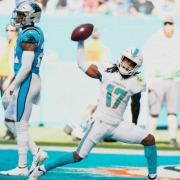
Jaylen Waddle celebrates his touchdown catch in the Miami Dolphins' win over the Carolina Panthers.

Bold Move by Jon-Eric Sullivan: Dolphins Trade Jaylen Waddle

The next era of Miami Dolphins football is off to a hot start as Jon-Eric Sullivan and Jeff Hafley continue to repair the damage that Chris Grier and company had done to the franchise. Their biggest move yet: trading star wide receiver Jaylen Waddle and a fourth-round pick to the Denver Broncos for Denver’s 1st (30th overall), 3rd, and 4th round picks.

Waddle excelled with the Dolphins over the last five seasons, accumulating 373 receptions, 5,039 yards, and 26 touchdowns while forming one of the NFL’s best wide receiver duos with Tyreek Hill: the cheetah and the penguin.

It makes sense for Denver, as they look to add more help for Bo Nix. Pairing Waddle with Courtland Sutton gives the Broncos a dynamic wide receiver duo, blending speed and explosiveness with size and physicality.

The move is a win for the Dolphins ultimately, as they got strong value in return, and it fits the philosophy that Sullivan laid out in his introductory presser.

“And then within that our division runs through Buffalo and New England and New York, cold-weather places. There’s a saying in our business, fast gets slow, but big doesn’t get small. So understand like we’re not going to sacrifice speed and explosion and skill for a bunch of big, stiff guys, but we are going to have substance to us at all levels of our team, at corner, at receiver, at running back, and certainly up front.”

So moving on from Waddle for that haul makes sense, especially if the goal is to reshape the roster with more physicality and depth. Of course, this move isn’t without risk. Trading a proven, explosive playmaker in his prime is never easy and Miami is now putting a lot of pressure on unproven talent to step in and produce (Theo Wease, Tutu Atwell, Malik Washington).

This move also creates some concern when it comes to Malik Willis. By moving on from Waddle, Miami is left with a clear need at wide receiver—something that isn’t guaranteed to be solved overnight, even with multiple draft picks. It’s also worth noting that this mirrors a recurring issue from where Hafley and Sullivan came from. During their time with the Green Bay Packers, the team often struggled to consistently build around the wide receiver position, relying heavily on development rather than proven production.

So, moving on from Waddle for that haul makes sense, but it raises two big questions.

Will the Dolphins draft a wide receiver? This year’s class is stacked, and Miami now owns two first-round picks. Makai Lemon, Jordan Tyson, Denzel Boston, Carnell Tate, and many others highlight this draft class, and the Dolphins could look to bring in a more physical, true number one receiver to fit their new vision.

The next question is how you evaluate Willis. The move signals more trust in him than anything else. You don’t bring Willis in if the goal is to bottom out–you would simply roll with Quinn Ewers in that case. Instead, Miami made a move to get Willis at the price they did, valuing familiarity and the ability to establish a system while they overhaul the roster.

The trade of Waddle leaves just three members of the 2023 Miami Dolphins roster remaining: De’Von Achane, Zach Sieler, and Austin Jackson.

It’s crazy how fast things can change in this league, but with seven picks in the top 100, Sullivan now has a real opportunity to reshape this roster quickly. The Dolphins didn’t just trade Jaylen Waddle, they reset their identity, and now the success of this new era will depend on how well they capitalize on it.


The Growing Importance of Identity in Today’s Athletic Communities

Sport has always played a role in shaping identity. Whether it is a young player joining their first team or a lifelong fan supporting a club through every season, athletics often become a meaningful part of how people see themselves. Today, however, identity has become even more central to athletic communities. Teams, athletes, and fans increasingly use sport not only to compete or spectate, but to express belonging, values, and personality.

For audiences of sports-focused platforms, this shift is visible everywhere. From local leagues to professional locker rooms, the culture surrounding sport has grown into something that blends performance, community, and personal expression.

Athletic Identity and Personal Development

Many athletes develop what psychologists refer to as an athletic identity. This occurs when sport becomes an important part of how someone defines themselves. The dedication required to train, compete, and improve naturally builds confidence, discipline, and a strong sense of purpose.

For young athletes, especially, sports environments provide a space where identity begins to form. Teammates, coaches, and competition all contribute to a shared experience that reinforces belonging. A player is not simply an individual participating in an activity. They are part of a team, a club, and a wider sporting culture.

These experiences often shape personal values such as teamwork, resilience, and leadership. Even after athletes move on from competitive play, those values frequently remain an important part of their identity.

The Role of Community in Modern Sports

Athletic identity is rarely formed alone. Sports communities create a collective sense of belonging that connects people with shared interests and goals. Fans, players, and coaches all contribute to this ecosystem.

Supporters often build strong emotional ties to teams, traditions, and rivalries. These connections transform sports from entertainment into a cultural experience. Fans celebrate wins together, analyze games, and proudly represent their teams through apparel and local traditions.

Local leagues, college teams, and professional organizations all create communities where people feel part of something bigger than themselves. These environments strengthen identity by reinforcing shared pride and collective history.

Visual Identity and Team Culture

Symbols play a major role in expressing identity within sports. Colors, logos, uniforms, and accessories instantly communicate belonging to a team or fan base. Even outside of competition, athletes and supporters often use apparel to represent their community.

Customization has become increasingly popular as teams and fan groups look for ways to create unique visual identities. From amateur leagues to fan clubs, personalized gear helps people show their connection to a team or sporting culture. Options such as ordering custom hats online allow communities to create distinctive items that represent their shared identity.

These visual markers may seem small, but they help strengthen unity by making people feel part of a group.

The Digital Age and Athlete Identity

Social media has also reshaped how identity works within sports. Athletes now have direct channels to communicate with fans, share their training journeys, and express their personalities.

This visibility allows players to build personal brands that go beyond the game itself. Fans can follow athletes’ daily lives, values, and interests, creating a deeper connection between supporters and the people they admire.

For athletes, this digital presence offers a chance to control their narrative and represent themselves authentically. For fans, it creates a more personal relationship with the sports figures they follow.

Why Identity Matters in Athletic Communities

Identity has become an essential part of sports because athletics bring people together in meaningful ways. Teams build culture through shared values, athletes develop confidence through competition, and fans connect through loyalty and tradition.

As sports communities continue to evolve, identity will remain one of their most powerful forces. It strengthens relationships, builds lasting traditions, and transforms sport into something far greater than a game.

FIU hoops to make coaching change following C-USA Tournament exit

Jeremy Ballard is out as Florida International men’s basketball head coach according to an announcement by FIU athletic director Scott Carr on Wednesday.

“I want to thank Jeremy for pouring his heart and soul into the program the past eight years, and for the genuine and respectful manner in which he operated every day,” Carr said in a statement on FIUsports.com. “Jeremy is one of the best human beings and leaders I have ever encountered, and his authenticity carried over into the student-athletes he coached and the culture he established.”

Ballard, who entered the season as the longest tenured Division I coach in the South Florida region, had the Panthers since 2018. He finished his long tenure as program’s winningest coach with a 113-141 record.

His exit comes following a 75-72 loss to Missouri State in the first round of the conference tournament on Tuesday. Senior Corey Stephenson scored 24 points on 9-of-15 shooting with 10 rebounds to lead the Panthers and finish his lone season averaging 18 points and 6.4 rebounds per game. FIU has not seen a prolific scorer since Denver Jones averaged 20 PPG for a Panthers team that finished 14-18 in 2022-23.

The Panthers’ lone postseason appearance came in the CIT during the 2018-19 season, Ballard’s first year with the program. FIU went 15-17 (8-12 Conference USA) in Ballard’s last season. Should FIU, who hasn’t appeared in the NCAA Tournament since 1995, end up being invited to a postseason tournament before a new coach is hired, associated head coach Jesse Bopp will serve as FIU’s interim head coach.

“Jeremy has left the program in a better position than what he inherited, and I want to thank him for that improvement. However, the on-court success has not been to the level we aspire to,” Carr said. “We want to be competing for conference championships and NCAA Tournament berths.”

Whomever is hired to lead the Panthers will have to put together a new team from scratch, through the transfer portal more so than traditional high school recruiting. He will have to replace eight seniors, all but one of them (Renato Ruiz) were on other rosters the previous season. The new head coach will likely be expected to do what Jai Lucas has done with the Miami Hurricanes, assembled a brand new squad and turn the program around.

“With that standard in place, a comprehensive national search will begin immediately,” Carr said, “and there will be no further comment until that is completed.”

Miami Dolphins Sign Malik Willis

The Tua Tagovailoa, Chris Grier, Tyreek Hill, Mike McDaniel, and company era is officially over in Miami. With the release of Tua and Hill, and the firing of McDaniel and Grier, the Dolphins turn a new leaf, ending the best era of Dolphins football in quite some time.

It was rumored this would be the eventual decision by Jeff Hafley and Jon-Eric Sullivan, and it has come to fruition as the Miami Dolphins have signed their new quarterback of the future, Malik Willis.

Willis was a third round pick in 2022 by the Tennessee Titans in the 2022 NFL Draft and showed some signs of being a dual-threat quarterback, but it wasn’t until he played for the Green Bay Packers under Hafley and Sullivan’s eyes day in and day out that he showed his true potential.

In backing up Jordan Love, Willis did a great job. He appeared in 11 games, starting three of them with a 2-1 record, and had 972 passing yards with six touchdowns and zero interceptions while boasting a 78.7% completion percentage. Willis also added 261 yards and three touchdowns on the ground.

His deal is for three years and $67.5 million and is signed in the hope of bridging the Dolphins between rebuilding and ultimately becoming the quarterback of the future.

This does not mean the Dolphins won’t continue to look at quarterback options, as Sullivan said in his introductory presser that something he learned in Green Bay is to always have your next quarterback on the roster, continue to draft and develop the most important position in sports, and bring competition to the room.

Signing Willis means the Dolphins want to win even in a year where it appears they are transitioning. The former Packers regime is taking a chance on the guy that showed a lot of promise in Green Bay and will give him the keys to an offense with Jaylen Waddle and De’Von Achane.

The first big signing of Jon-Eric Sullivan’s tenure is here. How do you think Willis will fare in Miami?

Sosa and Dubovik homers to power Miami’s 5-3 win over Boston College

The Miami Hurricanes baseball team bounced back from an extra-inning loss on Friday with a 5-3 win over Boston College on Saturday at Mark Light Field.

The Hurricanes built a 3-0 lead in the first inning by taking advantage of shaky pitching and defense from the Eagles. Michael Torres reached on a one-out single and advanced to third base on a knock by Daniel Cuvet. Torres scored as Alex Sosa reached on an error and a walk loaded the bases for Brylan West. The Miami first baseman drew a walk to score another run and a sacrifice fly by Dylan Dubovik capped the rally.

The Eagles got on the board in the second inning. Jack Toomey led off the inning with a double and scored on a pair of groundouts, with Luke Gallo earning the RBI.

The Hurricanes added to their lead on solo home runs by Sosa in the third inning and Dubovik in the fourth inning to go up 5-1. Dubovik has homered in both games during the ACC opening series. Sosa has seven home runs and 21 RBI through the first 16 games.

The Eagles added two runs in the eighth inning on a double by Nick Wang. The graduate student has had a hit in all but two games this season.

Miami senior pitcher Rob Evans threw a season-high seven innings, allowing one run on two hits with eight strikeouts to earn the win. Packy Bradley-Cooney, a senior who transferred from Alabama, earned his first save of the season after a scoreless ninth inning.

Boston College starter Tyler Mudd was charged with the loss after being tagged for all of Miami’s five runs on four hits through four innings.

Miami and Boston College will decide the ACC opening series with a rubber match on Sunday at 1 p.m.

No. 22 Hurricanes drop heartbreaker vs. Louisville on senior day

What started as an experiment has ended in a unique senior day at the University of Miami.

Three seniors chose to play what may be their final year of college basketball in their home state for a first-year head coach who was taking over a legend after their worst season.

The No. 22 Hurricanes fell at home against the Louisville Cardinals 92-89 on Saturday, but it doesn’t diminish the accomplishment of the Miami seniors and their journeys to the Watsco Center.

Malik Reneau is the true star of the trio. After three seasons at Indiana, Reneau returned to his hometown and has led the Hurricanes to the country’s biggest turnaround. Averaging 19.1 points and 6.7 rebounds per game, Reneau has led Miami to tying a school record for the most regular-season wins in Hurricane history.

Reneau scored 18 points with five rebounds and a 14-of-16 clip from the free throw line against Louisville.

Ernest Udeh Jr., an Orlando native, came to Miami after two years as a starter at TCU and one year off the bench in Kansas. Udeh started his career with a conference championship and two straight years playing in the NCAA Tournament.

His statistics gradually improved over the years, and at Miami, he dazzled the home crowd with slam dunks and served as the focal point of the type of team defense that this Hurricane squad is known for. He is among the top 25 in the county in rebounds with 9.5 per game. He scored eight points with eight rebounds on Saturday.

Tre Donaldson, a Tallahassee native, arrived after breaking out with Michigan, scoring 11.3 points and 4.1 assists per game for a Wolverines team that won the Big Ten tournament and finished in the sweet sixteen. He spent his first two seasons as a role player with the Auburn Tigers, who won the SEC Tournament in 2024 and have been a fixture of March Madness through the final three years of Bruce Peral’s tenure as head coach.

In Miami, Donaldson took his game to the next level, averaging 16.6 points and 5.9 assists per game. He led the Hurricanes with 25 points including their final basket of the game.

The Hurricanes found themselves trailing Louisville 46-37 at halftime after a slow first half. As usual, Miami has struggled from the three-point line (4-of-11), except for freshman point guard Noam Dovrat, who shot 3-of-6 from behind the arc.

The Cardinals started the game on a 13-2 run highlighted by three-point baskets by Issac McKneely and Ryan Conwell, who scored 18 points in the first half.

The Hurricanes made it as close to a four-point game with 1:44 remaining after a three-pointer by Dovrat to cut Louisville’s lead to 39-35.

With Donaldson and Tru Washington, the Hurricanes turned their three-point shooting around and came back to tie the game 77-77 with 4:21 remaining. Miami shot 4-of-8 from three in the second half. After tying the game with a three-pointer, Donaldson gave Miami its first lead of the game with a driving layup, going up 79-78 with 3:48 remaining.

Both teams continued to trade baskets, and a three-pointer from Adrian Wooley with 18 seconds remaining sealed Miami’s fate.

Conwell led the Cardinals with 24 points on 7-of-14 shooting, including 4-of-9 from three. J’vonne Hadley scored 16 points and McKneely and Wooley each added 15 points for Louisville, who finished with a 22-9 record and sixth place in the ACC.

Miami (24-7, 13-5) remains among the top four in the conference and therefore will start the ACC Tournament in the quarterfinals as the No. 3 seed. They will play the winner of Louisville against the winner of the 11th and 14th seeds on Thursday.

No. 24 Hurricanes open ACC play with extra-inning loss against Boston College

The No. 24 Miami Hurricanes opened up ACC play on a sour note with an 8-7 home loss against Boston College in extra innings on Friday.

The Hurricanes struck first on an RBI single by Daniel Cuvet. During the play, Michael Torres was able to score from first base on a fielding error to make it a 2-0 Miami lead in the first inning. The Hurricanes added three more runs in the second inning on a home run from Daniel Dubovik, his fourth of the season.

The Eagles struck back in the third inning with an RBI double by Ty Mainolfi. Nick Wang crushed a three-run homer to make it a 5-4 game.

Miami continued to add to its lead with an RBI single by Vance Sheahan in the third inning and another run-scoring base hit by Dubovik in the seventh to go up 7-4.

The Eagles clawed back to tie the game 7-7 with a sacrifice fly by Wang in the eighth, a one-run single by Luke Gallo, and another sac fly in the ninth inning.

The Eagles took their first lead of the game in the 11th inning. After loading the bases, Julio Solier struck out but the pitch went past the catcher, allowing Esteban Garcia to score.

AJ Ciscar threw eight innings for the Hurricanes in the no-decision, allowing four runs on six hits with four strikeouts. Dubovik and Jake Ogden each had three hits for Miami.

Both Gallo and Solier had two hits for the Eagles, who won despite having seven fewer hits and four errors. Boston College improves to 8-5 on the season after sweeping a mid-week series at Florida International and now upsetting Miami.

The Hurricanes, who lost their third game of the season, will look to even the series on Saturday.

FIU fizzles late, falls to Middle Tennessee 73-65

Tre Green scored 25 points to lead Middle Tennessee State to a 73-65 win over Florida International on Thursday in Miami.

The Blue Raiders avenged their first home loss against FIU since 2001, when the two teams were in the Sun Belt Conference and former NBA point guard Carlos Arroyo was leading the Panthers.

Kamari Lands scored 15 points and Jahvin Carter added 12 for the Blue Raiders (16-14, 10-9 C-USA), who have won four straight conference games for the first time this season.

FIU was led by Julian Mackey, who scored 16 points on 7-of-14 shooting. The senior, who is on his fourth team in four years, scored his 1,000th career point. Both Corey Stephenson and Eric Dibami scored 13 points and Zawdie Jackson added 11 points for the Panthers (14-16, 7-12), who missed out on a chance to finish the season with a winning record in Jeremy Ballard’s eighth season as head coach.

Despite making more field goals than MTSU, a lack of three-point shooting (3-of-15) ultimately doomed the Panthers. The Blue Raiders, on top of making 11-of-30 from behind the arc, also made 16-of-19 free throws.

The Panthers pounced on the Blue Raiders with an 8-3 run through the first three minutes of the game. Green single-handedly gave MTSU its first lead of the game with three baskets from the three-point line, putting the Raiders up 9-8 with 15:33 to go until halftime.

Both teams took turns leading throughout most of the first half. A driving layup from Dibami put FIU up 23-22 with 6:40 left until halftime.

Marcus Whitlock Jr. drained a three-pointer to put the Blue Raiders up 33-30 with 1:47 left in the first half. MSTU shot 6-of-15 from the three-point line during the first half.

With a driving layup from Hamed Olayinka and a pair of free throws from Jackson, the Panthers went into halftime leading 34-33. While FIU has struggled from outside (1-of-5 3PT) the three extra field goals and Dibami’s 10 points made the difference for the Panthers in the first half.

The Panthers kept ahead of the Raiders through the first six minutes of the second half. A pair of layups from Jackson highlighted a 10-2 run, putting FIU ahead 49-40.

MTSU went on an 8-2 run before Mackay made a three-pointer to keep the Panthers up 54-48 with 9:37 remaining in the game.

The Raiders stormed back to tie the game 56-56 on a three-pointer by Green with 6:15 remaining. Another three by Green gave MTSU a 59-56 lead with five minutes remaining. A layup from Torey Alston maintained the Raiders’ lead at 64-61 with 3:36 remaining. The Raiders would maintain their lead through the game’s final minutes.

The Panthers host Western Kentucky on Saturday for their season finale. FIU will need to win to punch its ticket into the C-USA Tournament, or hope for a loss from New Mexico State, UTEP, and Delaware.

How Crypto Traders Are Playing Games Without Realizing It, Moonbet Study Reports

By Amy Weiss, reporting on a study funded by Moonbet

About the Study

Moonbet funded a behavioral research program to examine the link between trading addiction recovery and mathematical literacy within crypto-active audiences. The goal was to test a simple question: Can transparent math help repair risk judgment?

Over 620 self-identified crypto traders who reported compulsive or high-frequency trading behaviors during periods of market volatility were enrolled in a 60-day experiment. Researchers divided them into two groups:

  • Control group: Participants who continued regular trading activity on centralized exchanges, where odds and risk algorithms remain opaque.
  • Experimental group: Participants who used Moonbet’s on-chain educational gaming mode, which displays real-time return-to-player (RTP) values, house edges, and provable randomness.

Both groups started with equal virtual budgets and identical volatility simulations. The study measured how transparent mathematical information affected risk-taking frequency, loss-chasing, stress levels, and probability estimation accuracy. 

The design followed a mixed-methods framework combining quantitative tracking (bet count, wager size, and PGSI risk scores) with qualitative interviews. By introducing full visibility into the math behind outcomes, Moonbet research aimed to transform reactive gambling impulses into structured, strategy-based decision-making.

Headline Findings

  • Mathematical transparency reduces impulsive betting behavior by 41 %.
    Traders who viewed real-time RTP and house edge values placed fewer high-risk bets during the study period.
  • Participants improved quantitative decision-making by 38 %.
    Exposure to transparent odds led to measurable increases in numeracy test scores and probability estimation accuracy.
  • Emotional loss-chasing dropped by 52 %.
    Participants reported significantly lower urges to “recover losses” through increased bet size or frequency.
  • Overall satisfaction scores rose 33 %.
    Users described the transparent model as “empowering” and “game-like without guilt.”
  • 73 % said they would prefer provably fair systems in trading apps if available.
    Transparency became a perceived marker of trust, not just novelty.

Method and Sample Overview

Metric Value
Participants 620 active or former crypto traders
Study duration 60 days (November–December 2025)
Design Two-group behavioral comparison
Group A Standard exchange traders (n = 310)
Group B Moonbet educational mode participants (n = 310)
Key metrics tracked Bet frequency, average bet size, self-reported stress, and math test accuracy
Funding Moonbet Research Program
Analysis period January 2026

Participants completed an initial behavioral assessment derived from the Problem Gambling Severity Index (PGSI) and a mathematical aptitude test focusing on probability, expected value, and variance. At the end of the study, both tests were repeated to measure change.

All participants retained full anonymity. Group B used Moonbet’s on-chain platform with public proofs of fairness, while Group A used typical exchange environments with hidden internal odds (liquidation thresholds, margin exposure, and volatility algorithms).

Results

Table 1. Behavioral Outcomes by Group

Metric Group A (Exchange Traders) Group B (Moonbet Model) Change
Average daily trades/bets 62 37 −40 %
Mean loss-chasing incidents (per week) 5.1 2.4 −52 %
Probability estimation accuracy 61 % 84 % +38 %
PGSI risk score (0–27 scale) 11.2 6.1 −45 %
Self-reported stress (0–10) 7.4 4.9 −34 %

These results indicate that transparent mathematical visibility significantly correlates with reduced impulsive gambling-like behaviors. Participants consistently described Moonbet’s visible house edge and RTP as “anchors” that prevented emotional decision spikes.

Table 2. Emotional and Cognitive Feedback

Indicator Agree (Group B %) Neutral (%) Disagree (%)
“Understanding odds helped me make better choices.” 89 7 4
“Seeing RTP values reduced my urge to chase losses.” 83 10 7
“Transparency made gambling feel educational, not compulsive.” 76 14 10
“I trust transparent platforms more than exchanges.” 92 6 2

Interpretation and Behavioral Insight

The study described crypto traders as “gamblers who believe they’re investors.” It highlighted cognitive distortions like the illusion of control, overestimation of skill, and reward-chasing after losses. 

Moonbet’s study built on this premise by introducing mathematical transparency as an intervention, not a deterrent. By revealing the underlying probability curves and expected return per bet, players no longer chased randomness; they learned from it.

Dr. Emilia Harris, a behavioral economist and co-author of the analysis, summarized the shift:

“The transparency reframes risk as math, not emotion. People stop thinking ‘maybe I’ll win’ and start thinking ‘this bet has an expected loss of 1 %. That’s fine.’ The change is small but fundamental.”

Participants reported that seeing live RTP numbers and mathematical proofs on-chain made the system feel “fair,” even when they lost. That shift from belief to understanding reduced the dopamine-driven feedback loop characteristic of gambling addiction.

The data also suggest a possible link between numeracy and relapse prevention; those who showed higher probability estimation accuracy after the program had significantly lower PGSI relapse scores one month later.

Moonbet’s Educational Gaming Model

Moonbet’s “Math Mode” integrates game-based learning with live, on-chain verification. Instead of hiding the odds, it exposes them as part of gameplay, turning risk management into a skill.

Key components of the model include:

  • Live Odds Dashboard: Displays house edge, expected value, and variance for every game in real time.
  • On-Chain Proofs: Every round’s outcome, random seed, and payout hash can be verified publicly on the Solana blockchain.
  • Interactive Tutorials: Explains probability, volatility, and expected loss using live data from current games.
  • Liquidity Pool Access: Users can act as the “house” by joining LP pools, flipping the role from player to probability manager.
  • Responsible Play Layer: Automated prompts trigger when users’ betting speed or loss frequency exceeds statistical thresholds.

Key Takeaways

  • Trading addiction mirrors gambling behavior. Over two-thirds of traders in the study showed identical risk-chasing patterns.
  • Mathematical awareness is protective. Transparency reduced impulsive actions and emotional volatility by measurable margins.
  • Provable fairness builds trust. Public proof-of-RTP models can strengthen long-term retention without manipulative design.
  • Education changes the loop. Turning odds into teachable math reframes risk as knowledge, not luck. Journal of Gambling Issues
  • Moonbet leads this paradigm. Its Math Mode bridges entertainment, strategy, and education, making transparency the game itself.

Resources and Key Literature

Academic and Behavioral Sources

  • University of Bristol (2024). Gambling-Related Practices within Cryptocurrency Trading Platforms. (University of Bristol)
  • Gainsbury, S. et al. (2023). Problem Gambling and Financial Risk in Digital Markets. Addictive Behaviors Reports. (PMC)
  • Parke, J., & Griffiths, M.D. (2022). Cognitive Distortions and Decision Biases in Gambling and Speculative Trading. Journal of Behavioral Addictions. (JOGS Cognitive Distortions Preprint)
  • American Psychological Association (2023). Online Trading as Behavioral Gambling: Neural Correlates of Risk Exposure. (APA Magazine Feature)
  • Shaw, C. (2024). Mathematical Literacy and Impulse Control in Gambling Environments. Journal of Experimental Psychology.  (Journal of Experimental Psychology)

Industry and Technical Reports

  • ChainData Lab (2025). On-Chain Education Models for Responsible Gaming.
  • Coin Metrics (2024). Exchange Liquidity and Trader Behavior Under Volatility. (Coin Metrics Research)
  • Moonbet Research Notes (2026). Mathematical Transparency and Player Autonomy.

Methodological Tools

  • Problem Gambling Severity Index (PGSI), Canadian Centre on Substance Use and Addiction (2022). (PGSI)
  • Quantitative numeracy scales adapted from Probability Understanding Tests (Cambridge Cognitive Lab, 2021). 

Why Reporters Should Care?

As speculative finance merges with entertainment, the line between trader and gambler continues to blur. This study provides quantitative evidence that mathematical transparency, not moral restraint, can reshape risk behavior.

Moonbet’s review reframes responsible gaming as responsible understanding, offering an approach that regulators and educators can build on. The implication is clear: knowledge of the math isn’t just protection; it’s empowerment.

One-Sentence Takeaway

Making odds, house edges, and randomness fully transparent helps crypto casino traders break risky gambling cycles, reducing impulsive loss-chasing and building trust through mathematical understanding.

Disclosure

This report summarizes research funded by Moonbet, an on-chain casino built on the Solana network. All behavioral analysis was conducted independently under Moonbet’s research grant. Figures reflect conditions between November and December 2025.

NBA 2025-26: Regular Season Trends That’s Currently Shaping Betting Odds

As the 2025–26 NBA season moves past the February trade deadline and into the final stretch, betting odds are now based more on real results than preseason expectations. Teams have played enough games to show who they are. And sportsbooks have adjusted their numbers along the way.


For bettors, this stretch of the season often provides a more reliable view of the league. Patterns in performance, consistency, and team depth become easier to recognize after months of games. This article outlines the key trends currently shaping NBA betting odds as the regular season continues.

The Rise of the “New Big Three” Contenders

A new group of contenders has begun to shape the championship picture this season, with the Thunder, Nuggets, and Spurs emerging as the teams drawing the most attention on major sportsbooks such as FanDuel. Current FanDuel basketball betting odds reflect the steady performance of these teams as they continue to separate themselves from much of the league.


Their rise reflects a shift away from preseason expectations and toward teams that have delivered steady results on the court. Strong rosters, reliable production, and clear team identities have helped these clubs stand out throughout the season. Because of that consistency, this group has become a major factor in how championship odds and game lines are being set.

The 65-Game Eligibility Rule Is Disrupting MVP Betting

The NBA’s 65-game eligibility rule has become one of the biggest factors shaping MVP betting this season. Players must meet the minimum game requirement to qualify for major awards, so missed games can quickly change the race’s outlook. Bettors now have to consider availability just as much as performance when evaluating MVP futures.


Shai Gilgeous Alexander remains the MVP favorite, but his margin for missed games has become smaller after sitting out ten games with an abdominal strain. He still has some room before reaching the eligibility limit, but each absence carries more weight as the season progresses. His situation has added uncertainty to the market, since even a short setback could affect his chances.


Nikola Jokic faces an even tighter situation after missing time with a knee injury and sitting close to the eligibility cutoff. With only a small number of games left before he risks disqualification, his MVP odds carry more risk than usual despite strong production. The eligibility rule has made durability a central part of the MVP race, and bettors are closely tracking games played for both stars.

Cade Cunningham’s MVP Value Explosion

Cade Cunningham has quickly moved into the center of the MVP conversation as injuries and eligibility concerns have affected other top candidates. His odds have climbed to around +600, turning him from a long shot into one of the more realistic contenders in the market. Bettors have taken notice as his steady production and leadership have helped push the Detroit Pistons to the best record in the Eastern Conference at 42- 14.


Cunningham’s rise shows how quickly the MVP market can change during the season. Strong team performance has strengthened his case, since voters often favor players on winning teams. If the Pistons continue to hold one of the league’s best records and Cunningham stays healthy, his odds could continue to improve as the regular season moves forward.

Boston Celtics Defying Expectations Without Jayson Tatum

The Boston Celtics have remained competitive despite the possibility that Jayson Tatum could miss the entire season while recovering from an Achilles injury. Even without their franchise player, the Celtics are still viewed as a serious contender with championship odds around +1100. Expert NBA Game Predictions have continued to highlight Boston as a competitive team because of its depth and balanced scoring rather than reliance on a single star.


Boston has also performed well against the spread, going 7- 2 ATS in their last nine games behind strong play from Jaylen Brown. The Celtics have often exceeded expectations relative to posted lines, which suggests the market may still be adjusting to their new lineup. As long as Boston continues to produce steady results, it could remain a team that offers betting value.

Defensive Dominance Is Driving Totals Markets

Defense has played a bigger role in totals betting this season, especially with teams like the Thunder and Pistons holding opponents to low scoring numbers. Games involving strong defensive teams often turn into slower and more controlled matchups, which can keep final scores below posted totals. Because of this, bettors have been paying closer attention to defensive performance when evaluating Over and Under bets.

Reading the NBA Betting Market

The NBA betting market keeps changing as the regular season moves closer to the playoffs, so staying alert can make a big difference for bettors. Odds can shift quickly when teams go on a run or when player news comes out, which makes timing important. Watching how the lines move can often tell you as much as the final score. Bettors who pay attention to these changes usually have a better feel for the market. As the season continues, reading the market well can help bettors make smarter choices.