Home Sweet Home for Inter Miami

Two months is a long time in soccer, just ask Inter Miami.


Miami ended the month of September with a draw at Toronto FC and a defeat to Chicago Fire, allowing Philadelphia to sweep in and claim the Supporters’ Shield. After a glorious two years that saw them win the Leagues Cup in 2023 and finish with the best regular season record in MLS history in 2024, it seemed that Miami were finally starting to regress to the mean. Or so they thought.


The Herons would win each of their next four before losing 2-1 at Nashville SC, forcing a Game Three in South Florida. This time, Miami made no mistake whatsoever by demolishing Nashville 4-0 to book their spot in the Conference Semifinals for the first time ever. Whilst Lionel Messi bagged himself a brace, Tadeo Allende also scored two goals, demonstrating why countless pundits like Sid Lowe and Tim Vickery have described him as one of the top rising stars in MLS. However, in order to confirm their spot in the final four, they would need to overtake their Kryptonite: FC Cincinnati.


Having lost in each of their last four trips to TQL Stadium in league play, Miami didn’t quite have the upper hand going into Saturday’s match-up, but they nevertheless delivered with arguably their best display of the season. Javier Mascherano raised a few eyebrows with his decision to start Argentine teenager Mateo Silvetti over Luis Suárez, who was suspended for Game Three after lashing out at Andy Najar, but his decision soon paid off.


The visitors took an early lead as Messi teed up an open Silvetti on the left flank, who dialled in a perfect cross for Messi to head home. Messi would return the favor near the hour-mark after receiving, turning, and unleashing Silvetti, who slotted home. Similarly to others like Neymar Jr. and Carlos Alberto Pintinho, Silvetti is yet another South American talent who is making an instant impact at an early age. After arriving in September from Newell’s Old Boys and playing three matches, Silvetti headed to Chile and emerged as a revelation with 3 goals and 1 assist in their run to the FIFA U-20 World Cup Final, before returning to the USA and playing in Miami’s last four matches.


Miami would have been well aware of the previous night’s match, which saw Vancouver Whitecaps relinquish a 2-0 advantage and go down to 10 men at home, only to end up edging LAFC on penalties. It’s why, just a few moments later, Miami added to their lead as Messi won possession off Evander and threaded the needle for Allende, who coolly fired into the left corner. The cherry on top came just over 10 minutes later as Messi conjured up a masterful trivela pass to Allende, who timed his run to perfection, held off his man, and found the back of the net to secure their spot in the Eastern Conference Finals. The following two matches would New York City FC triumph 1-0 in Philadelphia, whilst San Diego FC edged Minnesota United 1-0 on Monday.


Unlike Vancouver, San Diego and NYCFC, Inter Miami didn’t just squeeze past their opponent; they sent a statement, winning by 2+ goals for the sixth time in seven matches. And after having to travel to Tennessee and Ohio in the past few weeks, they can rest assured knowing that the path to the MLS Cup Final will lie in South Florida. They will host New York City FC on Saturday, and if they win, they will host either San Diego FC or Vancouver in the final.


The last time these two sides, Miami won 4-0 in the Big Apple thanks to goals from Baltasar Rodríguez and Suárez, and a Messi brace. Can they repeat this result in the weekend? Stay tuned for what will undoubtedly be the most important match in Inter Miami’s five-year history.

Flyers Complete Comeback Late in Regulation, Defeat Panthers in Sunrise

SUNRISE, Fla. — Before turkey and ham fills up your plates for Thanksgiving, the Florida Panthers and Philadelphia Flyers filled the need for pre-holiday hockey on Wednesday night at Amerant Bank Arena.


Despite trailing 2-0 in the second period, the visiting Flyers completed a multi-goal comeback in the final minute of regulation to take down the Panthers 4-2.


Tyson Foerster scored the game-winning goal with 46 seconds to play in the third and Sean Couturier scored an insurance marker with 25 seconds to go as the Flyers improved to 12-7-3 on the season.


The Panthers fell to 12-10-1 as they dropped their second straight game on home ice.


On Florida’s first shift of real sustained pressure in the Flyers offensive zone, Sam Bennett slid a pass underneath a sprawling, stick-less, Nick Seeler to Brad Marchand who roofed the backdoor shot in for his team-leading 14th goal of the season.


Carter Verhaeghe doubled the Panthers lead 5:16 into the second with his fourth goal of the season. A.J. Greer kickstarted a tic-tac-toe passing sequence with a spinning feed off the rush to Aaron Ekblad, who fed Bennett down low before Verheaghje cleaned up the Thanksgiving leftovers on a wide open cage to make it 2-0.


“Our line is playing pretty well,” Verhaeghe said. “We’re getting on the forecheck, getting some action. I mean, sometimes it comes, sometimes it doesn’t. We’re just gonna try to keep it going”


Flyers defenseman Emil Andrae got Philadelphia on the board 7:57 into the middle frame with his first goal of the season. Andrae’s point-shot, which appeared to get deflected on its way to the net, beat Sergei Bobrovsky blocker side to cut the deficit to one.


Minutes after Philadelphia’s opening goal, another point-shot from Andrae was deflected into the Panthers net, only this time it was by his teammate Matvei Michkov. Sitting in the slot, Michkov tipped in his sixth goal of the season, tying the game at 2-2 just 3:16 after Andrae’s goal.


The Flyers had the ice tilted their way for most of the game after tying things at 2-2, but the third period is where they really started to dominate the game.


“I thought we were slow with the puck,” Panthers head coach Paul Maurice said of his team’s effort in the third. “I think they got in on some pucks, and we were just late getting to some loose pucks that were laying around and they maintained that control.”


With the Panthers pinned in their zone late in the game, the Flyers capitalized, and eventually won the game thanks to a situation where both of Florida’s defensemen were basically out of the play.


First, Gustav Forsling broke his stick. Then moments later, his partner Aaron Ekblad was laboring on the ice in pain after taking a puck to his left ankle.


Amid the chaos of Florida’s disadvantage, Tyson Foerster beamed what would be the game-winner past Bobrovsky, putting the Flyers up 3-2 with 46 seconds left in regulation.


Flyers captain Sean Couturier buried any hope of a Panthers comeback 21 seconds later after he put away a back-door feed from Christian Dvorak, giving his team a 4-2 cushion before Florida could attempt to pull their goalie for an extra attacker.


“We played well enough to win tonight,” Panthers defenseman Seth Jones said. But it sucks that we couldn’t get one more before they did.”


PANTHERS NOTES

Defenseman Gustav Forsling skated in his 500th career NHL game on Wednesday. Of the 500 games, 378 were with the Panthers. The 29-year-old Swede spent the majority of his six years in Florida as their top defenseman, putting up 177 points (50 goals, 127 assists), while being a mind-boggling +172.


There was no update on defenseman Aaron Ekblad, who appeared to get injured after blocking a shot on his left ankle. The play happened with less than a minute left in the game, so it wasn’t a surprise that there wasn’t an update on him.


‘I don’t know yet,” Paul Maurice responded when asked if there was any concern for Ekblad. “We’ll see after.”


What’s Next

None of the 32 NHL teams will be in action on Thursday due to a one-day Thanksgiving break.


Florida will be in action on Friday afternoon as they’ll play host to the Calgary Flames (8-14-3). Puck drop will be at 4 p.m. ET at Amerant Bank Arena in Sunrise.

Sports tournaments: digital tools are reshaping competition

Organizing a sports tournament once felt like setting off on a logistical expedition. Whether you were planning a neighborhood soccer championship, a regional tennis event, or a grassroots e-sports bracket, the process required layers of paperwork, constant communication, and a tremendous amount of manual coordination. Over the past decade, however, the world of sports tournaments has been transformed. Technology—initially viewed as a helpful extra—has become the foundation upon which competitive events are built, managed, and experienced.

This evolution didn’t occur in a sudden burst, but through a gradual shift brought on by digital platforms, rising participant expectations, and ever-growing online communities built around shared athletic passions. Today, tournaments—whether live, online, or hybrid—bear little resemblance to what they looked like even a few years ago. Modern events demand clarity, speed, and seamless interactivity, encouraging organizers to use tools that streamline every stage of the journey.

Introducing modern tournament creators

Before diving further, if you’re looking for a quick, intuitive way to build a polished bracket, don’t forget to check out this free-to-use online tournament creator. This platform represents many of the innovations currently redefining how tournaments are designed, and it offers a clean example of how far digital tools have come.

Tournaments are not just collections of matches. They are carefully structured frameworks meant to channel excitement, test skill, and showcase talent. Because of that, the tools used to craft these structures play a crucial role in shaping the overall experience—both for participants and spectators.

The power of flexible formats

Modern tournament platforms give organizers the freedom to choose from a vast range of competition styles. Traditional single-elimination brackets remain iconic for their intense, do-or-die atmosphere. Double elimination, on the other hand, provides athletes with a buffer by allowing a second chance. Round-robin systems ensure that every competitor faces each opponent in turn, while Swiss formats—common in chess, card games, and e-sports—pair players of similar skill as the event progresses.

What makes today’s tools particularly appealing is how fluidly these formats can be generated, adjusted, and expanded. Instead of manually editing spreadsheets or sketching diagrams, organizers can create and modify brackets in seconds. Late sign-ups, structural changes, or unexpected withdrawals no longer send planners into chaos. Digital tournament creators ensure that adaptations are smooth, accurate, and instantly reflected on every device.

Communication becomes effortless

A tournament’s quality often rises or falls based on communication. Participants need to know their schedules, spectators want timely updates, and staff members require a clear overview of match progress. Traditional communication methods—emails, printed sheets, handwritten charts—often led to inconsistencies or confusion.

Modern platforms centralize everything. Results update instantly. Schedules adjust automatically. Notifications reach participants in real time. This efficiency not only enhances the experience but reduces the organizational burden dramatically. Tournament creators have essentially become communication hubs, ensuring that everyone stays aligned from start to finish.

Accessibility for every organizer

One of the most meaningful changes is the democratization of sports event management. In the past, only tech-savvy or formally trained organizers could handle complex tournament structures. Now, accessible interfaces allow anyone—from teachers and coaches to casual hobbyists—to create professional-grade competitions with minimal effort.

This accessibility has broadened participation across sports, age groups, and communities. New organizers emerge, new events take shape, and more people feel empowered to join or create competitions aligned with their passions.

Customization as an identity tool

Not long ago, designing a uniquely branded tournament page required either costly services or advanced graphic skills. Today, customization is embedded into most tournament creators. From colors and logos to layout adjustments and personalized names, events can now reflect the personality and identity of the group behind them.

This degree of personalization strengthens engagement. Participants appreciate visually polished experiences, and organizers gain a sense of pride and ownership over the event they crafted.

Ensuring fairness and precision

Athletes expect fairness and transparency. That means solid structure, consistent logic, and error-free scoring. Digital tournament platforms automatically manage seeding, bracket progression, and score validation, minimizing human error.

This technical efficiency isn’t just convenient—it reinforces trust. When matches progress as expected and results are updated without delay, participants feel confident in the integrity of the competition.

Engaging spectators in real time

Fans increasingly expect immediate access to information. Modern digital tournament pages let spectators follow live brackets, check upcoming matches, and revisit results instantly. Sharing updates across social media or embedding a live bracket on a website is now effortless. Even small, community-driven tournaments can offer a level of transparency and excitement that used to be available only in professional leagues.

The rise of hybrid event formats

Hybrid tournaments, blending digital tools with physical matches, have become a hallmark of the modern sporting world. A basketball event might keep scoring, scheduling, and results online while the matches happen on local courts. E-sports events may be played online but culminate in live finals held in front of spectators.

This mixture of real-world energy and digital convenience creates a richer, more dynamic experience, opening the door to events that are both accessible and engaging.

Mobile-first tournament management

As smartphones become the main tool for communication and scheduling, tournament platforms must be mobile-friendly. Participants often check schedules between matches, referees update scores courtside, and spectators follow brackets from home or on the move. A responsive design ensures that every user—regardless of device—enjoys a smooth, frustration-free experience.

Mobile compatibility is no longer optional; it’s a core expectation in today’s fast-moving sports landscape.

The cultural impact of modern tools

Beyond logistics, digital tournament creators have a profound cultural influence. They strengthen communities by making events more inclusive. They encourage new players to join by ensuring clarity and fairness. They allow smaller clubs to grow by hosting polished, organized tournaments without significant resources.

This democratization of competition fosters friendship, sportsmanship, and long-term engagement across regions and interests. People feel welcomed into events that once seemed too complicated to participate in.

Reducing the workload for organizers

Running a tournament should be exciting—not exhausting. Digital tools lighten the burden by simplifying score entry, centralizing information, and automating updates. Organizers can focus on what truly matters: the experience, the atmosphere, and the fairness of the competition. By removing the administrative stress, these tools help create events that are enjoyable for everyone involved, including the staff behind the scenes.

Looking ahead to future innovations

The evolution of online tournament tools is far from over. Developers are exploring advanced analytics, automated ranking systems, predictive modules, and AI-driven suggestions for optimal formats based on event size and nature. As these systems grow more intelligent, they will unlock new creative possibilities for organizers.

And for those interested in how top-level sports research is shaping tomorrow’s technologies, the influential work conducted at the MIT Sports Lab offers a compelling look at how data science, biomechanics, and innovative engineering could soon redefine how competitions are organized, analyzed, and optimized. Their research underscores how deeply the sporting world is intertwined with digital progress.

A new standard for organizers everywhere

The rise of modern tournament creators marks a defining moment in the history of sports event management. They’ve transformed a complex, time-consuming process into something smooth, flexible, and accessible. They’ve empowered communities of all sizes to create polished, engaging competitions. And they’ve elevated the expectations of athletes and spectators, who now enjoy clearer, more interactive experiences than ever before.

Whether you’re planning a friendly weekend event or a multi-stage championship, embracing digital tournament tools is no longer a luxury—it’s the key to delivering a professional, enjoyable, and memorable experience.

The Modern Table: How Online Blackjack Is Redefining Classic Play

Blackjack is one of the most beloved card games, enjoyed at home tables, bustling casinos, and lively social gatherings around the world. Every deal combines chance and skill, making each moment unpredictable and exciting. It’s this perfect balance that has made blackjack a timeless favorite for generations.


Now, blackjack is stepping into a new era. The game still carries the same familiar charm that players love, but the digital world has given it fresh energy. Let’s look into how the digital version is transforming the classic game into a modern experience.

Enhanced Accessibility and Convenience

Online blackjack is accessible to players anytime and anywhere. The ability to join a table from a phone, tablet, or computer removes many traditional obstacles. This flexibility allows the game to fit naturally into daily routines.


Players can switch between tables in seconds, creating a smooth, uninterrupted experience. There is no need to wait for a seat or travel long distances. The convenience of digital access has become one of the defining strengths of modern blackjack.

Innovation Through New Variants and Side Bets

Online blackjack has introduced a variety of new game formats that bring fresh twists to the classic rules. These innovations keep the gameplay exciting for experienced players. They also offer unique experiences for newcomers.


Some of the most popular new variants include Blackjack Switch. In this version, players are dealt two hands and can swap the top cards between them. Golf Blackjack, an exclusive game offered by FanDuel Casino online blackjack, is a variation inspired by the sport. This variant offers players a fresh, engaging twist on the classic game.


Side bets and special features have also become a hallmark of online blackjack. These options introduce new rules and variations that encourage experimentation and keep each session interesting. The variety of formats ensures that players can explore different approaches to the classic game without changing its core appeal.

Faster Gameplay

The pace of online blackjack is significantly faster than in physical casinos. Players can act on their own schedules, eliminating the delays associated with crowded tables. This creates a quicker and more efficient style of play that many people appreciate.


Faster gameplay is ideal for players who want short sessions without sacrificing quality. It also allows experienced players to play more hands in less time. This element of control is one of the reasons online blackjack continues to grow.

Advanced Graphics, Sound, and Themes

Online blackjack has embraced advanced graphics that bring the game to life on any screen. Tables, cards, and chips are rendered in high detail, creating a visually appealing environment. Subtle animations, smooth transitions, and realistic card movements also make the game feel more dynamic and immersive than traditional digital versions.


Meanwhile, sound design plays a key role in shaping the experience. Background music, ambient casino sounds, and audio cues for card actions create an atmosphere that draws players in. These audio elements add depth to the game, making each session feel more engaging and alive.


Engaging themes is another way online platforms enhance the blackjack experience. Tables can feature a variety of visual styles, from classic casino looks to futuristic or fantastical designs. Players can choose environments that match their mood or preferences, creating a personalized and memorable experience. 

Bridging Digital and Physical Worlds

Live dealer blackjack represents one of the most critical advancements in online gaming. Real human dealers manage actual cards in studio environments, and high-quality video streams bring the action directly to players. This setup recreates the social energy of a physical casino, helping players feel connected to others.


The live format also boosts trust because the dealing and shuffling are visible in real time. Players can observe every movement at the table, which adds transparency. This blend of digital convenience and physical authenticity appeals to a wide range of blackjack fans.

Gamification

Online blackjack has introduced gamification elements that add new layers of engagement beyond the standard gameplay. Features such as achievement systems, progress tracking, and challenges encourage players to interact with the game more frequently. These elements turn each session into part of a broader experience rather than just an isolated hand.


Daily challenges and campaign modes provide structured goals for players to complete. Completing these goals offers a sense of accomplishment and encourages continued exploration of different game features. Leaderboards and milestones create a social dimension, allowing players to compare progress and engage in friendly competition.


Gamification appeals to players who enjoy interactive, game-like experiences. By incorporating these features, online platforms make blackjack feel more dynamic and rewarding to explore. This approach ensures that players remain engaged and motivated, even during routine or casual sessions.

The New Era of Play

Online blackjack has entered a new era where the classic game meets modern technology. Gamification, innovative variants, and interactive features are changing the way players engage with the table. The core mix of strategy and chance remains, keeping the game familiar yet exciting. Players can explore challenges, track progress, and enjoy the game in fresh ways. This evolution shows how a timeless favorite can adapt and thrive in today’s digital landscape.

James Madison beats Omaha in FIU Multi-Team Event

After rallying past Florida International on Monday, the James Madison Dukes returned to the Ocean Bank Convocation Center on Tuesday to defeat the Omaha Mavericks 88-77 on Tuesday to conclude their portion of the FIU Multi-Team Event.

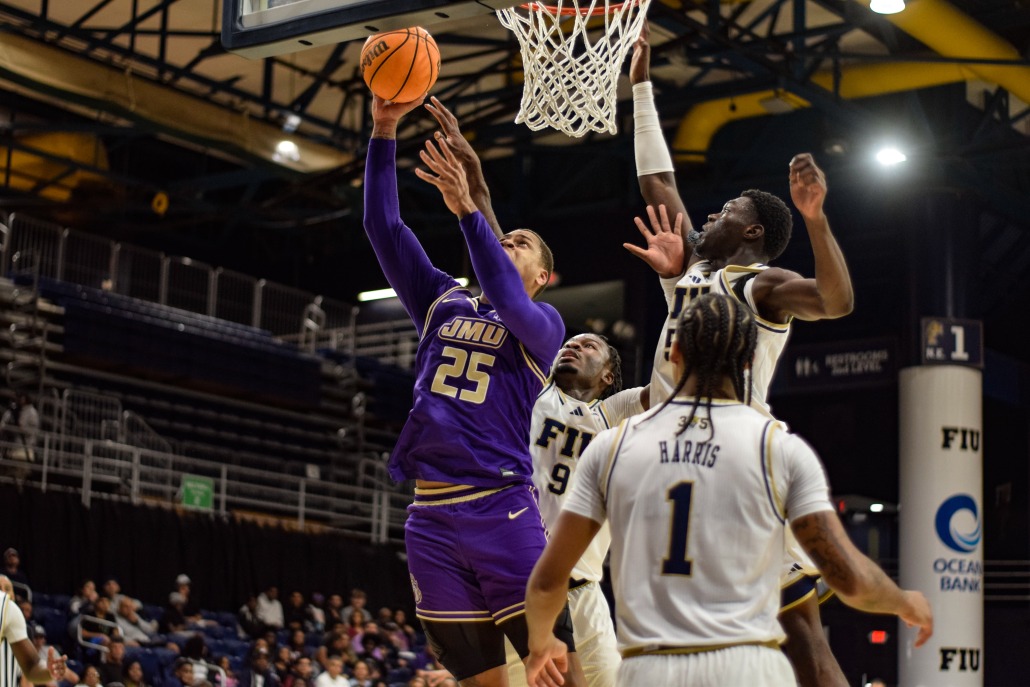
The Dukes continue to ride the hot hand of junior forward Justin McBride, who scored a game-high 24 points on 9-of-11 shooting. McBride helped James Madison build a commanding 48-32 lead at halftime with 14 points including a perfect 3-of-3 from the three-point line.

As a team, the Dukes shot 17-of-30 from the arc throughout the game. Freshman guard Preston Fowler scored 18 points on 6-of-8 shooting, all from the three-point line. Senior guard Cliff Davis scored 15 points including 3-of-5 from the three-point line for the Dukes. Senior guard Bradley Douglas added nine points, all on three-point shooting. Senior forward Gabe Newhof chipped in nine points inside the paint for the Dukes (5-3).

Omaha was led by senior guard Lance Waddles, who scored 18 points with 10 rebounds for the game’s only double-double. Khamani Cooper scored 16 points, Christian Richardson added 11 points with three blocks and Tony Osburn and Grant Stubblefield each had 10 points for the Mavericks.

Tied 11-11 six minutes into the game, the Dukes created separation with a 13-2 run to go up 24-13 with 11:08 remaining, highlighted by two three-pointers by McBride and a long shot from Preston Fowler.

Three-point shooting served James Madison well in the first half. The Dukes drained three more shots from the arc during a 12-0 run that grew their lead to 39-18 with 6:40 to go in the half.

Richardson scored five straight points including a slam dunk to cap a 10-0 run to put Omaha back within 11 points, trailing JMU 39-28 with 3:17 remaining.

Both teams traded three-point shots to start the second half. Fowler made four threes within three minutes to keep JMU ahead of Omaha by 22 points with less than 10 minutes to go in the game.

Trailing 84-62 after a Douglas three-pointer with seven minutes left in the game, the Mavericks went on a 15-4 run to finish the game with an 11-point loss.

Omaha will take on FIU at 2 p.m., Wednesday in a game both teams need to win for the sake of their respective early-season outlook.

Corey Stephenson’s 25 points not enough as Panthers dropped by Dukes at home

Finally tested at home against a fellow Division I opponent, the Florida International Panthers came up short, falling to the James Madison Dukes 80-72 in the opener of the FIU multi-team event on Monday.

Corey Stephenson led the Panthers with 25 points on 10-of-22 shooting, including 5-of-14 from the three-point line, and seven rebounds. The senior guard, who transferred from Cal State Bakersfield, led the FIU offense in the first half with 15 points as the Panthers went into halftime leading 45-41.

Senior guard Julian Mackey scored 11 points for the Panthers on 3-of-9 shooting and three free throws. Sophomore guard Ashton Williamson added 10 points to round out FIU’s double-digit scorers.

James Madison was led by junior forward Justin McBride, who scored 26 points on 8-of-14 shooting, 3-of-6 from three-point range, and 7-of-9 from the free throw line. He also grabbed nine rebounds and two blocks. Bradley Douglas added 11 points with nine free throws.
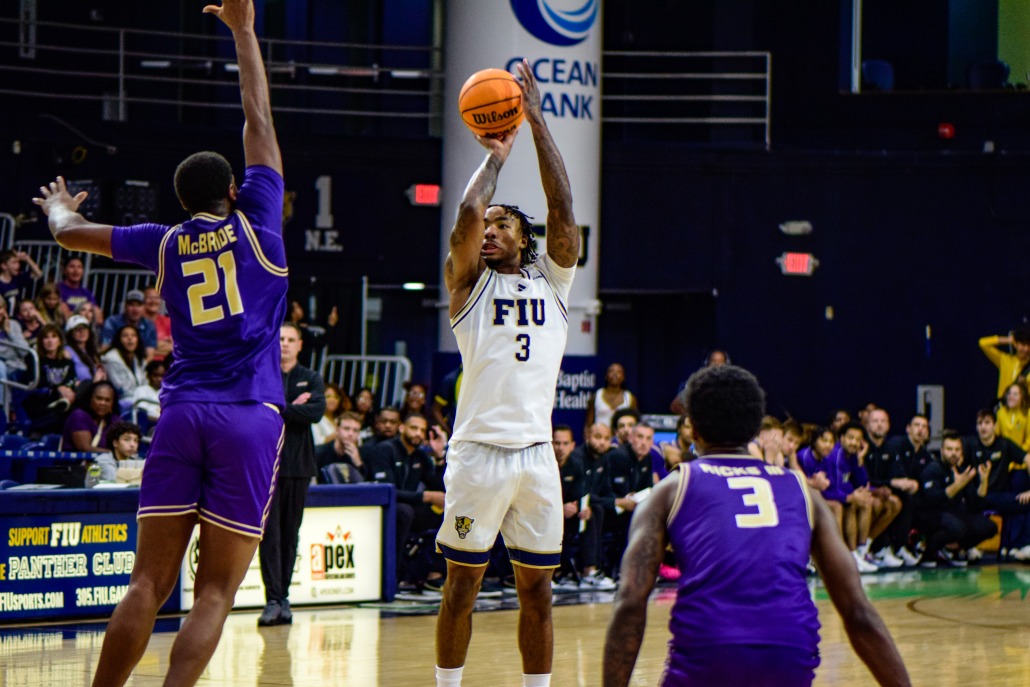
As a team, the Panthers (6-of-16) made one more three-pointer than the Dukes (5-of-17), which largely explains their 45-41 lead at halftime. Brit Harris scored four points on a three and a free throw to highlight an 11-5 run to give the Panthers a 22-15 lead with 10:28 left in the first half.

In the second half, the Panthers shot 4-of-15 from the arc to finish the game with the same three balls as James Madison (10). Both teams shot 35 percent from the field but the Dukes had one extra basket and five more free throws. James Madison out-rebounded FIU 56-41, led by freshman forward Christian Brown, who grabbed a game high 11 boards.

A dunk by Eli Wilborn tied the game 27-27 with 5:39 left in the first half. It was the highlight of an 8-0 run that gave James Madison a 31-27 lead with 4:47 remaining.
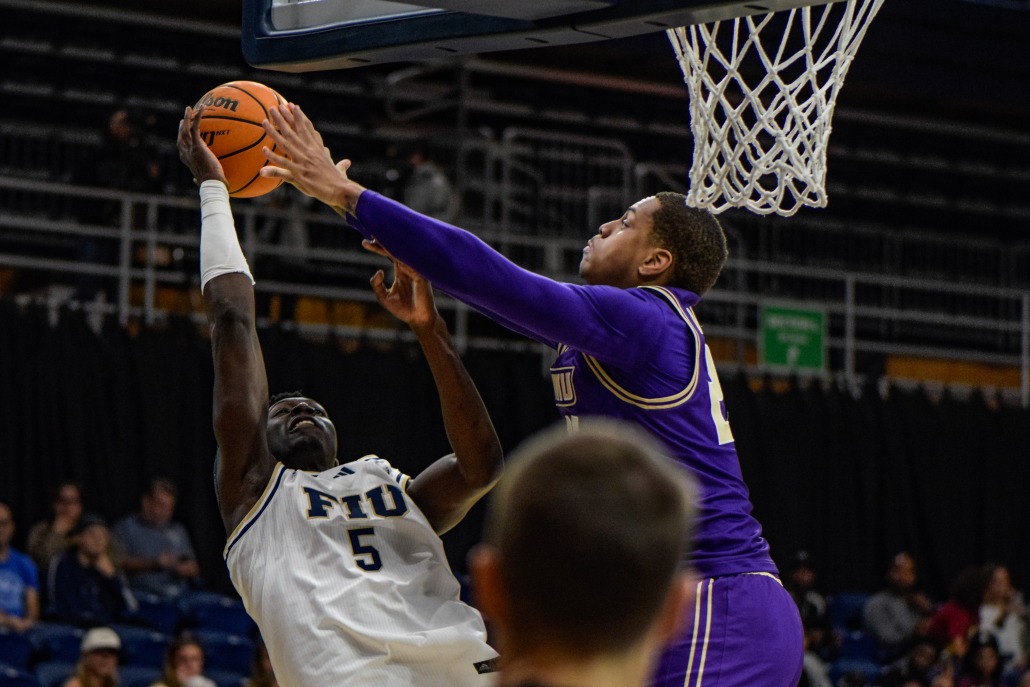
The Panthers responded with a 10-2 run capped by a three-pointer by Zawdie Jackson to give them a 37-33 lead entering the final three minutes of the half. Both teams continued to go back and forth and change leads until a jumper and two free throws by Ibrahim Olajuwon in the final 1:13 ended the half with FIU leading by four.

The second half became a dogfight and the Panthers last held onto a lead with 7:17 remaining after an Olayinka free throw to go up 66-65. The Dukes finished the game outscoring FIU 15-6 through the game’s final seven minutes. Back-to-back three-pointers by McBride put the Dukes up 74-67 with four minutes remaining.

A three-pointer by Mackey put FIU within three points nearing the final minute, but it turned out to be the Panthers’ last basket.

FIU (2-3) won its first two home games against non-NCAA competition in Florida National and Ft. Lauderdale but lost on the road to LSU and Nebraska. This game against a member of the Sun Belt was meant to truly gauge the kind of team FIU has.

The Panthers host Omaha on Wednesday at 2 p.m. James Madison (4-3) will play Omaha at FIU on 7 p.m, Tuesday.

Florida Atlantic falls to UConn in offensive thriller

Florida Atlantic’s bowl hopes were dashed at home on Saturday after falling to UConn in a 48-45 offensive thriller.

After falling behind 24-3, the Owls clawed back and found themselves leading 45-41 with 2:11 left in the fourth quarter. Quarterback Caden Veltkamp carried the ball himself and charged 11 yards for his second rushing touchdown of the game. He finished with 494 passing yards, two touchdowns both passing and rushing, and one interception.

The Huskies responded to being behind for the second time all game by marching down the field and capping their final drive of the game with a touchdown run by Cam Edwards. The running back finished the game with 101 yards and two scores.

The Owls had a chance to tie the game with 22 seconds remaining, but missed the field goal.

It was a prolific day for the Florida Atlantic passing offense, which leads the nation in yards per game through the air. Three different FAU receivers crossed the 100-yard mark. Dominique Henry led the pack with 157 yards including a 90-yard touchdown catch to give the Owls their first lead of the game, up 31-27 with 6:48 remaining in the third quarter.

Easton Messer caught 11 passes for 119 yards including a 33-yard touchdown to keep the Owls within a field goal of UConn with 7:13 remaining in the fourth quarter. He also scored a 39-yard rushing touchdown in the second quarter. Messer is sitting at 966 yards on the season, a career high.

Asaad Waseem rounds out the group with 109 yards. Kaden Shields-Dutton led the Owls’ rushing attack with 77 yards and a touchdown.

The Huskies were led by quarterback Joe Fagnano, who completed 33-of-46 passes for 446 yards and three touchdowns. Fagnano who entered the game fourth in the country in yards passing, finished the regular season with 3,448 yards, while leading UConn to a 9-3 record.

Florida Atlantic (4-7) hasn’t had a winning season or a bowl appearance since 2020. Even though the addition of Veltkamp and Messer (who transferred together from Western Kentucky) didn’t result in an improvement in the win-loss column, they did accomplish a lot this year. Veltkamp has the school’s single-game and single-season record for pass completions and is the fourth Owls QB to pass for over 3,000 yards in a season. Messer became the only Owls’ non-quarterback to have a receiving, rushing, and passing touchdown in the same season.

The Owls close out the 2025 season at home against East Carolina.

Seniors lead FIU past Jacksonville State, earn sixth bowl berth in program history

The Florida International senior class of 2025 which has been through years of struggles and hardships has finally seen the fruits of their labor.

In their final home game, the FIU seniors led the Panthers (6-5) to a 27-21 win over Jacksonville State to earn bowl eligibility for the first time since 2019 on Saturday in Pitbull Stadium.

Down 21-14 midway through the third quarter, the Panthers scored 13 unanswered points to pull off their sixth win of the season and fourth conference win, an achievement that hasn’t happened at FIU since 2018.

FIU quarterback Joe Pesansky completed 14-of-28 passes for 196 yards, two touchdowns, and two interceptions. Trailing in the fourth quarter, Pesansky delivered when the Panthers needed a play most and connected with Alex Perry for a 64-yard touchdown pass to take a 24-21 lead. The Panthers have won in each of Pesansky’s three starts.

Senior running back Kejon Owens rushed for 135 yards and a touchdown to become the school’s single-season rushing leader. Owens currently has 1,039 yards and 10 touchdowns on the season.

Jacksonville State entered the game undefeated in conference play and on top of the C-USA standings. The Gamecocks proved why they are among the most prolific rushing teams in the nation, with Cam Cook gaining 138 yards and a touchdown and quarterback Caden Creel rushing for 100 yards of his own.

Owens’ touchdown gave the Panthers an early 7-0 lead. The touchdown drive came after Jacksonville State ended its initial drive with a missed field goal.

The Gamecocks soon responded by tying the game on a 28-yard pass from Creel to Deondre Johnson. Cook scored on a one-yard run to give the Gamecocks a 14-7 lead in the second quarter. They were stuffed at the one-yard line later in the half by the FIU defense and were prevented from padding their lead entering halftime.

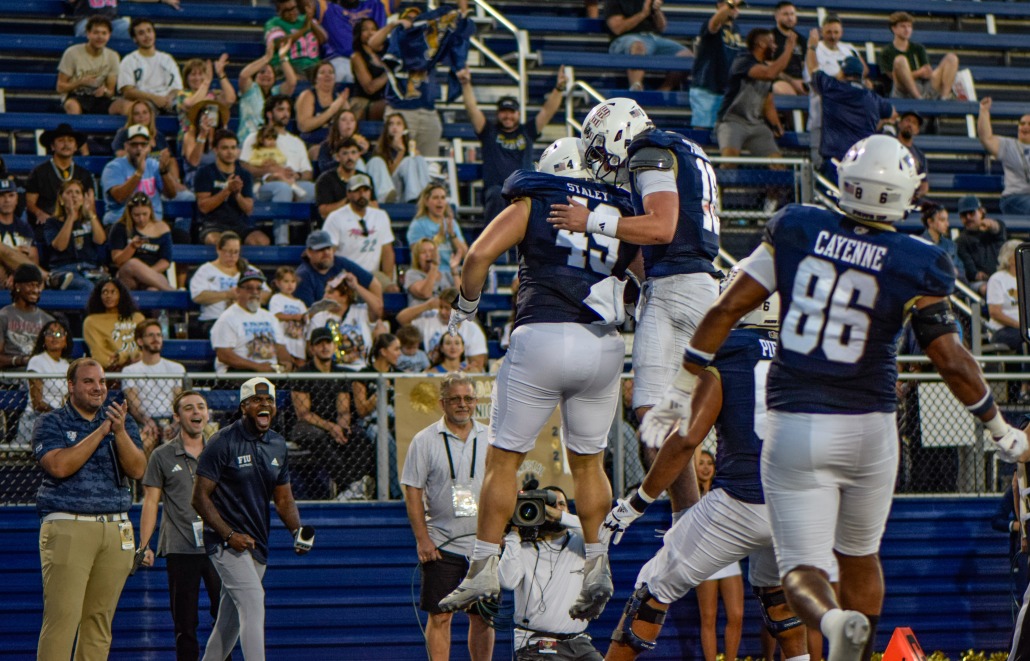
The Panthers struck back in the second half with a trick pass from Pesansky to offensive lineman Chad Stanley to tie the game 14-14 in the third quarter.

After recovering a fumble on defense, the Gamecocks’ offense responded with a 20-yard touchdown pass from Creel to Pearson Baldwin to retake the lead 21-14 with 7:14 left in the third quarter. It was the last time Jacksonville State would see the end zone.

After Noah Grant’s second field goal of the game enlarged FIU’s small lead, the Gamecocks’ offense drove towards midfield until a pass on 4th and 3 was completed out of bounds to end their chances at retaining C-USA perfection.

With their postseason spot secured, FIU will close out the season next week at Sam Houston State.

Jacksonville State’s first conference loss has now set up a three-way tie for first place in the standings. The Gamecocks will battle it out with Western Kentucky next week for a place in the C-USA championship game.

Oilers Take Down Panthers In Stanley Cup Final Rematch

SUNRISE, Fla. — It’s been five months since the Florida Panthers hoisted the Stanley Cup on home ice for the second consecutive season.


It’s been the same five months since the Edmonton Oilers watched from the other side for a second consecutive season as the Panthers celebrated with the Cup.


A regular season game in November will never draw close to the intensity, emotion, or importance of a Stanley Cup Final game. But that didn’t mean Saturday’s rematch of the past two Stanley Cup Finals was going to be a snooze fest.


The Oilers came out on top 6-3, with two empty net goals sealing the victory in a not so kind, not so run of the mill Eastern vs Western Conference matchup.


Before puckdrop, an already extremely short-handed Panthers squad had another injury blow catch them pregame.


Top-pair defenseman Aaron Ekblad surprisingly didn’t take the ice for warmups on Saturday night, and ended up missing the Stanley Cup Final rematch with an illness, per Panthers head coach Paul Maurice.


Edmonton had the start they were looking for in the same building where their season ended the past two seasons. Just 23 seconds after puck drop, Jack Roslovic — who wasn’t a member of the Oilers last year — scored one Edmonton’s first shot of the game.


Anton Lundell tied the game 6:30 into the first after he poked in a cross-crease pass from Mackie Samoskevich for his sixth goal of the season.


Samoskevich, 23, was playing in his 100th career NHL game.


Florida’s timely response was quickly overshadowed, as Roslovic scored his second of the night and ninth goal of the season only 36 seconds after Lundell’s equalizer.


As Edmonton’s first power play of the night dwindled down, Mattias Ekholm beat Bobrovsky with a shot from the slot, making it 3-1.


One game removed from a 32-save shutout performance, Bobrovsky gave up three goals on the first six shots he faced.


Unfortunately for Bobrovsky, the bad night only got worse.


Vasily Podkolzin roofed a bad-angle shot up and over Bobrovsky’s shoulder 6:45 into the second to put the Oilers up 4-1.


Bobrovsky’s night came to an end following that. He was pulled after allowing four goals on 17 shots in 26:45. Daniil Tarasov took over in relief.


Florida remained afloat thanks to a one-timer goal from Samoskevich as a power play opportunity just expired. Samoskevich cut the deficit to 4-3 with 9:56 to play in the second.


Sam Reinhart then made it a one-goal game 13:30 into the second after the Panthers leading goal scorer swatted a puck out of mid-air, with his backhand, on the power play.


After scoring two unanswered, the Panthers had Edmonton on their heels until the final three minutes of the game.


Connor McDavid and Matt Savoie sealed the victory after both players scored empty netters, making a 4-3 contest 6-3 within 27 seconds.

Florida Atlantic pounds Pacific to start Sunshine Slam

Kanaan Carlyle scored 21 points to lead Florida Atlantic to an 82-59 win over Pacific in the Sunshine Slam on Thursday. 

Carlyle shot 7-of-12 from the floor with a pair of three-point baskets and a perfect 5-for-5 from the free throw line. Isaiah Elhoin scored 13 points including 3-of-5 from the arc and Devin Vanterpool added 12 points for the Owls. 

“I was able to take advantage of the defense early,” Carlyle said. 

The Tigers were led by Elias Ralph’s 16 points on 6-of-11 shooting, followed by TJ Wainwright’s 12 and Isaac Jack’s 11.

A three-pointer from Wainwright gave Pacific an early 7-5 lead three minutes into the game. The Owls quickly responded with a layup by Vanterpool, which started a 15-3 run capped by a three-pointer by Elohim to give FAU a 20-10 lead after 7:30 minutes of play. 

The Owls stretched their double digit lead to a 15-point margin, the largest in the first half, after a Niccolo Moretti layup highlighted an 11-5 run with 1:22 left until halftime. 

Elohim drained a pair of free throws to end the first half with the Owls leading 40-28. FAU shot a perfect 8-of-8 from the free throw line in the first half and finished the game with a 13-of-16 clip from the charity stripe. 

Elohim and Carlyle drained three shots from the three-point line as the Owls went on a 10-2 run to stretch their lead to 20 points at 68-48 with 5:57 left in the game. 
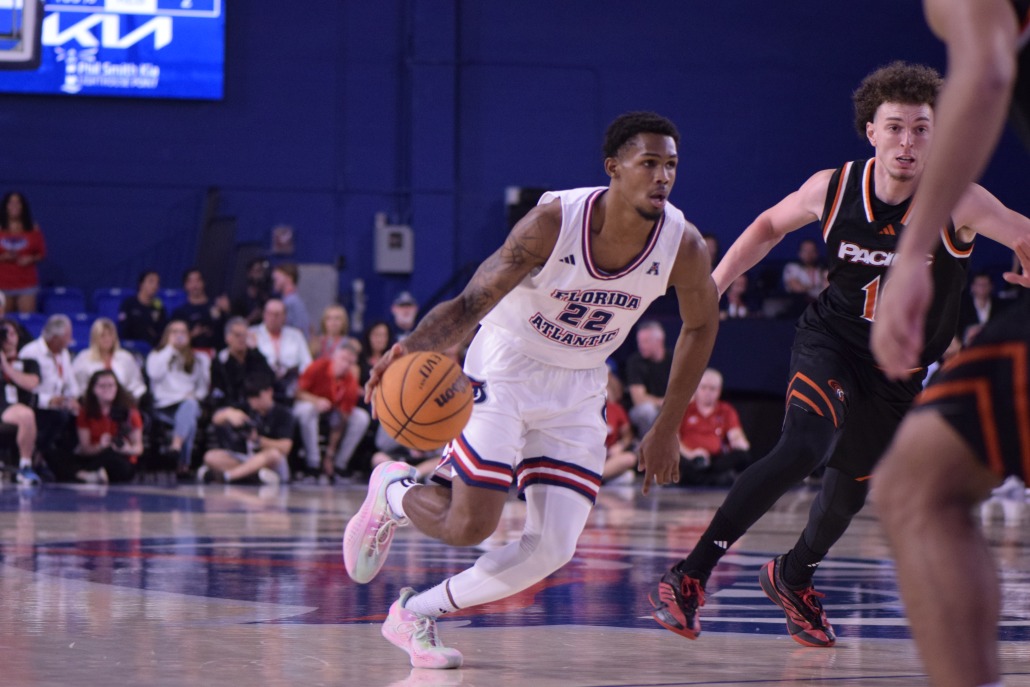
FAU’s last bucket of the game came from a three-pointer by Max Langenfeld, his only basket of the game. The Owls shot 11-of-26 from the three-point line but more important to head coach John Jakus is holding the Tigers to a 2-of-11 clip from outside.

“The 2-11 from three is something I’m really proud of,” Jakus said. “Their three point shooters, one had zero, one had one, as far as the guys that we really focus on. So for us to learn to handle that better, and to scout is significantly better.”

The Owls improve to 4-1 on the season. They rebounded from falling to Liberty for their first loss of the year with a 92-63 home win over Coastal Georgia on Monday. Vanterpool led the way for that game with 30 points on 12-of-21 shooting.

The Owls will continue the Sunshine Slam on Monday when they face Loyola Marymount at Daytona Beach at 8:30 p.m. on CBS Sports Network. They will end the tournament with a matchup against George Mason or Ohio.

The Owls will return home on Sunday, Nov. 30 to host St. Bonaventure.